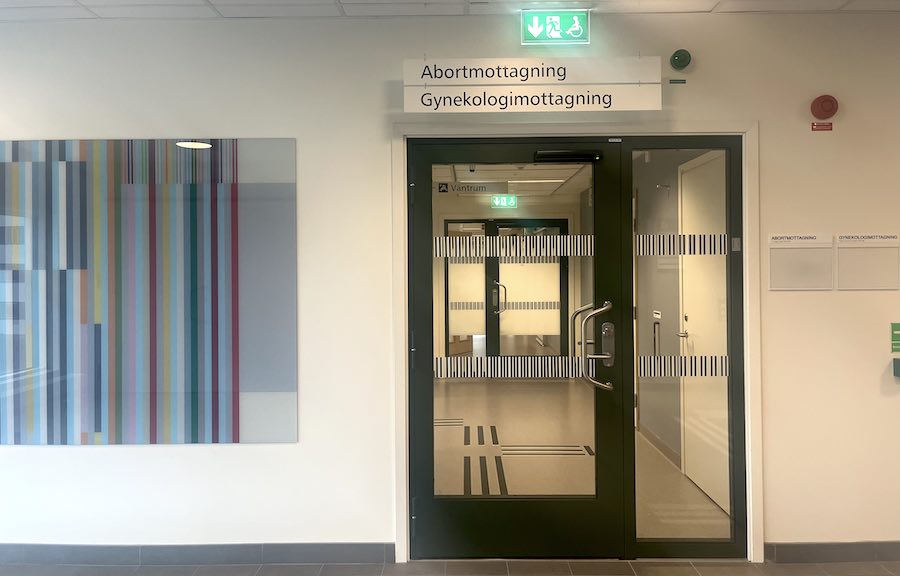
The entrance to the Kiruna hospital in Kiruna, Sweden. Here, the sole midwife offering abortion care above Sweden’s Arctic circle sees patients in both their first and second trimesters.
(Photo: Cecilia Nowell)Leaning across the midwife’s desk, Lena (not her real name) explains that she isn’t sure whether she wants to continue her pregnancy. At 36, she feels this is the moment when she must decide if she’d like her 5-year-old son to have any siblings. Her husband is desperate for more children, and everyone in her hometown, the Arctic village of Kiruna, Sweden, expects mothers to have multiple children.
“You can’t say you’d be happy with one in Kiruna,” she says. Everyone’s always asking, “When are you going to have siblings?”
But Lena knows the actual work of birthing and raising the child will fall to her. And she’s not sure she can do it again. Life here, 125 miles north of the arctic circle, is both beautiful and difficult: The aurora borealis lights up the night sky, but daylight hours are few; locals still practice a long legacy of reindeer herding, but vanishingly few jobs remain outside the nearby iron mine.
Asked if she feels like she has to rush the decision as she approaches her 11th week of pregnancy—beyond when a provider would offer abortion pills in the United States—Lena says no, she feels like she can take her time to make the right decision.
That’s because in Sweden, even in the far north, where only one abortion provider serves a region the size of Kentucky, abortion with pills is available through the second trimester. A midwife dispenses the medications and monitors the patient throughout the experience. This process has allowed Sweden to safely expand access to care in rural regions where a provider with surgical training would be required in the United States.
Sweden’s use of abortion pills has important lessons for the United States, where bans are pushing many more patients into the second trimester before they are able to see an abortion provider. Even as US abortion advocates continue to raise awareness of the medications’ safety, in the face of attacks by the GOP-controlled federal government, few acknowledge the fact that the pills are also used safely much later in pregnancy in many parts of the world.
In Sweden, midwives provide abortion pills to terminate pregnancies through 22 weeks of gestation—after which the country limits abortion care. Pills are used in about 97 percent of abortions performed in Sweden, compared to 63 percent of cases in the United States. The Swedish model suggests there is still a way to keep abortion accessible under an administration hostile to reproductive freedom and bodily autonomy, if providers are willing to broaden how they provide care.
Abortion pills—and their use later in pregnancy—have a uniquely Swedish history. In 1982, Swedish biochemist Sune Bergström won a Nobel Prize for his discovery of a hormone-like compound, called prostaglandins, in the human body. Initially, scientists began investigating the ways prostaglandins could treat vascular diseases and ulcers, but one of Bergström’s PhD students, a gynecologist named Marc Bygdeman, was struck by another function of the chemical: its role in uterine contractions.
As part of his PhD research, Bygdeman began studying whether a prostaglandin could improve the effectiveness of a new French medication, called mifepristone, by causing contractions to help expel the pregnancy. It did, and over the next decade Bygdeman—and in turn his PhD student, another gynecologist named Kristina Gemzell Danielsson—began testing different types of prostaglandins to identify which worked most effectively, and with the fewest side effects, to induce an abortion. Inspired by Brazilians, who’d begun using the ulcer medication misoprostol to skirt their country’s abortion restrictions, Gemzell Danielsson and Bygdeman eventually developed the two-medication protocol—one dose of mifepristone followed by four tablets of misoprostol—that is used worldwide in abortion care today.
“I usually say that Sune was my academic grandfather,” Gemzell Danielsson told me this spring, speaking from her office at the Karolinska Institute, the Stockholm-based medical university that awards the Nobel Prize. Outside her office, a bookshelf displays an old midwife’s bag, containing a Pinard horn and forceps. Inside, Gemzell Danielsson wears a silver necklace in the shape of a coat hanger. “There’s a direct sort of lineage here in Sweden.”
But where most countries limited their approvals of that two-drug regimen to early in pregnancy, Sweden did not.
“In the beginning, the focus was to use medical abortion up to nine weeks,” because “that’s when most spontaneous abortions happen,” Gemzell Danielsson said. But after Sweden approved the use of abortion pills before nine weeks, in 1992, she and her colleagues began looking for a safe method for second-trimester abortions. “And that’s when we started to use medical abortions, exactly the same combination”: mifepristone followed by misoprostol.
“That spread quickly to the other Nordic countries,” Gemzell Danielsson recalls, “because we are so few.”
A small number of physicians, most of whom live in capital cities like Stockholm and Oslo, serve large, highly rural countries, where most patients get their reproductive health care from midwives instead. And few of those physicians, not to mention the midwives, are trained on the recommended procedural method for second trimester abortions, called a dilation and evacuation. Whereas a procedural abortion requires certain instruments and facilities, providers offering second-trimester abortions with pills only need the medications and a quiet room for their patient.
Today, in large part because of the research coming out of Sweden, the World Health Organization’s guidelines on abortion care include guidance on how to use abortion pills up to and beyond 24 weeks of pregnancy, and not solely through 10 weeks.
Meanwhile, Gemzell Danielsson continues to advocate for using abortion pills throughout pregnancy, particularly in low-resource settings like rural regions and conflict zones. She and her colleagues at the Karolinska Institute have conducted research on the ability of Ugandan midwives to offer second-trimester “post-abortion care” (typically completing an abortion after a woman has induced one on her own) with pills when no physician with surgical training is available. Swedish midwives have also shared their experiences offering abortion pills later in pregnancy with physicians in the United States, including Dr. Gabrielle Goodrick, an Arizona abortion provider, who offers the pills later in pregnancy.
Goodrick is one of a few, but certainly not the only, provider in the United States using mifepristone “off label”—meaning that she is using the medication outside the scope of the Food and Drug Administration’s approved use of mifepristone through 10 weeks of pregnancy. More than 20 percent of medications prescribed in the US are used “off label,” or for purposes other than their FDA-approved use, including many cancer, depression and cardiovascular drugs. Goodrick believes that the pills could allow a broader coalition of providers to offer abortion care; she herself came to the practice as a primary care provider, not an ob-gyn.
Every day, Sandra Wallis and her team of fellow midwives at Östra hospital’s gynecological ward manage three to four abortions with patients who are at least 10 weeks pregnant. Here, in Sweden’s second-largest city, Gothenburg, reproductive health care is a core priority for the academic hospital. In 2012, scientists conducted the world’s first uterus transplant. Across the academic hospital’s courtyard, a map in the main building clearly lists the abortion clinic among other wings at the center—a conscious choice to destigmatize the care, says Helena Hognert, one of the clinic’s obstetrician-gynecologists.
One quiet weekday morning, Wallis, a 33-year-old mother of two, gives me a tour of the floor where she oversees second-trimester abortion care.
Second-trimester medication abortion is “very individual,” she says. “Some women, they abort really fast. They might only need one dose [of misoprostol, or four pills]. And for some women, it takes a few days.” She adds that a stay beyond 24 hours is “very rare, but it happens. Most women abort the same day that they’re here.”
Like an abortion before 10 weeks, patients here are instructed to take one dose of mifepristone followed one to two days later by a dose of misoprostol. But instead of proceeding with the abortion at home, midwives at Östra hospital schedule patients to come into the gynecological ward the day that they take the misoprostol. At the hospital, midwives administer doses of misoprostol buccally or vaginally every three hours—averaging three to four doses total—until the abortion is complete.
The experience “is a mix of having a miscarriage and a delivery,” Wallis explains. “It’s what the body would do on its own.”
The medications soften the cervix and induce contractions, until patients generally feel an urge to use the bathroom. At Östra hospital, midwives keep a pan in the toilet so they can be sure the fetus and placenta are complete after a patient aborts. If any pregnancy tissue remains in the uterus following the process, the patient’s life could be at risk. To control their pain during the procedure, Wallis and the other midwives offer paracervical blocks (an injection of lidocaine in the cervix); and to control post-abortion bleeding, a shot of oxytocin.
“We’re creating miscarriages with medicine,” Wallis says. Allowing midwives to manage second-trimester abortions with pills, “is kinder to the tissue,” she believes.
Popular
“swipe left below to view more authors”Swipe →Medication abortion allows for the intact delivery of a fetus, which gives some patients the option to view their fetus and take home footprints or photographs. In those cases, typically of wanted but nonviable pregnancies, Wallis says, she often cleans and swaddles the fetus: “It gives dignity, because for most of them they have actually lost a child.”
That’s not to say, however, that every patient prefers a medication abortion. The procedure can be long and painful, when a procedural abortion would be complete in 10 minutes with far less pain and bleeding. And D&Es are as safe as medication abortions.
Johanna Jonsson, one Gothenburg resident who shared her abortion story in the recently released book Abortion: 50 years of free abortion, 50 stories, recounts seeking second-trimester abortion care after an earlier abortion failed to abort both of the twins she was carrying. Her body did not respond to the normal dose of mifepristone and misoprostol. She recalls taking 15 doses of misoprostol over seven full days before a gynecologist finally manually dilated her cervix with her finger. “I asked about surgery,” Jonsson recalls, “And they were like, no, we don’t do that.”
Although Jonsson’s experience is rare, it’s why Nathalie Kapp, chief medical adviser for the International Planned Parenthood Foundation, encourages countries to maintain a balance of procedural and medication abortion care, and to continue training obstetrician-gynecologists in both of the procedures.
“I feel it’s really important that we have both options,” she said. “Medication abortion is incredibly important. It’s really allowing a lot of things to happen as far as women being able to have abortions without doctors and without midwives and without providers in all kinds of settings. I think it’s been transformative. But I do think it’s not an experience that everybody wants to have.”
In her research, she’s found that women report higher satisfaction after procedural abortions, but that being able to choose an abortion method is key. When patients use pills to self-manage a second-trimester abortion, she’s found that they report fewer complications before 16 weeks.
Kapp also adds that because second-trimester medication abortions can take hours, patients should be offered pain medication throughout the procedure. A paracervical block, she said, fades within about an hour. At her clinic in Arizona, Goodrick offers IV pain medication during the entire process.
Whether a country offers procedural or medication abortion care depends as well on its economic and healthcare system, says Kristina Castell, a policy adviser at the Swedish Association for Sexuality Education.
In the United States, “you have private care, you have private hospitals, that it’s so much more lucrative to provide surgical abortions,” she says. Not to mention, it can be difficult if you “need to take two days off work” for a medication abortion.
In Sweden, meanwhile, the country’s universal health system is less focused on profit, says Castell. The widespread availability of abortion pills has allowed Sweden to reach more patients, faster, in a largely rural country, without accruing massive healthcare costs. Medication abortion has allowed Sweden to “have abortion included in mainstream healthcare” that does not require traveling to a specialist, says Gemzell Danielsson.
And in regions where access to procedural abortion care is increasingly limited, whether due to provider training or policy restrictions, perhaps it’s worth knowing that care is not only safe but widely offered.
Disobey authoritarians, support The Nation
Over the past year you’ve read Nation writers like Elie Mystal, Kaveh Akbar, John Nichols, Joan Walsh, Bryce Covert, Dave Zirin, Jeet Heer, Michael T. Klare, Katha Pollitt, Amy Littlefield, Gregg Gonsalves, and Sasha Abramsky take on the Trump family’s corruption, set the record straight about Robert F. Kennedy Jr.’s catastrophic Make America Healthy Again movement, survey the fallout and human cost of the DOGE wrecking ball, anticipate the Supreme Court’s dangerous antidemocratic rulings, and amplify successful tactics of resistance on the streets and in Congress.
We publish these stories because when members of our communities are being abducted, household debt is climbing, and AI data centers are causing water and electricity shortages, we have a duty as journalists to do all we can to inform the public.
In 2026, our aim is to do more than ever before—but we need your support to make that happen.
Through December 31, a generous donor will match all donations up to $75,000. That means that your contribution will be doubled, dollar for dollar. If we hit the full match, we’ll be starting 2026 with $150,000 to invest in the stories that impact real people’s lives—the kinds of stories that billionaire-owned, corporate-backed outlets aren’t covering.
With your support, our team will publish major stories that the president and his allies won’t want you to read. We’ll cover the emerging military-tech industrial complex and matters of war, peace, and surveillance, as well as the affordability crisis, hunger, housing, healthcare, the environment, attacks on reproductive rights, and much more. At the same time, we’ll imagine alternatives to Trumpian rule and uplift efforts to create a better world, here and now.
While your gift has twice the impact, I’m asking you to support The Nation with a donation today. You’ll empower the journalists, editors, and fact-checkers best equipped to hold this authoritarian administration to account.
I hope you won’t miss this moment—donate to The Nation today.
Onward,
Katrina vanden Heuvel
Editor and publisher, The Nation