
There Is Still Only One Way Out for Israel and Iran
What was true before is still true now: There is no military solution to this conflict. Only diplomacy and a commitment to peace will work.
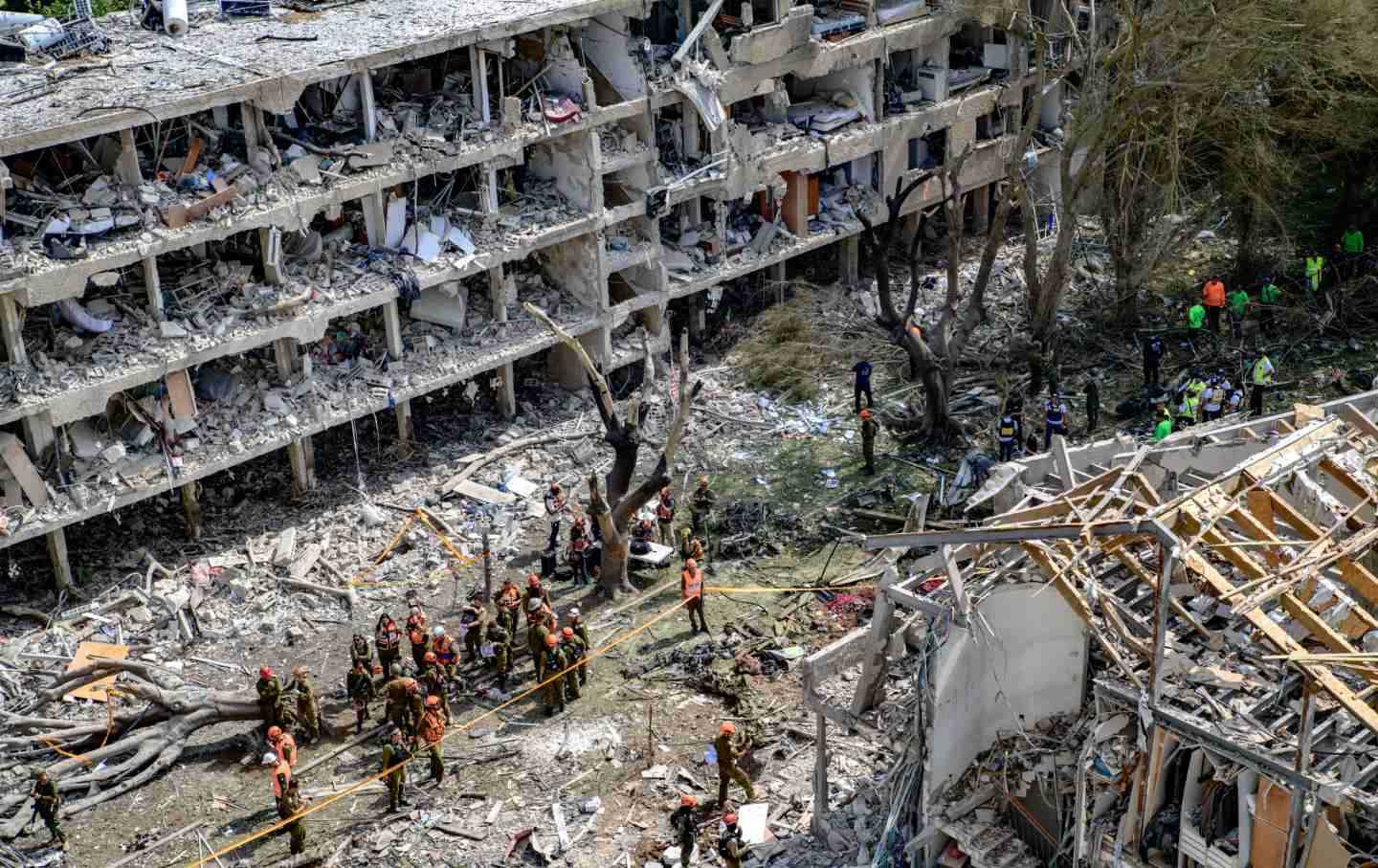
Israeli paramedics and forces are on the scene where buildings are destroyed as a result of Iran’s missile attack in Tel Aviv, Israel, on June 22, 2025.
(Matan Golan / Middle East Images / AFP via Getty Images)When the 12-day war between Israel and Iran began, I was at an Israeli-Palestinian peace conference in Paris. But the war reached me nonetheless. An Iranian missile hit a street a block away from my home in Tel Aviv. My apartment on Moses Hess Street, named after the German-Jewish socialist philosopher/writer who was a friend and colleague of Karl Marx and Friedrich Engels, was severely damaged. All the windows were shattered, and little fragments of glass were scattered over everything. Shelves with all of my personal and work files fell, destroying many little personal artifacts that I had collected or had been given to me by friends over the years. There are cracks in the walls. The whole ceiling of the bathroom collapsed.
The apartment, like many in my building, street, and neighborhood, was declared unlivable. I have been living with several hundred other neighbors in a hotel provided by the Tel Aviv Municipality for evacuees until they can find an alternative living space.
I realize that my circumstance is nothing compared to those of the Palestinians in Gaza, who have lost their homes, families, and basic institutional infrastructure to Israel’s bombs. Many of us in the peace movement hope that our personal tragedies will help the average Israeli to understand the reality of the Palestinians in Gaza. That is easier said than done, however. The mainstream electronic media have avoided showing the images that most people see around the world, preferring to concentrate on our own pain, the 1,200 mainly civilians who were killed by the murderous Hamas attack on October 7, the fate of the hostages and the soldiers dying almost every day. And now, the war against Iran has pushed Gaza even further into the background.
So why did Netanyahu decide to attack Iran? Clearly Iran had been weakened by the tremendous blows to Hamas and Hezbollah, its allies in the “axis of resistance,” and the fall of the Assad regime in Syria. Netanyahu had made the supposed “existential threat” of the Iranian nuclear project his prime external enemy around which to build the need for his strongman leadership. Until now, it had been assumed that Israel could not attack Iran’s nuclear program without American assistance. But Iran’s weakened position made it possible to go it alone.
Was it necessary? One of the reasons that a large majority of the Israeli population supports the attack on Iran are the frequent statements by Iranian leaders that “Israel must be wiped off the map” (both Ayatollah Khomeini and President Ahmadinejad). So when Netanyahu says that Iran is an existential threat, they believe it. In actuality, some historians say that Iran hasn’t attacked another country for at least the past 250 years, and even longer. However, they have been attacked by others—for example, when the CIA overthrew the secular regime of Mohammad Mosaddegh in 1953 and placed the now discredited Shah in his place, or when Saddam Hussein’s Iraq invaded Iran in 1980, causing eight bloody years of deadly warfare with American backing.
The CIA had concluded that Iran had not made a decision to pass the nuclear threshold. The same was true for Tulsi Gabbard, Trump’s national intelligence director. Many experts said that Iran was six months and possibly even one year away from having the capacity to assemble and deliver nuclear weapons. However, an expert on the Israeli nuclear project—professor Avner Cohen, author of Israel and the Bomb, believes that Iran may be just a few weeks away from a possible breakout point if it feels threatened and decides to go in that direction. That’s what Israel itself did on the eve of the 1967 Six-Day War when it quickly assembled a bomb. It’s what Pakistan did in the 1990s when it felt threatened by India’s bomb.
The only way to end the possibility that the Iranians will decide to go nuclear—which could set off a very unstable chain reaction of nuclear proliferation in the region, with Saudi Arabia, Egypt, and Turkey also seeking nuclear weapons, to join with the already existing Israeli program—is by a negotiated agreement with Iran.
Let’s not forget that the Joint Comprehensive Plan of Action, the Iranian nuclear deal negotiated by President Obama with Iranian President Rouhani in 2015, was working. It was Netanyahu who convinced President Trump in his first term to withdraw from the agreement in 2018.
Reviving that agreement is essential. Such a deal would have to include clear and verifiable inspection elements, as well as a commitment from both sides to stop threatening each other’s existence. If that is not achieved, the danger is that the Iranians may choose the North Korean option and rapidly race toward the completion of nuclear weapons, which would guarantee that they wouldn’t be attacked. They have the scientific know-how to do that.
One of Netanyahu’s primary reasons for attacking Iran was to distract attention from the ongoing Israeli attacks in Gaza, which are a major war crime, being carried out in a disproportionate response to the Hamas war crime committed on October 7. If the war in Gaza is finally brought to an end, what will be needed is a constructive postwar scenario for the future, something that Prime Minister Netanyahu has been avoiding like the plague.
That leads me back to the Israeli-Palestinian civil society conference in Paris that I was participating in when the Iranian missile struck my Tel Aviv neighborhood. The conference was hosted by the Paris Peace Forum. Three hundred Israelis and Palestinians were brought together by the Alliance for Middle East Peace to provide input to the proposed French-Saudi initiative for a conference at the UN devoted to “Recognition of a Palestinian State, Ending the War and a Two-State Solution.
At one of the plenaries, a 22-year-old student from Gaza gave a powerful and heart-rending description of her family’s reality in Gaza. That was followed by a strong presentation calling for an end to the war and an effort to work toward peace by the grandson of Oded Lifshitz, the peace activist journalist from Kibbutz Nir Oz, who was killed in Hamas captivity. Among the participants were many prominent Israelis and Palestinians, including former Israeli prime minister Ehud Olmert and former Palestinian foreign minister Dr. Nasser El-Kidwa (Arafat’s nephew), who have been promoting a plan to end the war, for reconstruction and a resolution of the conflict based on a two-state solution.
That is the kind of energy—collaborative, empathetic for all peoples, focused on peace—that we need to bring to the Israel-Iran conflict.
A few months ago, I was approached by Iranian nuclear physicist Behrooz Bayat. He told me that a group of Iranians and Israelis wanted to create an Israeli-Iranian forum for dialogue and coexistence as opposed to military confrontation between the two peoples. Also involved was Dr. Arash Azizi, who is a lecturer at Yale. We had a three-way Zoom discussion followed by a broader Zoom with Israelis and Iranians.
Before we managed to announce our statement of purpose, the war began, and we decided to quickly formulate and issue the following statement:
We, Iranians and Israelis, share grave concerns for the future of our countries and the region. Israel and Iran have been engaged in indirect conflict for decades; a conflict that puts the entire region in danger, and especially the people of these countries. Following the exchange of fire last year, the Israeli attacks starting Friday morning, and the Iranian attacks starting Friday night, the conflict has now entered us into a new phase. Already around 200 civilians have been killed in Iran and at least 23 in Israel. This is a reminder of the price paid by citizens in war.…
Iranians, Israelis and Palestinians deserve to live in safety and dignity….
We refuse to accept the inevitability of violent conflict as the only way forward between our nations, Israel and Iran, or their positioning as eternal arch-enemies. The endless and senseless wars of this region won’t benefit our people, all of whom have the right to live in peace and security.
Popular
“swipe left below to view more authors”Swipe →The statement was signed by 24 Israelis and Iranians. By now, over 2,400 have added their names, including professor David Harel, president of the Israeli Academy of Arts and Sciences, former speaker of the Knesset Avraham Burg, former director general of the Foreign Ministry Dr. Alon Liel, and many others.
Yet, for any real progress to be made, we need regime change in Israel and in Palestine, and it wouldn’t hurt in Iran as well. Progressive regime change in the United States would also be welcome.
More from The Nation
Albanian Student Strikes Spur a Political Crisis Albanian Student Strikes Spur a Political Crisis
A new round of protests against the ruling party’s corruption has Prime Minister Edi Rama giving cops bonuses to crack down on dissent.
Inside India’s Gen Z Cockroach Janta Movement Inside India’s Gen Z Cockroach Janta Movement
Young Indians are challenging the purge of voter rolls by Modi’s right-wing government. Shrishti Khanna, who was detained by Delhi police while covering the protests, explains.

The Clarion Call of “NAZA” The Clarion Call of “NAZA”
Yuval Abraham and Rachel Szor’s new film not only documents the horrors of the present but give us a glimpse of a possible future too.
The Specter of Lepenism Looms Over France’s Social Crisis The Specter of Lepenism Looms Over France’s Social Crisis
Joining forces with the “yellow vests,” youth demonstrators are raising the alarm in a country falling to the far right.

Progressives Are Backing Puerto Rican Independence. It’s About Time. Progressives Are Backing Puerto Rican Independence. It’s About Time.
More and more leftists are concluding that statehood for the island is not enough.
The Saudi Phase of the Iran War Signals More Chaos to Come The Saudi Phase of the Iran War Signals More Chaos to Come
The conflict that Donald Trump has repeatedly proclaimed an unequivocal American victory keeps spiraling out of control.

