
In Lebanon, Grief Is Everywhere. But So Is Our Defiance.
We are reeling from Israel’s massacres. But people are tirelessly organizing on the ground, and are not giving up.
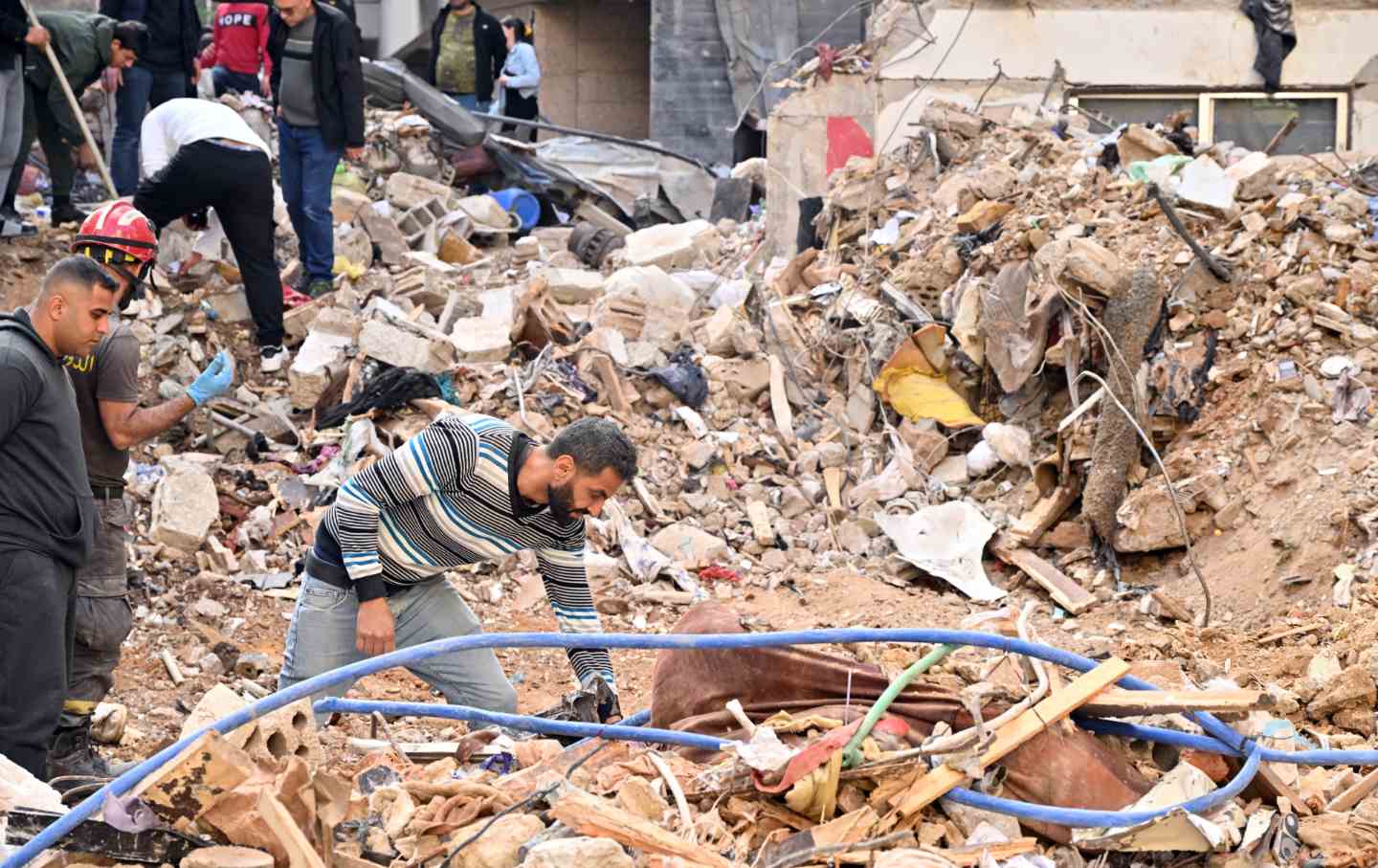
Last Sunday was Easter—a day theologically dedicated to the triumph of life over death. But here in Lebanon, the air was heavy with grief. On April 8, Israel killed 303 people in at least 100 air strikes conducted across Lebanon in around 10 minutes—a day we have collectively called “Black Wednesday” since—with many still lost and unaccounted for.
Since the wider Israeli war on Lebanon began on October 8, 2023, there has been black Wednesday after black Wednesday. At The Public Source, the news outlet where I work, I’m part of a team that is counting our dead; there is no official toll being provided by our government. We meticulously note their names, their photos, their hometowns. We ask: Did they die alongside their entire family? Are they the children of fighters killed before them? Was a massacre committed by Israel in the strike that killed them? So far, Israel has killed at least 6,691 people, by our count, since October 8.
For the last two and a half years, being around the elders in my family at times like this has been the natural lens for reflection. Against all odds, we celebrated my mother’s Easter on Sunday. Her family is Syriac Orthodox, and my great-grandmother watched Ottoman soldiers stab her mother to death when she was just a girl. My maternal great-grandparents survived the Sayfo—the “sword” of Ottoman genocide that forced their people, the Assyrians, to flee the heartlands of upper Mesopotamia a century ago. My grandfather’s village, Azekh (now İdil), is known for its prolonged resistance to Ottoman erasure.
The Sunday before, April 5, we celebrated my father’s Easter. My paternal grandparents were forced out of Palestine in the Nakba that began in 1948, uprooted by the same Zionist death machine that today issues forced displacement orders and unleashes scorched-earth policies on the steadfast Lebanese villages of our south. And its goals for them are the same. The settler colonial state seeks to depopulate so that it may expand, to erase and destroy so that it may occupy.
To be all of these things in this moment in Lebanon’s history—a moment that has continued in perpetuity since the inception of the Zionist project—is to recognize that I live in a home built on survival. A century ago, my maternal great-grandparents fled Ottoman soldiers to find refuge here. Decades ago, my paternal grandparents fled Zionist militias. Today, I watch as Israeli occupation forces attempt to ethnically cleanse the entire south up to the Litani and Zahrani rivers, under the guise of a “security” belt.
Fifty-five years ago, Imam Musa al-Sadr foresaw this expansionism. In a televised speech, he emphasized that the danger “is not limited to Palestine…but will extend and extend, forming a threat to all regions of the east, and even to the west.” He mocked the “global stupidity” of colonial powers who believed they could rein Israel in.
The Sayfo and Nakba are not isolated tragedies. They are casualties of the same imperial line in the sand that today attempts to cut the south out of Lebanon; the very same imperial line through which the “Greater Israel” vision attempts to manifest on our soil.
During World War I, to secure their military service, the United Kingdom promised its “Smallest Ally,” the Assyrians, their ancestral homeland. In 1916, Sykes-Picot divvied up Bilad el-Sham between the French and British mandates. And then in 1923, the UK signed away the Assyrian homeland in Lausanne, and secured the new borders of its mandates under Paulet-Newcombe, creating what we now know as Lebanon.
When France took the mandate for Lebanon and the UK for Palestine, they each settled refugees of the Sayfo and Armenian Genocide. This “solved” the Assyrian problem and shed responsibility for their return. And it allowed France to create pro-French Christian buffers against Arab nationalist movements—a direct ancestor of Israel’s historical attempts to weaponize sectarian geography.
This colonial history is the obvious blueprint for the Zionist project. The architects who sidelined the survivors of the Sayfo to carve up Southwest Asia are the same ones who issued the Balfour Declaration and facilitated the Nakba. They have always viewed us not as a people tied to our soil but as demographic variables to be managed, displaced, or erased in service of greater imperial interests.
Today, just as it always has done, Israel preys on the very sectarian and ethnic divides that define my own family tree, manipulating its way into the fragile sectarian fault lines of the Lebanese psyche, and turning neighbor against neighbor. Israeli occupation forces have placed intelligence-gathering QR codes on leaflets dropped from the sky, used espionage and webs of spies on the ground, and launched air strikes on “safe” residential areas to turn our geography—our villages, our streets, our neighborhoods—into zones of discrimination and paranoia where kin persecute one another over their confession.
Sectarianism was written into Lebanon’s constitution by the colonial French mandate in 1926, dividing state power across sect lines and successfully fragmenting identity along those same lines. In a state where it has been only 36 years since the end of a civil war that left scars of division easily reopened, the Israeli strategy to turn neighbor against neighbor can still be effective. A friend of mine and her family were recently displaced from their neighborhood in Dahieh, Beirut’s southern suburbs, after repeat threats for all of Dahieh by Israel. It was hard enough to find a place to stay as landlords in “safe” areas were either exploiting the moment to hike up rent, or turning people away for being Shia. But when she did find a landlord who was welcoming, the neighbors threatened her safety. And just a few days after signing the contract, when she and her family didn’t leave, the neighbors cut off her electricity and water to force her out. The cruelty is no accident; it is the desired result of a war designed to turn our own neighborhoods into front lines.
But even as it tries to exploit our unhealed wounds and divide us, Israel willfully neglects a fundamental truth: The land it is attempting to empty is not a vacant “buffer zone.” The Zionist project, like all imperial projects, arrogantly disregards that it is home to a people who would rather be buried in their soil than be forcibly displaced away from it. In Lebanon’s case, that means places like Bint Jbeil, historically a central site of the resistance to Israeli attacks. The people defending this territory—mostly without the support of the Lebanese army—are not outsiders. They have always lived in and tended the land, no matter how much colonial powers pretend otherwise, and continue to be the only thing keeping Southern Lebanon from Israeli annexation.
The West views this resistance through a reductive, Islamophobic lens. In its present form, it is Shia-dominated due to the demographic makeup of the south today. But on the ground, the defense of the land is a mosaic. Among the martyrs mourned this past week was an Armenian—a descendant of genocide and dispossession—whose death is a testament to resistance as a national obligation.
Over the last several weeks, the Lebanese army has gradually withdrawn from land it is sworn to protect, effectively abandoning people who refused to flee their hometowns. Then, as Israeli bombed terrorized Lebanon on Black Wednesday, the Lebanese heads of state rejected the short-lived US-Iran ceasefire from earlier that morning, and called for direct negotiations with Israel instead.
Direct negotiations have taken place in Lebanon’s recent history. In 1983, as Israel still occupied one third of Lebanon, Lebanon and Israel signed the May 17 Agreement after direct negotiations—widely condemned as a “treaty of shame” and seen as forced surrender and recognition of Israel. (It was later abrogated by the government in 1984 following the February 6 Intifada.) The last time Lebanon and Israel engaged in direct talks was in 1992 in Washington, which did not amount to anything.
Popular
“swipe left below to view more authors”Swipe →Negotiations ever since have always been multilateral, or indirect—always taking place through a third party, usually the UN or the US—and have been the strategy chosen to end hostilities for years. Many on the ground see this move to direct talks, especially after the Black Wednesday massacre, as the state leveraging this massive civilian death to force a normalization that the people have always rejected. This move carries unmistakable parallels with the Abraham Accords: “security” for recognition of a state of Israel and de facto normalization, completely ignoring the 1955 Israel Boycott Law and the constitution of our state. Now we fear what is to come.
Thousands have participated in anti-normalization “Black Wednesday” protests almost every day since the Israeli massacre. To the many enraged in the streets, the government’s move is not mere diplomacy: It is a willingness to trade the precious soil of the south for a seat at a table that has long decided our erasure.
I understand those who find it hard to have hope. When your own people are turning against one another, when the state seems to be positioning itself against an entire populace, how can we fathom getting through this? When first responders and rescue workers are targeted—as we saw last weekend with the Red Cross workers martyred while trying to save the living. When every single time I dare to check Instagram, a different friend has posted a photo mourning a martyr—a close friend, a family member. There are markers of loss everywhere.
But there are also markers of sumud, in all of its forms. Even as the state has withdrawn, and even as some people are hostile or look away, a makeshift economy of solidarity has emerged. People are tirelessly organizing on the ground in grassroots networks, raising funds and sourcing mattresses, tents, basic goods, hygiene products, hot meals, and shelter.
A close friend tells me about his father who has chosen to stay in his house in Hadath, Dahieh. His family is split; his father is currently hosting family members displaced from his hometown of Deir el-Zahrani, while others remain there, steadfast, despite Israel’s repeat displacement orders for the entirety of the south. His father spends his days organizing to get aid to people housing themselves in the empty Azarieh complex in downtown Beirut, and all the way to those who remain in Deir el-Zahrani.
This Easter, as we witness the martyrdom of those who refuse to abandon the land, we are reminded that لَيْسَ لِأَحَدٍ حُبٌّ أَعْظَمُ مِنْ هَذَا: أَنْ يَضَعَ أَحَدٌ نَفْسَهُ لِأَجْلِ أَحِبَّائِهِ—“Greater love hath no man than this: that a man lay down his life for his friends” (John 15:13). It is this love, the ultimate act of self-sacrifice, that serves as the only physical promise of return for the uprooted—it is the triumph of life over death.
The Zionists may possess the technology of erasure, but they will never understand the depth of our roots and our commitment to our people and our land. We are a people who have survived repeated occupations, the Nakba, and the Sayfo. We are of the land; we are the soil itself. And the soil does not negotiate its own existence.
More from The Nation

Japan’s Far Right Is Courting Young Voters Japan’s Far Right Is Courting Young Voters
Sanseitō has attracted young voters through a robust social-media strategy, Charlie Kirk–like public speaking events, and anti-establishment messaging.
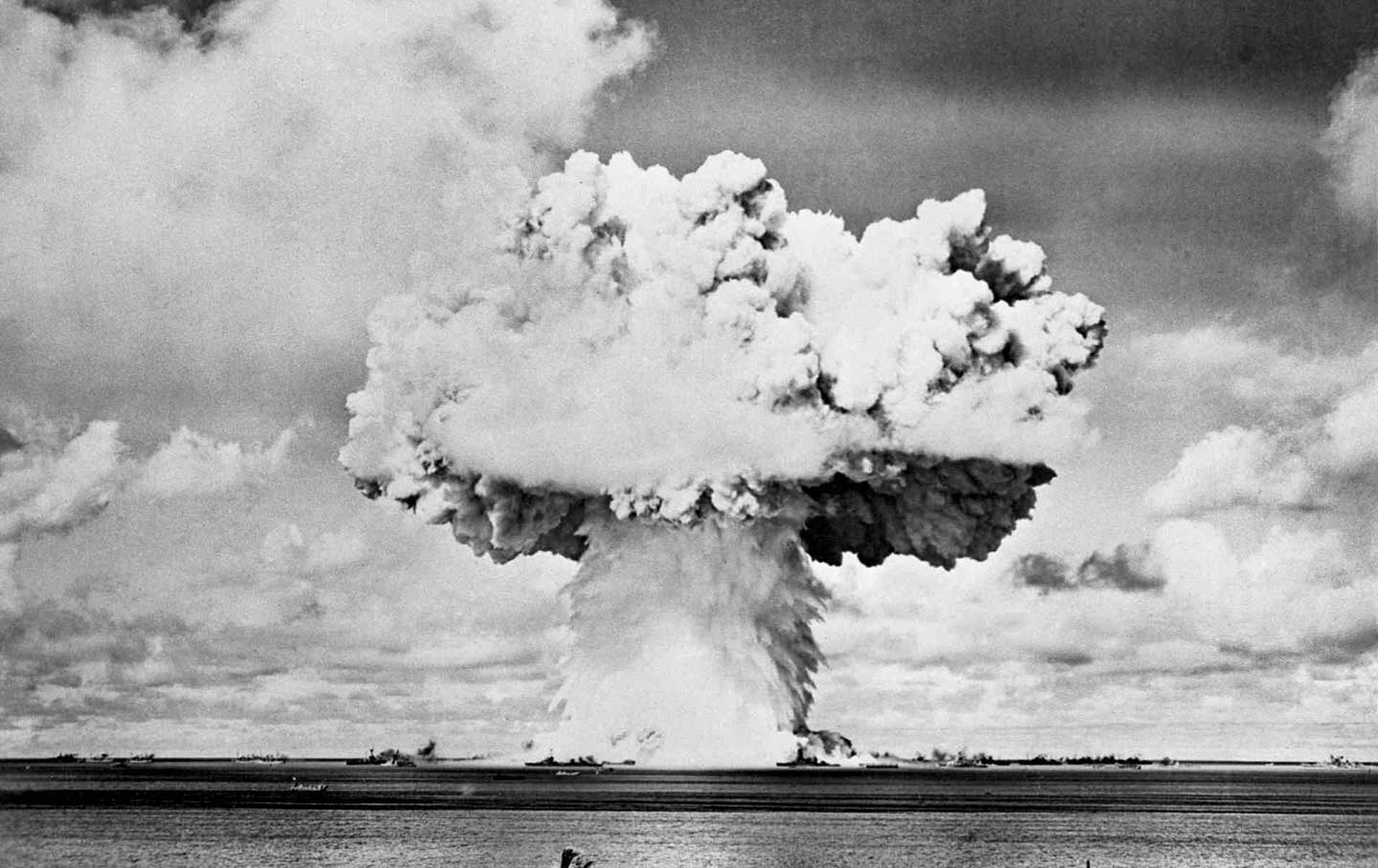
This AI Panic Is Nothing New This AI Panic Is Nothing New
In the 1940s, The Nation asked questions about the atomic bomb we’re asking of artificial intelligence today.

The Decades-Old Roots of Trump’s War on Iran The Decades-Old Roots of Trump’s War on Iran
An interview with historian Behrooz Ghamari-Tabrizi about the generations of US presidents who have tried to destroy the Iranian regime.
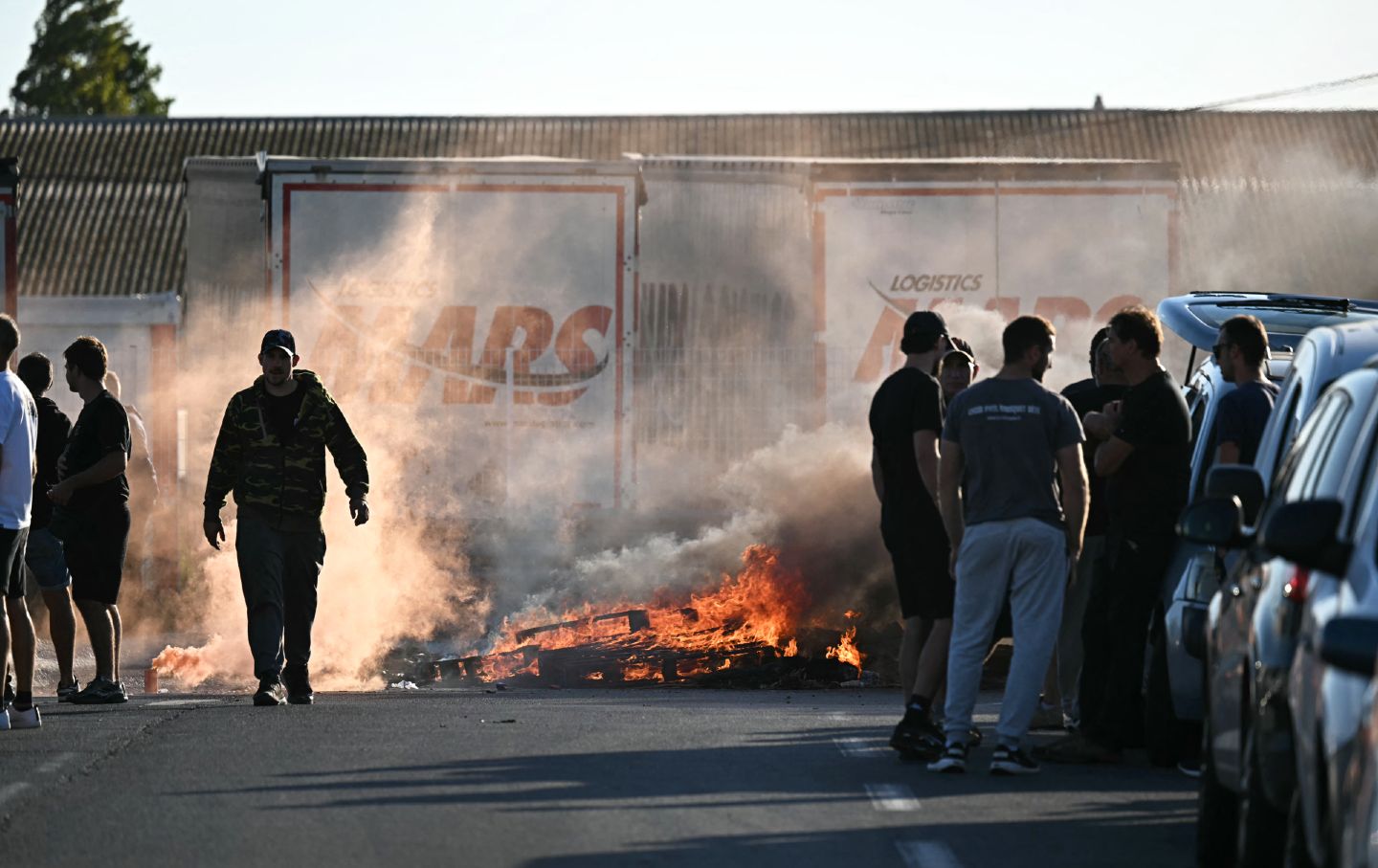
Emmanuel Macron’s Turbulent Exit Emmanuel Macron’s Turbulent Exit
Between a budget crisis and a cost-of-living squeeze, Macron is leaving a country feeling more insecure than ever—and ready to take to the streets.
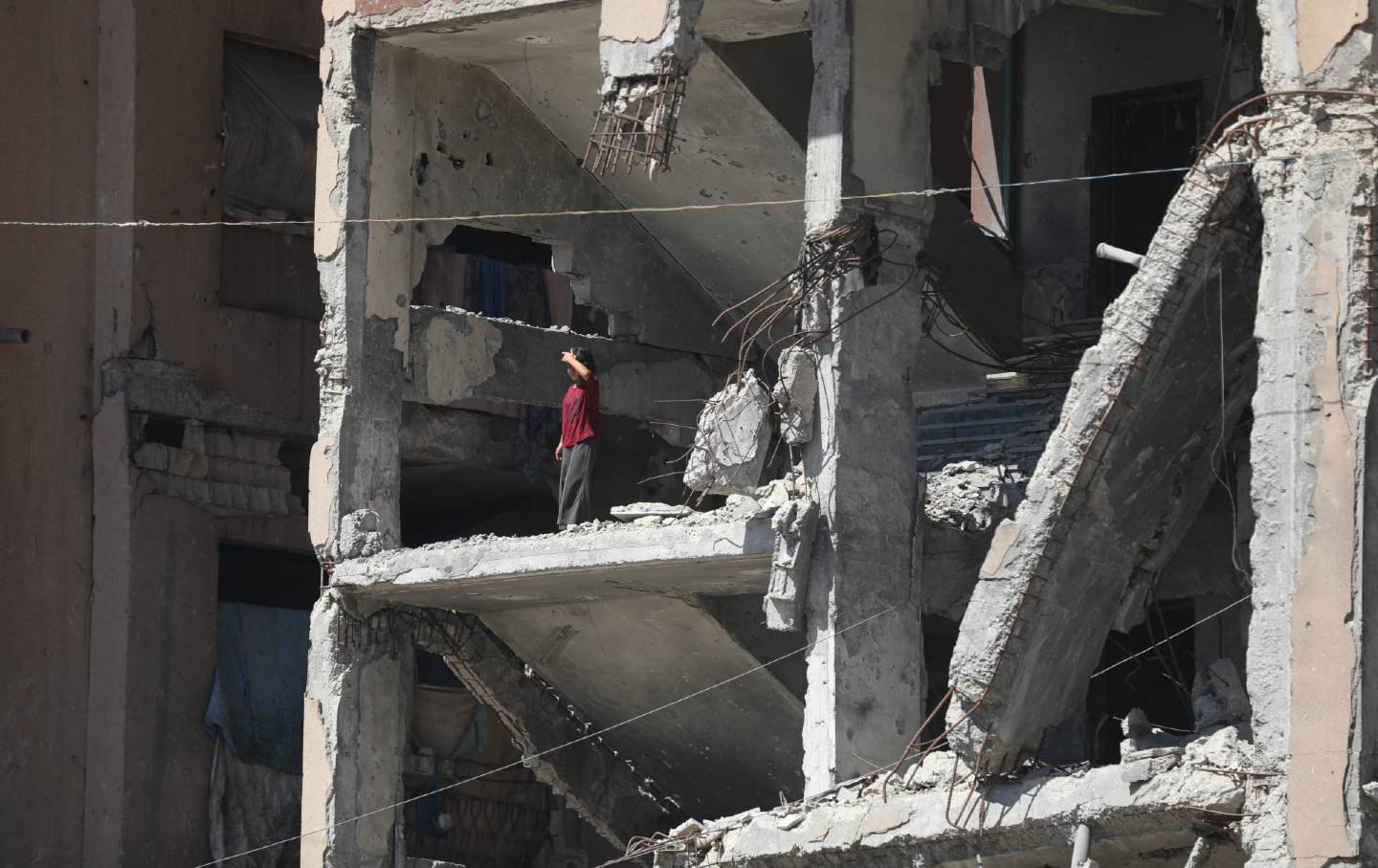
Israel’s Election Can’t Fix What Netanyahu Broke Israel’s Election Can’t Fix What Netanyahu Broke
The fundamental problem is not the name of the prime minister, but rather the actions of the Israeli government and the urgent issues that need to be addressed.
The AfD’s Rise Isn’t Just About East Germany The AfD’s Rise Isn’t Just About East Germany
The Alternative für Deutschland has a stable national poll lead, including in the former West Germany. Its rise owes to much more than Eastern grievances.

