
The Honeymoon Is Over Between Trump and Europe’s Far Right
Viewing an alliance with Trumpist America as a liability.
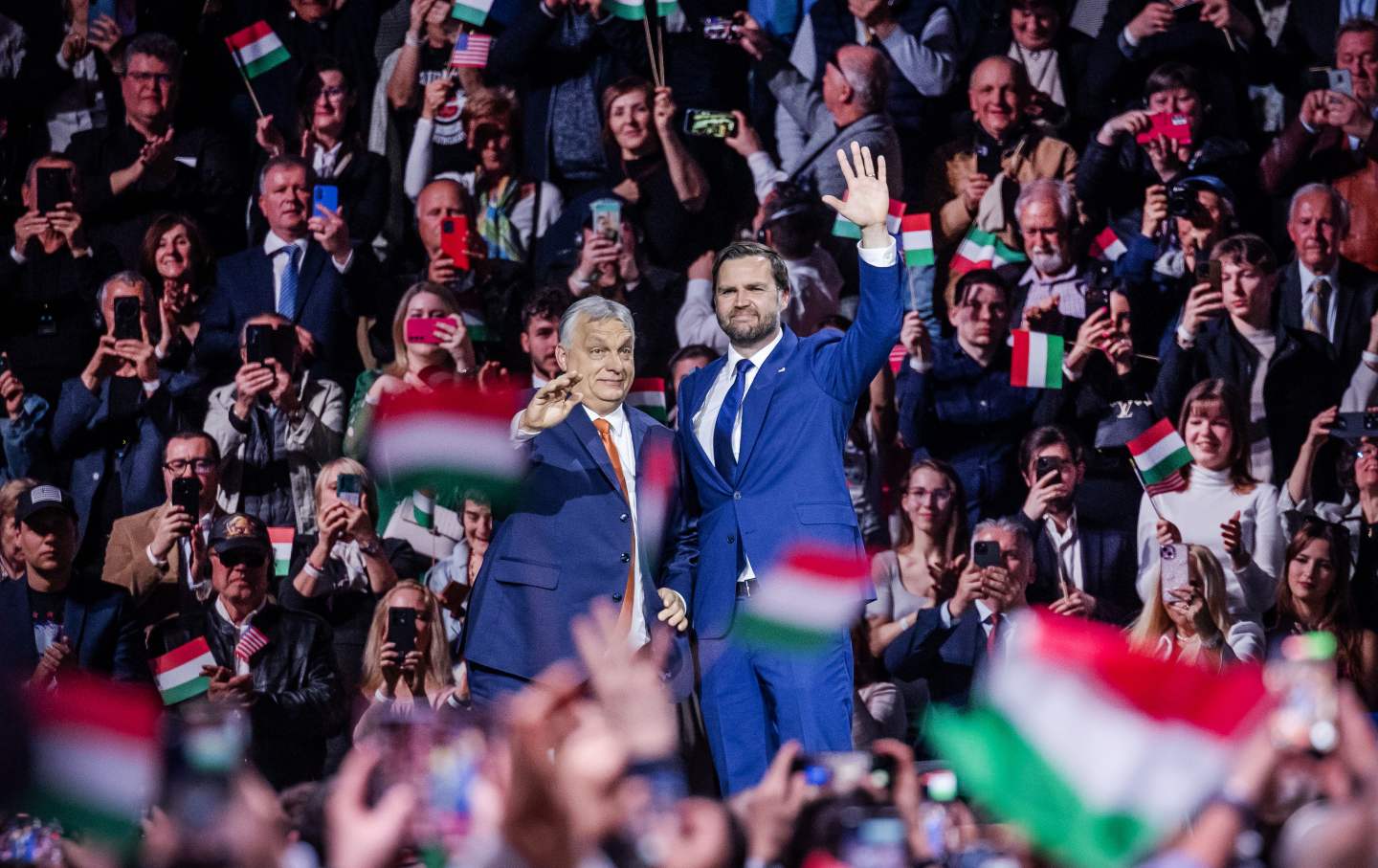
Donald Trump’s Gulf War has brought an already frayed relationship with Europe to a new tipping point. At the top of European fears: that a prolonged closure of the Strait of Hormuz will expose them to a new energy crisis, four years after the oil and gas tremors that followed Russia’s 2022 invasion of Ukraine. A “stagflationary shock,” in the words of EU Economy Commissioner Valdis Dombrovskis, could soon join the list of European grievances with Washington, after recent tussles over Greenland or the extortionate trade deals forced upon them last summer.
Look no further than the growing friction between Trump and his fellow travelers among the far-right movements in or out of power across Europe. From Germany and Italy to France and Hungary, Trump’s repeated aggressions are placing his natural allies in an unenviable political position, forcing them to level with the spillover effects caused by their big brother in the White House.
Last Sunday’s crushing defeat for Hungarian strongman Viktor Orbán, who had received a ringing endorsement from the Trump administration, ought to be taken as a warning sign: Cleave too closely to the White House at your own peril. Orbán’s replacement, Péter Magyar, is far from the liberal paragon that some might make him out to be, and benefited from the economic malaise associated with the later years of Orbán’s term in office. But the incoming premier also speaks for the desire in Hungary to restore a better working relationship with the European Union after the constant bickering of the Orbán years.
In that, Magyar’s victory confirms the continental hard right’s trend toward cooperation via the European Union. A breakaway veteran of Orbán’s Fidesz party, Magyar has stated that he “hopes to make decision-making easier” on the EU-level and would not hold up, for example, a new European financial lifeline for Kyiv. That’s a refutation for Trump, whose constant broadsides against Europe’s stance on the Ukraine conflict mirrored the ousted premier’s. On Wednesday, Trump sought to minimize his ally’s defeat, telling ABC that he “wasn’t that involved in this one.”
In post-EU Britain, home to arguably the most US-phillic of European hard right parties, Nigel Farage’s Reform UK is also expressing frustration with the White House. No doubt Farage cares quite little about Trump’s April 7 claim that “Iranian civilization will die” unless Tehran accepts capitulation—that “went way to far,” the English politician said, though he has indicated that as prime minister he would authorize American strikes at Iranian infrastructure from UK airbases. What he surely does care about is the prospect that Trumpism could prove an electoral drag, as falling support seems to suggest. One recent study suggests that the leading reason for voter hesitation is Farage’s perceived proximity to Trump.
The turnaround is just as marked from Giorgia Meloni. Since Trump’s return to power, the far-right Italian premier, the leader of a party that traces its roots back to post-WWII neofascism, sought to serve as a chief intermediary between Washington and the EU. While hewing closely to Brussels on European support for Ukraine, Meloni advocated for tempering the European response to Trump’s “Liberation Day” tariffs.
In recent days, Meloni has started to reap a more bitter fruit. Trump has taken to lashing out at the Italian premier, calling her a coward for her refusal to allow the US to launch strikes against Iran from its bases in Italy. That rebuke added to Trump’s latest tirade against Pope Leo, which Meloni deemed “unacceptable.” On April 14, she announced the suspension of Italy’s security pact with Israel, a decision that came after Italian troops involved in a United Nations peacekeeping mission came under Israeli fire in Lebanon.
A great deal of this is necessary posturing for a turbulent geopolitical moment. But it’s not just that. After all, European leaders of all stripes are being forced to contend in a continental political scene where there’s ample reason to see partnership with Trumpist America as a liability at best, when it’s not outright exploitative.
In France, skepticism of the US has long kept Marine Le Pen’s Rassemblement National at a relatively cool distance vis-à-vis the MAGA world—a far cry from the symbiosis projected by Orbán or the Italian hard right.
But an April 14 report from Reuters has its thumb on some of the deeper costs of proximity. In the lead-up to France’s presidential elections in 2027, the news agency is reporting that Charles Kushner, the US ambassador to Paris and father of Trump’s son-in-law Jared, is holding a series of consultations with leading contenders. Their talks with the Rassemblement National purportedly left US diplomats with little confidence in the RN’s capacity to steer the French economy, curtail the country’s high public deficit, and “win US investment,” in Reuters’ paraphrasing of the unnamed officials.
If Trump has sought to drill in one message to Europeans, it’s that American “friendship” comes at a price. From exorbitant tariffs to purchases of American fossil fuels and weapons, the White House expects European publics to swallow its dictates. The European nationalist has no magic solution to a grim political math demanding large increases in military spending at a time of tightening budgets. He may even feel a pang that his country’s digital economy or defense industry is in a state of drastic dependence on US technology.
Bonhomie can only do so much in covering up these ingrained imbalances. It’s all far and well to boast of common civilizational values—and it’s far too early to talk of a divorce. But the stilted deal being forced on Europe by this trigger-happy White House has its costs. Even for Trump’s boosters on the old continent, that relationship is showing some wear.
Become a Sustaining Donor This September
Between the reemergence of right-wing red-baiting and Donald Trump’s use of the chilling National Security Presidential Memorandum–7 to criminalize left political organizing, we’re seeing McCarthyism reborn before our eyes.
This assault on democracy cannot be ignored or wished away. Resisting it requires bravery in the face of threats and repression, a steadfast commitment to the truth, and the unwavering belief that we can—and will—overcome this darkness.
We must have an independent media that sets the record straight, unearths corruption and abuses of power, and advances a politics of justice and dignity for all if we’re to win this fight.
That’s why I’m writing to you today. This September, The Nation needs to add 100 monthly donors to sustain our progressive journalism. Your contribution makes the next investigative report, the next truth-speaking column, and the next pathbreaking essay all possible.
I hope you’ll support our work with a recurring donation today. If you donate $10 or more a month, we’ll send you a brand new “Hands Off the Free Press!” sticker to recognise your commitment to our cause. Please, donate today.
Onward,
Katrina vanden Heuvel
Editor and Publisher, The Nation
More from The Nation
This AI Panic Is Nothing New This AI Panic Is Nothing New
In the 1940s, The Nation asked questions about the atomic bomb we’re asking of artificial intelligence today.
The Decades-Old Roots of Trump’s War on Iran The Decades-Old Roots of Trump’s War on Iran
An interview with historian Behrooz Ghamari-Tabrizi about the generations of US presidents who have tried to destroy the Iranian regime.

Emmanuel Macron’s Turbulent Exit Emmanuel Macron’s Turbulent Exit
Between a budget crisis and a cost-of-living squeeze, Macron is leaving a country feeling more insecure than ever—and ready to take to the streets.
Israel’s Election Can’t Fix What Netanyahu Broke Israel’s Election Can’t Fix What Netanyahu Broke
The fundamental problem is not the name of the prime minister, but rather the actions of the Israeli government and the urgent issues that need to be addressed.
The AfD’s Rise Isn’t Just About East Germany The AfD’s Rise Isn’t Just About East Germany
The Alternative für Deutschland has a stable national poll lead, including in the former West Germany. Its rise owes to much more than Eastern grievances.
Chinese Development Is the Betrayal Washington Cannot Forgive Chinese Development Is the Betrayal Washington Cannot Forgive
The prospects for Xi Jinping’s visit are dim because American leaders are blaming China for the failures of globalization.

