
Democrats Should Become the Pro-Porn Party
An immodest proposal.
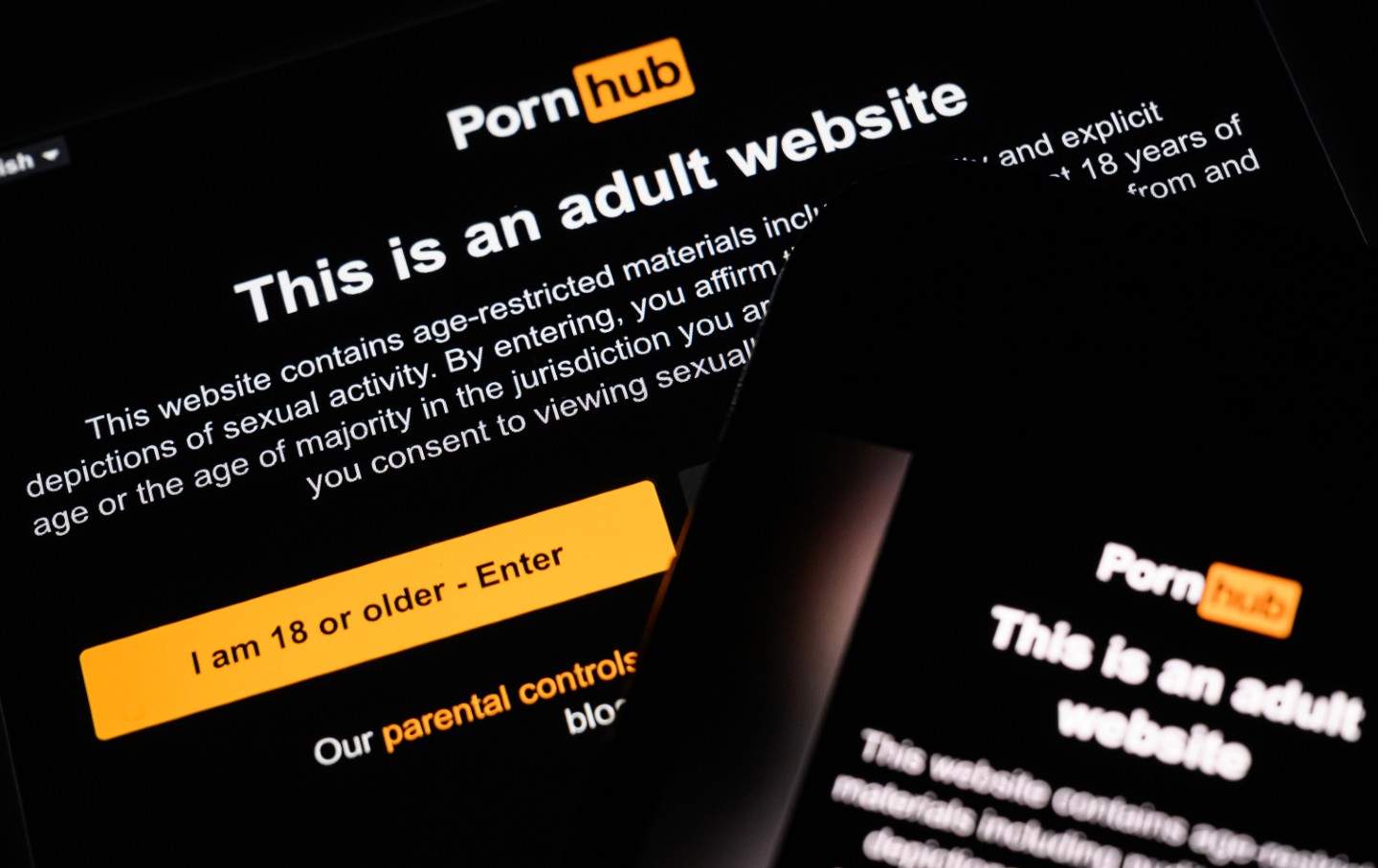
In this photo illustration, the age-restriction warning screen of the website PornHub is displayed on two digital screens.
(Leon Neal / Getty Images)
I have many thoughts on how the Democratic Party might start to win back young men who have abandoned the party for fascism. None of them involve abandoning women’s rights, women’s leadership, or the LGBTQ community. But one of my suggestions is that the Democrats should embrace pornography and other examples of sexiness and smut under the umbrella of free speech.
Democrats must be the party of free speech and artistic expression. That is the liberal position. Republicans have hijacked the free speech issue, but the only free speech conservatives actually believe in is the “freedom” to shout racist and sexist crap online. That argument works on certain types of men—men who think using slurs makes them “edgy” and counterculture. Men who get uncomfortable when they don’t know the right thing to say. Men who don’t know how to talk to women.
But using a person’s preferred pronouns or swallowing a racial insult in your throat is not actually a free speech issue: It’s a human decency issue. The government does not fine you if you say the n-word, nor does it prevent you from getting a date just because you talk like a dude who is one rejection text away from becoming a mass shooter. Republicans are not protecting incels from government overreach; they’re protecting them from the social consequences of their beliefs.
Now, to be clear, pornography is viewed and enjoyed by all sorts of people, male and female, gay and straight, trans and cis. Indeed, one of the highest, best uses of porn (I can’t believe I just wrote that) is that it helps young people figure out what they’re actually into. Sex-positive porn enjoyers are not a political demographic the Democrats generally have a problem with.
Young, cishetero men who like jerking off to boobs the size of back problems are. They have been led to believe that Republicans are the protectors of free speech in this country. Some of those guys don’t care about free speech: They vote Republican because Republicans support their desire to treat real-life women like the sex objects of their fantasies. There’s nothing that can be done to save these people.
But Democrats can speak to people who honestly believe that freedom of thought and expression are under attack in this country, because it is under attack—from Republicans. You might not be able to convince a cishetero white guy that “Free Palestine” flags are germane to his free speech concerns, but you might convince him that porn is.
That’s because pornography is an actual free speech issue. So is smut. So is obscenity. These are forms of free speech that conservatives and Republicans in the government are constantly trying to regulate. There is no way that a young male interested in downloading some “not safe for work” content should be under the impression that the Republican freaking Party are the people who are going to defend and protect this right to do so. Liberals are the people who are supposed to be at the vanguard of free expression when it comes to sexy time. Democrats should be exposing the fundamental Republican hypocrisy of treating PornHub like a sin but Donald Trump like a god. And they can do that by loudly and proudly defending people’s rights to access PornHub (or whatever the kids are using these days).
Sex pests Clarence Thomas and alleged attempted rapist Brett Kavanaugh are the perfect examples of that hypocrisy. In their private lives they’ve been accused of sexual harassment and indecent behavior, but when it comes to actual legal issues involving lascivious speech, they suddenly reach for their Bibles. Thomas and Kavanaugh believe in the “freedom” to menace real-life women, but not the freedom to draw fake ones.
The latest example of this cognitive Republican dissonance comes from the third, awful decision released by the Supreme Court on the last day of its term, Free Speech Coalition v. Paxton. At issue was a Texas law that requires adult websites to use age verification software in an effort to restrict the ability of minors to access pornography.
Nobody was arguing that minors have a constitutional right to access porn. But adults do. Regulating adult access to porn is a point-and-one-handed-click restriction on the freedom of speech and the freedom of expression.
If it’s not obvious to you how an age verification system restricts adult access to adult websites, well then consider yourself lucky to have never been on an adult website in the modern Internet age. In my anecdotal “research”—for science—there is not a single one of these sites where I’d feel comfortable putting in my credit card information, or my freaking driver’s license, or anything else that could be used to reliably verify my age.
But the Supreme Court waved these concerns away and affirmed Texas’s right to suppress free speech. Writing for the 6-3 Republican supermajority, Thomas argued:
Adults have the right to access speech that is obscene only to minors. And, submitting to age verification is a burden on the exercise of that right. But, adults have no First Amendment right to avoid age verification, and the statute can readily be understood as an effort to restrict minors’ access. Any burden experienced by adults is therefore only incidental to the statute’s regulation of activity that is not protected by the First Amendment.
Thomas’s argument is illogical on its face: Adults have a right that has nothing to do with kids; age verification burdens the right; however, adults don’t have a right to be free of the thing that violates their rights… because porn.
Popular
“swipe left below to view more authors”Swipe →What Thomas is doing in the legal weeds of this decision weakens the freedom of speech far beyond the pornography context. That’s because courts traditionally apply what they call “strict scrutiny” to any First Amendment issue. It means that for the government to restrict speech, it must show a “compelling” reason to do so, and it must restrict speech in the most limited way possible. We see Republicans apply this standard all the time whenever any religious wing nut gets offended by the existence of gay people. In another case that came out on the same day as this one, Republicans on the court literally applied strict scrutiny to decide that a public school district can’t use books that depict LGBTQ people without notifying parents, because such books offend the First Amendment rights of bigoted parents.
But in this case, Thomas and the Republicans ruled that strict scrutiny was not appropriate when all the state wants to do is limit people’s First Amendment rights to view porn. Instead, Thomas said that the court should use “intermediate scrutiny,” which is a different made-up standard that allows courts to rubber-stamp government restrictions that they like as a matter of policy. Thomas says that the Texas law “advances important governmental interests unrelated to the suppression of free speech,” but that is a dirty lie. The very point of the Texas law is the suppression of free speech, if you understand porn to be under the umbrella of speech.
If Thomas can lower the standard the government must meet when restricting speech in this case, it’s fair to ask what might be next. Restricting porn might seem like a low-stakes issue, but it’s a small step from porn to art and music. It’s a small step from porn to video games. And it’s not hard to imagine justices like Thomas and Samuel Alito, who hate journalism, taking “intermediate scrutiny” out for a spin when it comes to the news.
In dissent, Justice Elena Kagan cuts through the crap. She writes:
Under ordinary First Amendment doctrine, this Court should subject [the Texas law] to strict scrutiny. That is because [the Texas law] covers speech constitutionally protected for adults; impedes adults’ ability to view that speech; and imposes that burden based on the speech’s content. Case closed.
Kagan’s dissent (denuded of its legal jargon, of course), is the First Amendment/free speech argument that Democrats should embrace. The government cannot burden constitutionally protected speech under the thin guise of protecting children. Democrats should be the explicitly (pun intended) pro-porn party. It should be the explicitly pro-privacy party. It should be the explicitly pro-OnlyFans and pro–sex workers party. If it’s going to support regulations of the industries of smut at all, it should be to protect the rights of workers and actors, while also protecting the privacy of users.
These are the actual free speech issues of our time. Let Republicans rail against “woke” terminology with their mouths while trying to ban Grand Theft Auto with their legislation. Democrats can outflank them by actually defending free speech from prudish Republican overreach.
Free Speech v. Paxton is a gift to any Democratic politician smart and bold enough to seize it. Republicans in Texas and on the Supreme Court have once again shown their puritanical nature, which is antithetical to free speech and free expression. Democrats should fight them.
Become a Sustaining Donor This September
Between the reemergence of right-wing red-baiting and Donald Trump’s use of the chilling National Security Presidential Memorandum–7 to criminalize left political organizing, we’re seeing McCarthyism reborn before our eyes.
This assault on democracy cannot be ignored or wished away. Resisting it requires bravery in the face of threats and repression, a steadfast commitment to the truth, and the unwavering belief that we can—and will—overcome this darkness.
We must have an independent media that sets the record straight, unearths corruption and abuses of power, and advances a politics of justice and dignity for all if we’re to win this fight.
That’s why I’m writing to you today. This September, The Nation needs to add 100 monthly donors to sustain our progressive journalism. Your contribution makes the next investigative report, the next truth-speaking column, and the next pathbreaking essay all possible.
I hope you’ll support our work with a recurring donation today. If you donate $10 or more a month, we’ll send you a brand new “Hands Off the Free Press!” sticker to recognise your commitment to our cause. Please, donate today.
Onward,
Katrina vanden Heuvel
Editor and Publisher, The Nation
More from The Nation

As Morale Sags, More Military Service Members Are Having a Crisis of Conscience As Morale Sags, More Military Service Members Are Having a Crisis of Conscience
According to multiple GI rights organizations, service members are inquiring in unprecedented numbers about seeking conscientious objector status.
What Remains of Riis? What Remains of Riis?
A new members’ club has revived Riis Park’s long-vacant bathhouse, reopening old questions about whom the People’s Beach is really for.

When Texas Sex Ed Falls Short, Gen Z Women Turn to Social Media When Texas Sex Ed Falls Short, Gen Z Women Turn to Social Media
A 2025 study found that 70 percent of adolescents sought reproductive health information through social media platforms.

Justice for Macklemore Justice for Macklemore
The rapper has been dumped from Ed Sheeran’s tour for saying “free Palestine.” That’s a disgrace.

We Are Living Under Roy Cohnian Logic We Are Living Under Roy Cohnian Logic
The political fixer created a career for himself as a self-promoting, ubiquitous hustler. Like Trump, he got away with it by having the right friends.

Time Has Run Out for AI Risk Deniers Time Has Run Out for AI Risk Deniers
The recent spate of reports about the technology’s destructive power underline two prime directives: Be afraid, and regulate aggressively.

