
The False Premise of European Rearmament
Have European leaders stopped to consider the Orwellian implications of gearing up their nations for perpetual war?
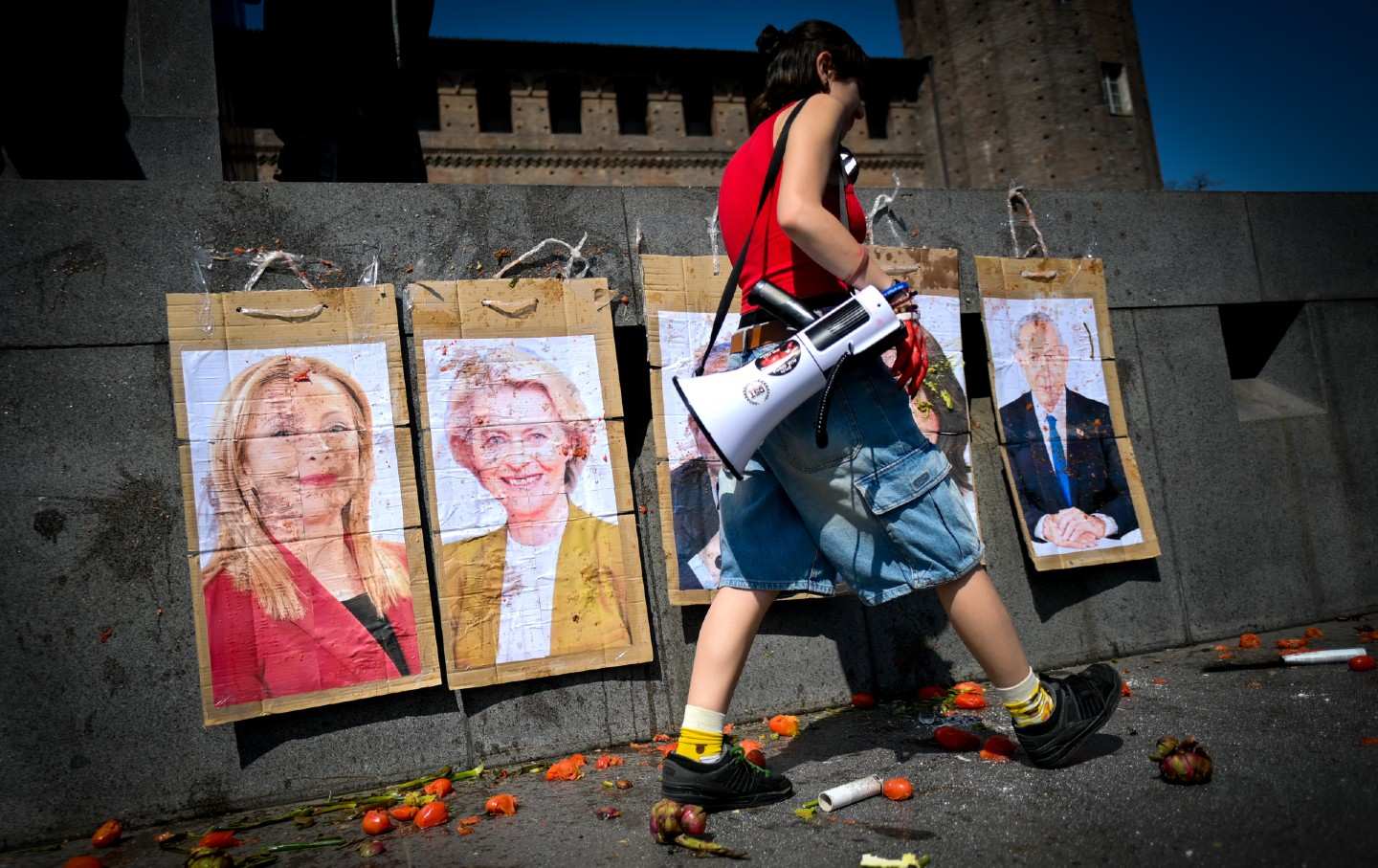
On March 5, European Commission President Ursula von der Leyen unveiled her Re-Arm Europe Plan, which aims to boost EU defense spending by €800 billion over four years. On June 5, NATO defense ministers agreed to double their members’ annual defense spending from an average of roughly 2.5 percent of GDP to 5 percent by 2032.
There are two main justifications for European rearmament. The first, and arguably the most important, is that President Trump has demanded it. Historically, the United States has contributed about 70 percent of NATO’s budget. Europe’s rearmament is in part a response to his demand that it pay its “fair share.” This goes in hand with the feeling that the US is poised to disengage from Europe—partly because of Trump’s desire to do business with Putin, partly because of the American pivot on the challenge of China. The two, of course, are linked in the current American geostrategy. But doubts about the American commitment to NATO cannot be openly admitted, so emphasis is placed on the second justification—the Russian bogey. Britain’s Strategic Defense Review (SDR)—published on June 5, calls for British rearmament as part of a “NATO first” policy—mentions the possibility of American disengagement only in passing; it is the Russian threat that looms largest.
“Russia’s full-scale invasion of Ukraine in 2022 was a strategic inflection point,” the SDR states, “irrefutably” demonstrating the threat of “state-on-state war” returning to Europe. The UK and its allies are under “daily attack, from [Russia], with aggressive acts of espionage, cyber-attacks, and information manipulation causing harm to society and the economy. Russia has demonstrated its ‘willingness’ to use military force, inflict harm on civilians and threaten the use of nuclear weapons to achieve its goals.” So Britain must rearm to deter and if necessary “fight and win” a war against Russia. As Mark Rutte, NATO’s secretary general, put it: The British had better rearm or learn to speak Russian.
Rearmament involves increased investment not just in conventional armed forces but also in the technologies of warfare: “dynamic networks of crewed, uncrewed, and autonomous assets and data flows.” The aim would be to achieve a tenfold increase in “lethality” (i.e., killing power). Since Russia has intentionally blurred the line between nuclear, conventional, and “sub-state” threats, an integrated British response should combine both conventional and hybrid forms of war preparation. Great stress is placed on the need for a resilient “home defense” to guard against espionage, political interference, sabotage, assassination and poisoning, electoral interference, disinformation, propaganda, and intellectual property theft.
The review is a superb example of how, starting from a false premise, remorseless logic can lead to a mad conclusion. The premise is that if Russia is not confronted by a rearmed Europe, it will seek to impose its will on the continent. Deny the premise, and the argument for mobilizing society and economy against Russia collapses. What it reveals is the strength of the warmongering mood of official Britain.
The attribution to Russia of aggressive intent harks back to the Cold War, with the old tropes shamelessly repurposed for current use. NATO was set up to keep the Russians from conquering Europe. Today, Russia must be prevented from becoming the “dominant military power in all of Europe,” according to Fiona Hill. Yet the Cold War itself was partly based on a misconception. Few now believe that Stalin’s Russia, still less its post-Stalin successor, set out to dominate the whole of Europe: Its purpose was to create a buffer against invasion from the West. However, the Cold War era did see a genuine ideological conflict between capitalism and communism. So it was not altogether fanciful to believe that we were engaged in a battle for the soul of the world.
Today’s repackaging of the Cold War lacks any such ideological dimension. It is replaced by the threadbare idea that autocracies are naturally expansionary, so our rearmament is a defense of Western values against otherwise rampant dictatorships. But there is no firm evidence that dictatorships are naturally more expansionist than democracies: Russia invaded Ukraine, and the United States invaded Iraq, both alleging threats to their security.
More plausible is the view that in the international anarchy, none are safe, so that each “peer” nation must be ready to repel aggressors. This is the basis of the “balance of power” theory. The argument is that we in the West have allowed our defenses to slip, thus tilting the balance in Russia’s favor. Unless this is remedied, Russia will take advantage of our slippage to pursue its own security goals at our expense.
Western analysts forget that Russian rearmament has been shaped by the same logic: Russia was stripped of its security shield by the West in its moment of weakness in the 1990s; under Putin, it has set out to restore as much of it as possible. The solution to the disorder inherent in a world of sovereign nations is not that they should all arm themselves to the teeth, but that they should develop rules of coexistence, and practice the arts of diplomacy and conflict resolution. Few of these were on display from either side in the run-up to the Ukraine war.
However, the defects of the SDR go beyond the false premise of a mortal Russian threat. Most palpable is its failure properly to distinguish between deterrence and war. The classic doctrine of deterrence asserted that being prepared to “fight and win” a war was the best deterrence against having to fight one, because of its threat to inflict unacceptable costs on any aggressor: In the Cold War, nuclear war was deterred by promising mutually assured destruction (MAD).
Following the general abolition of conscription (in Britain in 1960), deterrence in the Cold War era, being based on nuclear weapons and volunteer conventional forces, was largely separated from the peaceful pursuits of society. Military needs did not determine the shape of the economy or constrain public discourse. At the height of the Cold War, Western societies allowed sizable peace movements to challenge a defense strategy based on nuclear weapons, the Campaign for Nuclear Disarmament being the obvious British example.
According to the SDR, such dissent today would weaken the credibility of our deterrent. Our war-making (and hence deterrence) capacity must now permeate every aspect of society. For Britain to deter Russia, it must develop a “whole society” war readiness. As the SDR puts it: “UK must be better prepared for high intensity, protracted war.”
Popular
“swipe left below to view more authors”Swipe →There are two things wrong with this. First, the kind of armed peace advocated by the SDR obliterates the distinction between war and peace. We must realize that we are already at war with Russia and mobilize the nation to fight it. But how or when is such a war to end? As stated, it is never-ending as long as dictatorships exist in any part of the world.
Even worse, to keep the nation in a state of constant alert requires, as Prime Minister Keir Starmer frankly admitted, a “radical shift in mindset,” a “transformation of culture,” the “eradication” of “unacceptable” behavior—one that accepts defense and security as “the organizing principle of government.” The government should increase cadet enrollment in schools, spread understanding of the armed forces among young people, start “public outreach events across the UK, explaining the role the wider society must play in the UK’s security and resilience”—seemingly modest objectives until one realizes that they are part of the project for readying the “whole nation” for war.
Do the authors of this review have any grasp of the implication of the words they use? The language of “readying” the nation for war is the language of war itself, not of deterrence, appropriate, say, for the Second World War with its mass civilian bombing but not for a society that rightly regards itself at peace. Have they stopped to consider the Orwellian implications of gearing up the nation for perpetual war?
The SDR rightly draws attention to the increased and often subterranean threats of harm opened by rapidly accelerating technological innovation. But I draw an opposite conclusion. The multiplication of technological threats provides a compelling argument for global cooperation, not for a new Cold War continually teetering over into a hot war. It is the joint responsibility of leaders of all the great powers to act as adults and not as children playing around with their lethal toys. Russia should not have invaded Ukraine. The West should not have provoked Russia to do so by promising Ukraine membership of NATO. The doctrine that international law guarantees all countries sovereignty wilts before the global responsibility of those with the greatest power for good or ill to behave in such a way as to maximize the chance of a peaceful future for all.
Become a Sustaining Donor This September
Between the reemergence of right-wing red-baiting and Donald Trump’s use of the chilling National Security Presidential Memorandum–7 to criminalize left political organizing, we’re seeing McCarthyism reborn before our eyes.
This assault on democracy cannot be ignored or wished away. Resisting it requires bravery in the face of threats and repression, a steadfast commitment to the truth, and the unwavering belief that we can—and will—overcome this darkness.
We must have an independent media that sets the record straight, unearths corruption and abuses of power, and advances a politics of justice and dignity for all if we’re to win this fight.
That’s why I’m writing to you today. This September, The Nation needs to add 100 monthly donors to sustain our progressive journalism. Your contribution makes the next investigative report, the next truth-speaking column, and the next pathbreaking essay all possible.
I hope you’ll support our work with a recurring donation today. If you donate $10 or more a month, we’ll send you a brand new “Hands Off the Free Press!” sticker to recognise your commitment to our cause. Please, donate today.
Onward,
Katrina vanden Heuvel
Editor and Publisher, The Nation
More from The Nation
Israel’s Election Can’t Fix What Netanyahu Broke Israel’s Election Can’t Fix What Netanyahu Broke
The fundamental problem is not the name of the prime minister, but rather the actions of the Israeli government and the urgent issues that need to be addressed.
The AfD’s Rise Isn’t Just About East Germany The AfD’s Rise Isn’t Just About East Germany
The Alternative für Deutschland has a stable national poll lead, including in the former West Germany. Its rise owes to much more than Eastern grievances.
Chinese Development Is the Betrayal Washington Cannot Forgive Chinese Development Is the Betrayal Washington Cannot Forgive
The prospects for Xi Jinping’s visit are dim because American leaders are blaming China for the failures of globalization.

Pinochet: The Verdict of History in the Letelier-Moffitt Case Pinochet: The Verdict of History in the Letelier-Moffitt Case
An act of international terrorism on the streets of Washington, DC, still reverberates 50 years later.
How to Arrest Benjamin Netanyahu How to Arrest Benjamin Netanyahu
Make no mistake: The United States can seize Netanyahu for crimes under US law and prosecute him in US courts when he is in New York City this week.
In the Age of AI, Nuclear Weapons Abolition Is a Renewed Imperative In the Age of AI, Nuclear Weapons Abolition Is a Renewed Imperative
As long as we have nuclear weapons, the job of ending humanity will continue to be as easy as the push of a button—or an AI agent hacking into a nuclear command-and-control system...

