How Dobbs Unleashed a Breathtaking Disregard for Human Rights
How “Dobbs” Unleashed a Breathtaking Disregard for Human Rights
In this new era of Jane Crow, the right to choose is not only a question of bodily autonomy in life, but even in death.
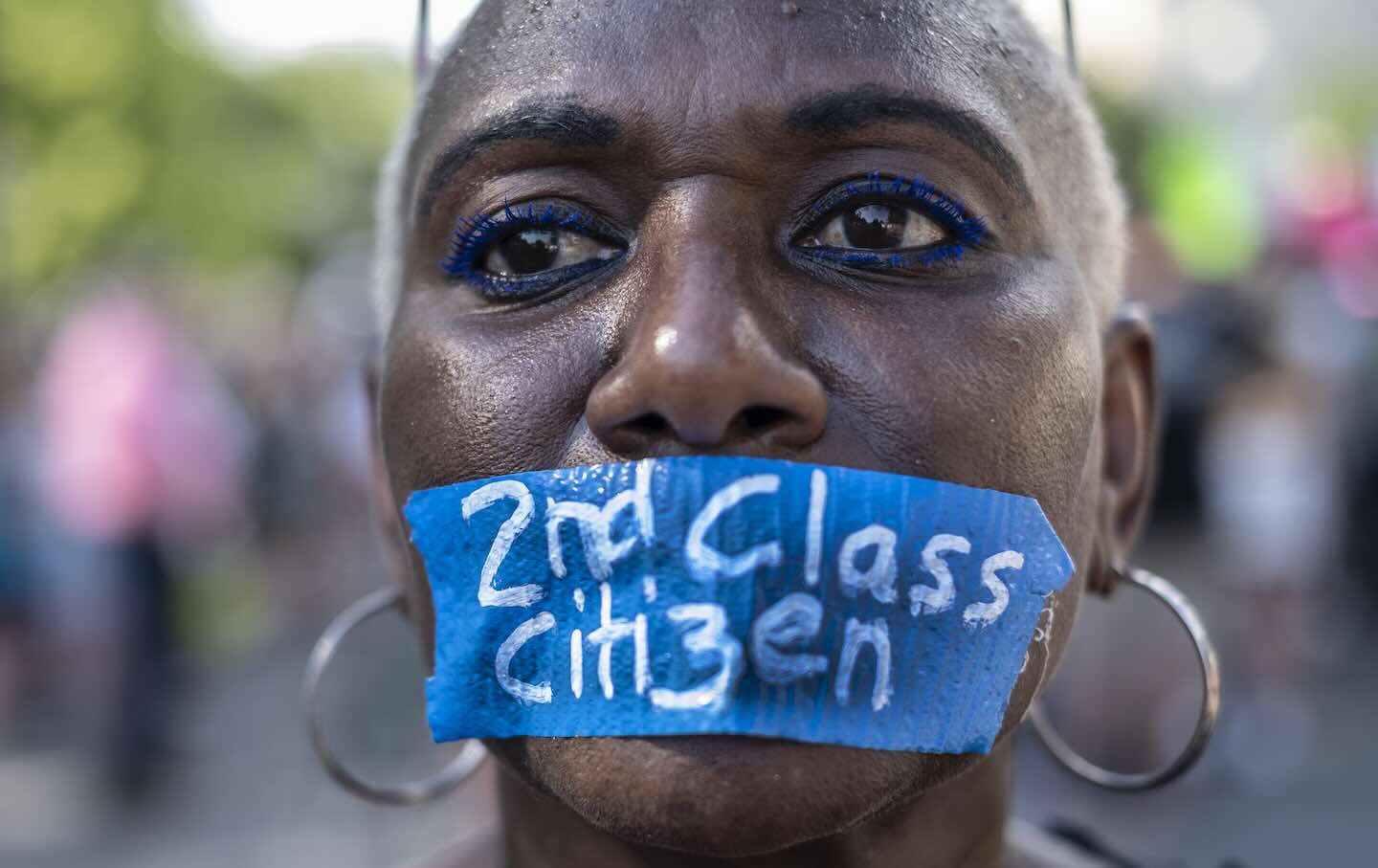
In a nightmare scenario straight out of dystopian science fiction, a brain-dead woman in Georgia has been forced to serve as a human incubator for over 100 days, in what amounts to the state-sponsored desecration of a deceased person. Yet this horrific situation isn’t fiction; it actually exists, in a state with one of the most draconian abortion bans in the nation. Indeed, it is because of Georgia’s abortion ban that hospital officials have taken control of Adriana Smith’s deceased body, acting without any regard for her grieving mother’s wishes.
Sadly, Adriana’s case reflects the new “Jane Crow” era, when the state in which a woman resides, becomes pregnant, and dies now determines whether she will be accorded basic civil and human rights. Since the Supreme Court’s Dobbs ruling overturned Roe v. Wade, which protected abortion rights in the United States, in June 2022, 19 states have passed laws that ban abortion altogether or place inordinate burdens on the ability to terminate a pregnancy—even in cases of rape or incest.
These new laws have unleashed a tidal wave of horrors: 10-year-old children forced to travel to the nearest state to terminate a pregnancy caused by sexual assault; women charged with abusing corpses or other offenses for having miscarriages; women forced to gestate dead fetuses or those missing a skull; women forced to bleed for days before receiving care, if they receive it at all. In Idaho, pregnant women have been airlifted out of the state to receive the medical care they are denied there.
Adriana’s case reflects the horrific double bind of race and sex in the United States. An African American nurse and mother, Adriana was declared brain-dead in February after seeking medical treatment. Tragically, a blood clot hadn’t been caught early in her pregnancy, during a medical visit in which Adriana complained of discomfort. Her mother, April Newkirk, believes that if her pain had been taken seriously, Adriana’s death could have been prevented. Standard tests that should have been performed to detect the clot and prevent her daughter’s death were not done, Newkirk said. Sadly, medical neglect is far too common among Black women, whose pain and medical complaints are often ignored or inadequately treated.
Yet, this is also a page ripped from the archives of an undeniable American history. Black women being reduced to the status of “property” and subjected to involuntary, forced labor and servitude that is sanctioned by unjust laws is nothing new. The horrors in Georgia reflect its putrid past, whereby it sanctioned and fought for it to persist in its secession declaration. Particularly noteworthy was Georgia’s virulent fight to keep Black women fastened to forced servitude.
In 1861, Georgia formally issued its secession from the United States, citing its commitment to slavery as its key reason. The Georgia legislature claimed the abolition of slavery as “endeavor[ing] to weaken our security, to disturb our domestic peace and tranquility.” Georgia lawmakers believed that keeping Black women in bondage was “their express constitutional [right]…in reference to that property.” Their sense was that the “Federal Government have [sic] striven to deprive us of an equal enjoyment” of slavery. This is exactly what the Thirteenth Amendment abolished—literally slavery and involuntary servitude.
Now in Georgia’s new Jane Crow, at least two Black women have died of preventable causes after the state enacted its abortion ban. Black women were already three to four times more likely to die during pregnancy than white women. Now we are witnessing how the combined tolls of racism and sexism burden Black women even in death.
Brain death is the legal and medical standard used in the United States to determine death. It is the common standard used to determine when tissues can be harvested for organ transplants. Hospital officials, however, are using Adriana’s body to continue gestating her fetus because, they say, they have no other choice under Georgia’s abortion law. They claim her case exists in a legal gray area, requiring them to keep her on mechanical support until there is sufficient fetal development for a forced cesarean section. Their actions also raise issues regarding the health of the fetus, which reportedly has hydrocephalus, or fluid on the brain—a condition that is often fatal or severely debilitating.
Bent on ignoring human rights and civil liberties, antiabortion lawmakers also flagrantly disregard the costs to women, their children, and their families. Nor have they demonstrated any concern about preventing pregnant women’s deaths, let alone expanding the social welfare safety net to improve the quality of life, housing, childcare, food, and the environment for women with children. On the contrary, lawmakers in Georgia and other antiabortion states have sought to reduce such services, making it more and more difficult for women with children to live with dignity.
In this new era of Jane Crow, antiabortion states are now poised to deny that dignity even in death, in the blatant service of legislators’ reproductive interests. More tragedies will continue to unfold. This dystopia is not confined to bad dreams; it is a present reality—one that April Newkirk has described as torture, where choice is not only a question of bodily autonomy in life, but even in death.
Your support makes stories like this possible
From illegal war on Iran to an inhumane fuel blockade of Cuba, from AI weapons to crypto corruption, this is a time of staggering chaos, cruelty, and violence.
Unlike other publications that parrot the views of authoritarians, billionaires, and corporations, The Nation publishes stories that hold the powerful to account and center the communities too often denied a voice in the national media—stories like the one you’ve just read.
Each day, our journalism cuts through lies and distortions, contextualizes the developments reshaping politics around the globe, and advances progressive ideas that oxygenate our movements and instigate change in the halls of power.
This independent journalism is only possible with the support of our readers. If you want to see more urgent coverage like this, please donate to The Nation today.