The Unqualified Hacks Hijacking Our Public Health
Crucial decisions—like rules around Covid vaccinations—are being made by a cabal of ill-equipped bros.
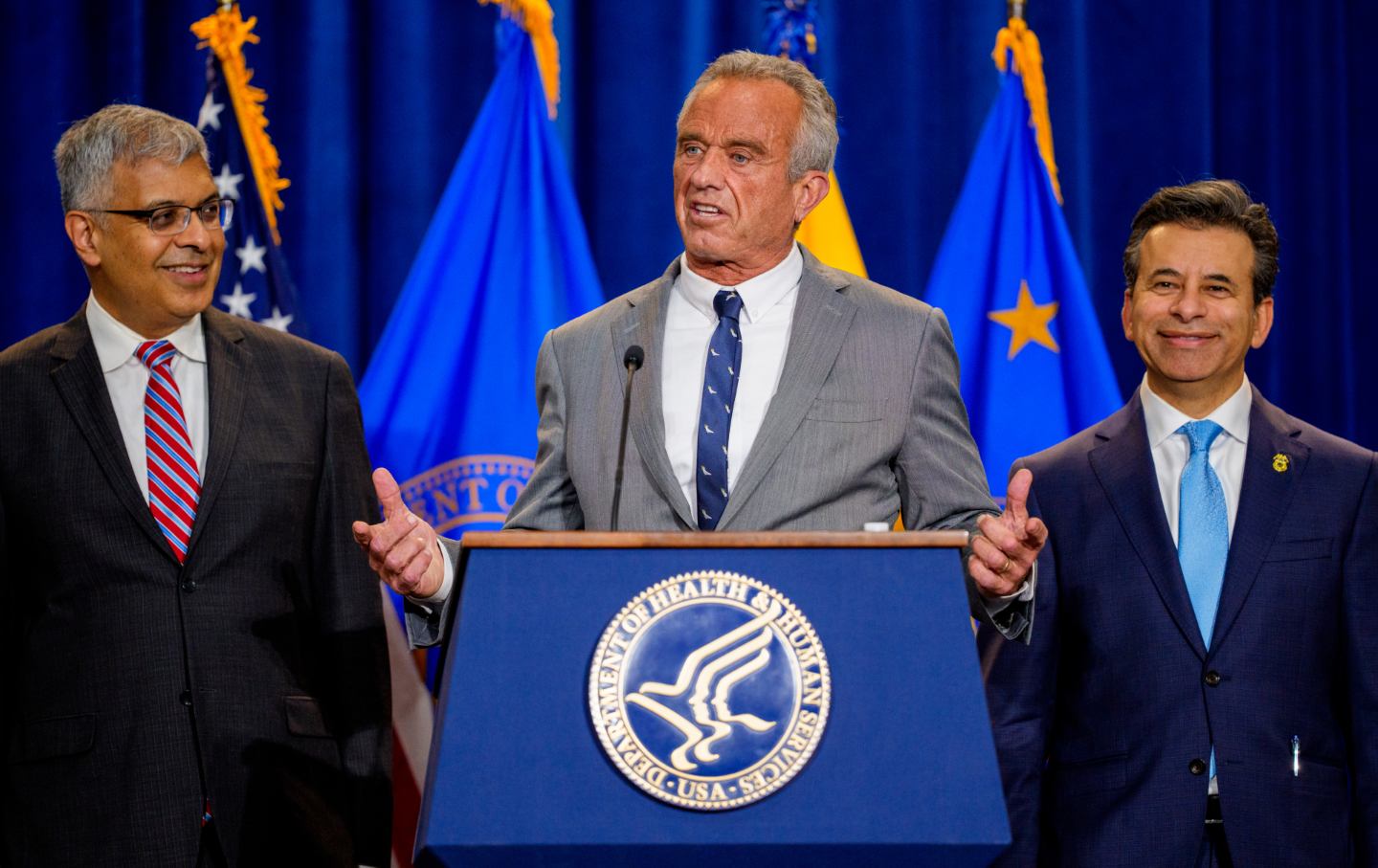
Health and Human Services Secretary Robert F. Kennedy Jr., accompanied by National Institutes of Health Director Jayanta Bhattacharya (L), and Food and Drug Administration Commissioner Marty Makary (R), speaks during a news conference at the Health and Human Services Department on April 22, 2025, in Washington, DC.
(Andrew Harnik / Getty Images)Even after what has been a catastrophic several months for public health and biomedicine in the United States, the past few weeks have shown us that things can always get worse.
By now, many of you have seen the new recommendations from the Department of Health and Human Services about Covid vaccines, limiting access to these shots for the foreseeable future.
Before I discuss what has happened with these recommendations, I have to mention who made them and how, because the “who” and the “how” in this instance are such a stark, radical departure from public health decision-making in America.
In June, the Centers for Disease Control and Prevention’s Advisory Committee on Immunization Practices (ACIP) was set to meet to consider the data on the boosters currently being used against the circulating variants of SARS-CoV-2, and to make recommendations for changes in the vaccination policies in the US.
But suddenly, on May 20, in a short piece in The New England Journal of Medicine, Food and Drug Administration Commissioner Marty Makary and Vinay Prasad, the director of the FDA’s Center for Biologics Evaluation and Research, announced a “new Covid-19 philosophy” for the agency. A week later, Makary, HHS Secretary Robert F. Kennedy Jr., and NIH Director Jay Bhattacharya issued a proclamation by video saying that they would remove pregnant women and children from the CDC-recommended immunization schedule, among other changes.
This is public health policy making by fiat, by individuals with no relevant expertise in infectious diseases, virology, immunology, or vaccinology, and all with varying degrees of vaccine “skepticism” well-documented in the public domain. ACIP, the CDC, and any other outside scientific and clinical advisers were all sidelined.
During the first Trump administration, a cartoon from The New Yorker made the rounds, with an image of a mustachioed man in a black shirt standing up, facing the other passengers and proclaiming: “These smug pilots have lost touch with regular passengers like us. Who thinks I should fly the plane?” Many of the passengers raised their hands in assent. What was a joke in 2017 is the reality of public health policy making in 2025. Critical decisions are now being made by those least qualified to make them. This will have profound effects on all of us, measured in sickness and death.
The “three guys in a room” (Prasad, Makary, and Bhattacharya) approach to vaccine policy making has made a hash of it. The guidance on pregnant women and children is categorical: Healthy pregnant women won’t get the vaccine. Yet pregnant women are at higher risk of complications from Covid. Vaccination ameliorates this concern, as the CDC’s own webpage on Covid and pregnancy reiterates. Young infants are also at high risk of hospitalization, and maternal immunization protects them. In fact, children under six months of age have rates of complications requiring hospitalization rivaling the elderly.
And how “healthy” will be defined in terms of eligibility for vaccination for anyone under 65 is up for grabs. Who will adjudicate who has an underlying condition conferring eligibility? Will insurers expect documented proof of clinical need? If 100 million to 200 million people, even by Prasad and Makary’s estimates, have these conditions, that means a whole lot of doctors’ notes. Clearly, only the most motivated will make it to the counter to get the jab in this scenario; anyone who faces ongoing barriers to healthcare is going to be left out in the cold. And none of this deals with those of us who might want to get vaccinated to protect more vulnerable people in our households, or who simply cannot afford to get sick and miss days of work should we get terribly ill.
This is complicated stuff, and it needs open, transparent discussion among experts, not three dudes in DC mouthing off. One has to think this is all meant to discourage Covid vaccination in the first place, something RFK Jr. would love to see. Added to all this is the three guys’ insistence that myocarditis (inflammation of the heart) is a common and severe side effect of the vaccines, requiring new warnings. In fact, it is a rare and almost always mild side effect. But the real goal here is to inject new and unfounded fears into these discussions, not to give people good information.
Let’s be clear what this is: a hijacking of public health decision-making by unqualified ideologues. It portends much more trouble down the road.
Become a Sustaining Donor This September
Between the reemergence of right-wing red-baiting and Donald Trump’s use of the chilling National Security Presidential Memorandum–7 to criminalize left political organizing, we’re seeing McCarthyism reborn before our eyes.
This assault on democracy cannot be ignored or wished away. Resisting it requires bravery in the face of threats and repression, a steadfast commitment to the truth, and the unwavering belief that we can—and will—overcome this darkness.
We must have an independent media that sets the record straight, unearths corruption and abuses of power, and advances a politics of justice and dignity for all if we’re to win this fight.
That’s why I’m writing to you today. This September, The Nation needs to add 100 monthly donors to sustain our progressive journalism. Your contribution makes the next investigative report, the next truth-speaking column, and the next pathbreaking essay all possible.
I hope you’ll support our work with a recurring donation today. If you donate $10 or more a month, we’ll send you a brand new “Hands Off the Free Press!” sticker to recognise your commitment to our cause. Please, donate today.
Onward,
Katrina vanden Heuvel
Editor and Publisher, The Nation