Who Will Protect Judges From Trump’s Incitement?
A threatened judiciary cannot rely on cops controlled by the White House.
In April, unexplained pizza deliveries started showing up at the private residences of more than two dozen federal judges as well as their family members. We know these unwanted deliveries were no random prank but a sinister threat because many were made under the name of Daniel Anderl, the son of a federal judge who was murdered in 2020 while protecting his parents from an angry litigant. The message was clear: “We know where you live, we know where you family lives, and we can kill you and your loved ones anytime we want.”
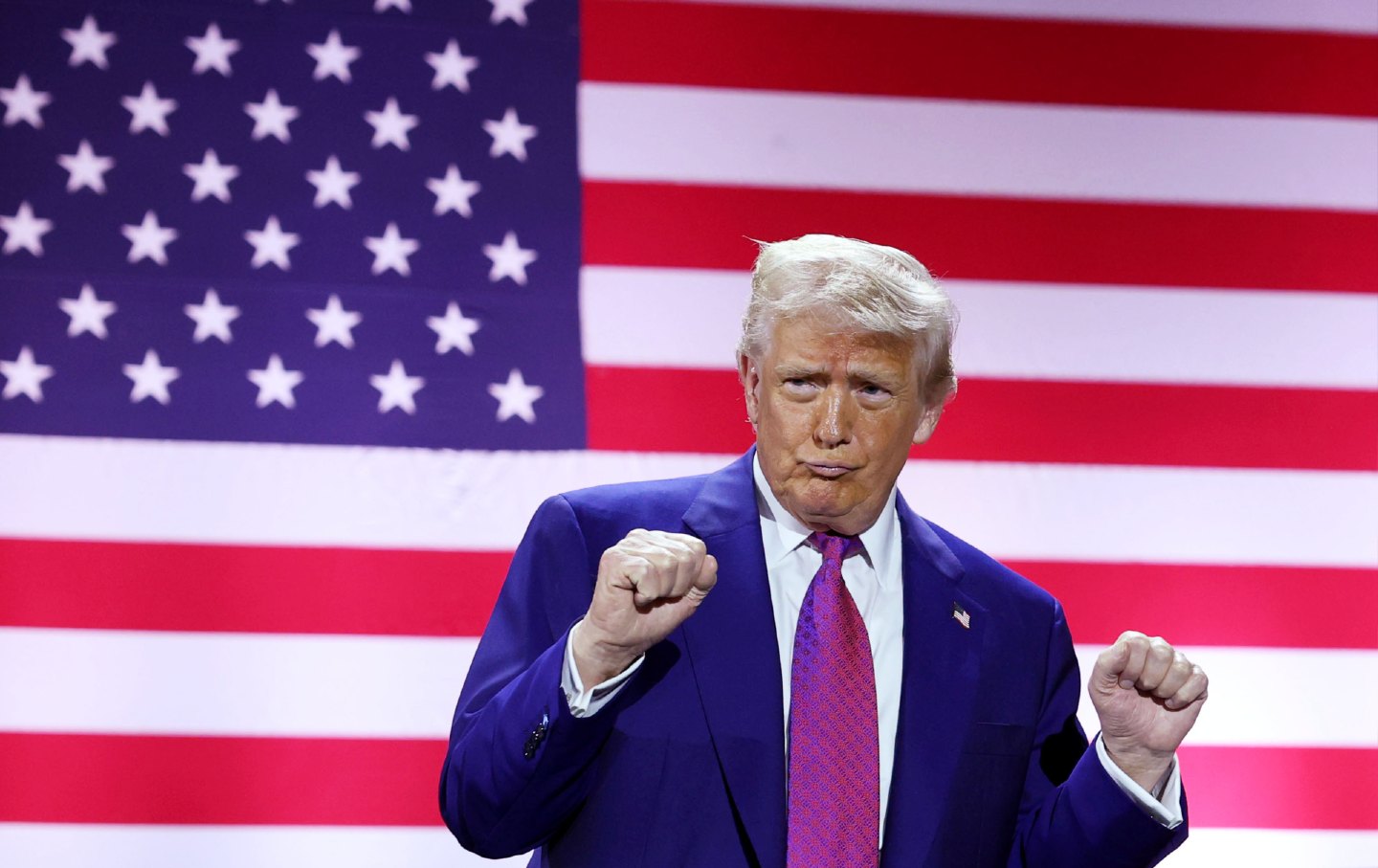
While the source of this campaign of intimidation remains as yet unsolved, it occurred during a time when President Donald Trump and his administration are increasingly inciting political anger against the judiciary—and MAGA followers are responding. With Congress under the control of Republicans and the leadership of the Democratic Party offering barely any opposition, the judiciary has become the main bastion of institutional restraint on the Trump administration. Federal judges have ruled against a raft of Trump initiatives, ranging from the deportation of immigrants without due process to the politically motivated punishment of Harvard University.
Responding to these setbacks, the Trump administration has attacked the judiciary with increasingly strident rhetoric. Trump and his close adviser Elon Musk have both called for recalcitrant judges to be impeached, while Vice President JD Vance characterized adverse decisions as “illegal.” Justifying the arrest of federal judge Hannah Dugan, Attorney General Pam Bondi told Fox News, “The [judges] are deranged is all I can think of. I think some of these judges think that they are beyond and above the law. They are not, and we are sending a very strong message today. If you are harboring a fugitive, we will come after you and we will prosecute you. We will find you.”
On Saturday, The Wall Street Journal reported that judges are not just worried that this inflammatory rhetoric is fueling the increasing number of threats they receive; they also worry that the White House might use its control of federal law enforcement to curtail needed protection. The Supreme Court is protected by a special police force, but federal judges as a whole are under the watch of the US Marshals Service, which answers to Bondi and ultimately to Trump.
According to the Journal:
Amid rising tensions between the Trump administration and the judiciary, some federal judges are beginning to discuss the idea of managing their own armed security force.
The notion came up in a series of closed-door meetings in early March, when a group of roughly 50 judges met in Washington for a semiannual meeting of the Judicial Conference, a policymaking body for the federal judiciary. There, members of a security committee spoke about threats emerging as President Trump stepped up criticism of those who rule against his policies.
The judges are not being paranoid. The immediate problem may be that threats against judges are steeply rising, but the deeper problem is that Trump has a history of inciting political violence—and still works hard to legitimize it. Notoriously, Trump fanned the flames of the January 6 assault on the Capitol. More recently, he has granted clemency to more than 1,500 people who had been convicted of involvement with the January 6 attempted coup. The Trump White House has also greenlighted a settlement of $5 million to the family of Ashli Babbitt, a rioter killed by police on January 6. The Trump White House is also promising a “hard look” at the conviction of two men who plotted in 2020 to assassinate Michigan Governor Gretchen Whitmer. The meaning of these acts is obvious: If you commit political violence against the foes of Trump and the GOP, the president will have your back.
Trump is, in effect, creating a permission structure and legal system whereby right-wing violence has the special protection of the state.
In American constitutional theory, the judiciary, like Congress, has a duty to check presidential power. This theory always stumbles over the fundamental fact that the judiciary has no effective power to make policies and has to rely on the other branches of government to carry out its decisions. In 1832, the Supreme Court laid out the doctrine of tribal sovereignty for Indigenous people in the decision Worcester v. Georgia. President Andrew Jackson supposedly said, “John Marshall has made his decision; now let him enforce it!” While there is reason to doubt that Jackson was so blunt in his language, he did privately speculate about sabotaging the decision.
In his first term, Trump brought a painting of Jackson into the Oval Office as a way to claim affinity with an earlier anti-system politician who ran roughshod over norms. The open question is whether, if push comes to shove, Trump will make the apocryphal story of Jackson true. If the courts continue to strike down Trump’s executive actions, will Trump say, “Justice Roberts has made his decision, let him enforce it”? Going further, will Trump call on a MAGA mob to attack judges, saying, “The courts have made their decision. Let them defend it with their lives”?
The courts cannot defend themselves. Nor can they rely on the US Marshals Service to do the job, since this is a body controlled by Trump.
The only legal avenue for protecting the courts is the creation of a police force independent of the president. To his credit, New Jersey Senator Cory Booker has been forward-thinking on this issue. As The Wall Street Journal reports:
On Thursday, Democratic Sen. Cory Booker of New Jersey introduced legislation that would allow the Chief Justice and Judicial Conference to appoint the head of the Marshals, placing the courts in charge of their own security. In a statement, Booker said the legislation was necessary because Trump “has made it abundantly clear through his words and actions that he does not respect the law, court orders, the safety of our judges, or our institutions.”
The Marshals’ “dual accountability to the executive branch and the judicial branch paves the way toward a constitutional crisis,” Booker said.
Going beyond Booker’s admirable efforts, Democrats as a whole need to make Trump’s threats to the courts a major political issue. One strong argument to make in the 2026 midterms is that Congress under the Republicans will not protect judges, but Democrats will. After Kamala Harris’s loss in 2024, Democrats have been reluctant to make Trump’s authoritarianism a major political topic. This is shortsighted. The pro-democracy pitch of 2024 failed because it was too abstract and also combined with a weakening commitment by the party to economic populism. But in previous elections, notably the 2018 midterms and 2020 presidential election, the pro-democracy message (combined with a strong economic message) won. There’s every reason to think that voters—particularly the politically motivated ones who show up for midterms—are frightened by Trump’s authoritarianism. Defending the courts is a winning issue if Democrats have the courage to use it. With judges showing bravery in the face of Trump’s threats, the opposition party needs to find some courage of its own.
Disobey authoritarians, support The Nation
Over the past year you’ve read Nation writers like Elie Mystal, Kaveh Akbar, John Nichols, Joan Walsh, Bryce Covert, Dave Zirin, Jeet Heer, Michael T. Klare, Katha Pollitt, Amy Littlefield, Gregg Gonsalves, and Sasha Abramsky take on the Trump family’s corruption, set the record straight about Robert F. Kennedy Jr.’s catastrophic Make America Healthy Again movement, survey the fallout and human cost of the DOGE wrecking ball, anticipate the Supreme Court’s dangerous antidemocratic rulings, and amplify successful tactics of resistance on the streets and in Congress.
We publish these stories because when members of our communities are being abducted, household debt is climbing, and AI data centers are causing water and electricity shortages, we have a duty as journalists to do all we can to inform the public.
In 2026, our aim is to do more than ever before—but we need your support to make that happen.
Through December 31, a generous donor will match all donations up to $75,000. That means that your contribution will be doubled, dollar for dollar. If we hit the full match, we’ll be starting 2026 with $150,000 to invest in the stories that impact real people’s lives—the kinds of stories that billionaire-owned, corporate-backed outlets aren’t covering.
With your support, our team will publish major stories that the president and his allies won’t want you to read. We’ll cover the emerging military-tech industrial complex and matters of war, peace, and surveillance, as well as the affordability crisis, hunger, housing, healthcare, the environment, attacks on reproductive rights, and much more. At the same time, we’ll imagine alternatives to Trumpian rule and uplift efforts to create a better world, here and now.
While your gift has twice the impact, I’m asking you to support The Nation with a donation today. You’ll empower the journalists, editors, and fact-checkers best equipped to hold this authoritarian administration to account.
I hope you won’t miss this moment—donate to The Nation today.
Onward,
Katrina vanden Heuvel
Editor and publisher, The Nation