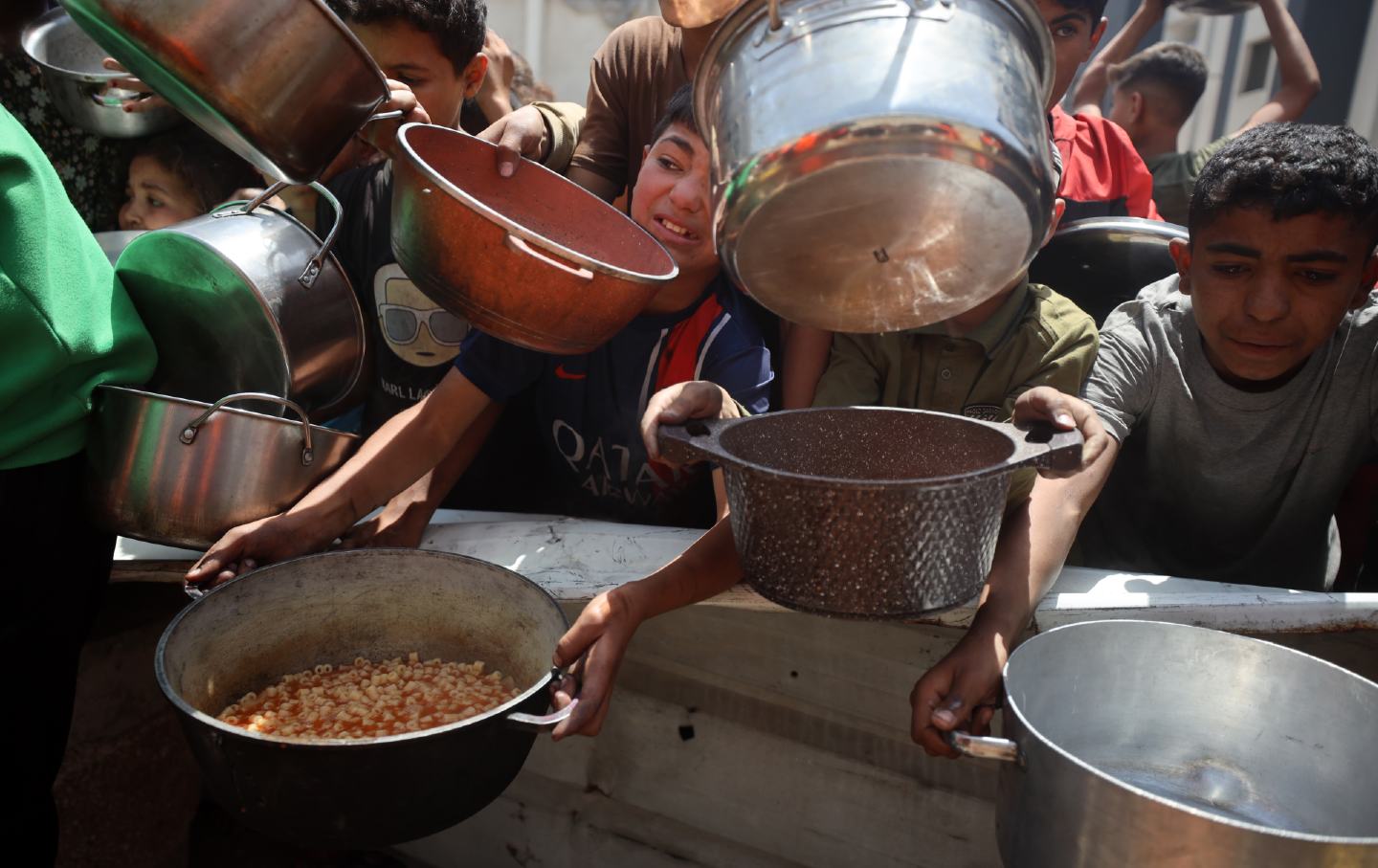
Children line up for a hot meal at a charity kitchen in Gaza City, on May 3, 2025.
(Majdi Fathi / NurPhoto via Getty Images)
A year ago, I was living the same nightmare that 2.2 million people in Gaza are currently living: constant exhaustion, dehydration, rapid weight loss.
It had been months since Israel had allowed any food, water, medicine, or gas to enter Gaza, and we were all slowly starving. I remember the way hunger settled into my body—not just as pain, but as a kind of silence. My head throbbed constantly. When I stood up, the room spun. My mouth tasted like metal. My limbs felt heavy, like I was wading through water. I stopped feeling hunger as a craving; it became something else—a slow shutting down.
I still remember when my parents, my then-2-and-a-half-year-old, and I were diagnosed with malnutrition. While I was the worst off, nothing hurt more than watching my own child and parents fade before my eyes. Watching them go hungry and knowing I had nothing to offer was its own suffering.
Every day, I would look at my son’s face and wonder if I would ever be able to fill his plate or cup again. Would there ever be a night when he didn’t cry himself to sleep from hunger? A morning when he woke without that hollow look in his eyes? I did what I could to keep him smiling and slip a little light into his day. Even when joy felt like a lie and safety was just a word we’d long forgotten the meaning of.
Now, I watch my friends, family, and colleagues suffer that same slow collapse, knowing exactly what it means and being unable to stop it.
On March 2, Israel once again tightened its stranglehold on the Strip, systematically blocking the flow of food, water, and medical aid. According to UN reports, only a trickle of humanitarian convoys have been allowed in—far below what is needed to stave off mass starvation. The World Food Programme warns that 93 percent of Gaza’s population now faces crisis-level hunger, with famine already taking hold in the north.
Every day begins the same in Gaza right now: with the attempt to make it to the next. People walk through streets of rubble looking for food, wood, or anything to keep their families alive. There’s no gas, no electricity, and barely any water. Wheat is gone. People crush animal-feed barley and corn into flour. Even that is hard to find.
Cooking gas ran out long ago; now people dig through the ruins for wood—old doors, broken furniture, anything that will burn. Fires burn in alleys, leaving a smell on everything: hair, skin, clothes. The sharp, sour smell of burning plastic and garbage fills the air. It never leaves you.
Aseel Afana, a mother in Jabalia, looks at her daughter’s face every day and feels the crushing pain of being unable to get her enough food or powdered milk. “Almost every night, Sila, who is only 14 months old, cries from hunger,” said Aseel, who can’t remember the last day her daughter felt full. “I try to keep her happy and maybe make her smile,” she added, “even though none of us has a reason to smile right now.”
Aseel’s voice shook as she described trying to keep her little daughter safe—even though, she noted, there’s no such thing as safety in Gaza. “I feel weak, helpless, naïve. And the world is watching us die. That’s the only conclusion we can reach—that our lives just don’t matter much.”
Amid this growing desperation, reports emerged over the weekend that the United States and Hamas are engaged in negotiations over a possible ceasefire and the urgent entry of humanitarian aid. A senior Palestinian official confirmed the talks, underscoring the critical need to ease conditions for the more than 2 million people facing severe hunger, dehydration, and medical shortages under Israel’s ongoing siege. As part of the negotiations, Hamas has agreed to release Edan Alexander, a 21-year-old Israeli-American soldier captive in Gaza. Donald Trump announced Alexander’s expected release, calling it a significant step toward both securing a ceasefire and unlocking aid access into Gaza.
If the reports are true, and if aid begins to flow again, it will come not a moment too soon.
When food is blocked at the border, when aid trucks are stalled, when bakeries are bombed and farmland flattened, it is no longer about denying supplies. It is about denying life. And that is why the world must understand: this is not a famine of nature—it is a famine by design.
Truckloads of aid sit idle at the border, turned away or delayed for weeks by Israeli decisions, while inside Gaza, parents grind animal feed into flour and children scavenge for scraps in the rubble.
The market barely holds together. There’s a very limited number of vendors behind makeshift tables, selling scraps: a bit of rice here, a bag of flour there. A few days ago, a friend of mine saw a starving woman walk up and hand over a gold bracelet, probably a wedding gift, asking quietly for a bag of flour. The seller glanced at her, then looked up at the sky, as if he was wondering how much longer any of them have.
And everywhere, the same soft, worn-out questions pass from mouth to mouth: Where can I find bread? Where can we get water?
In Gaza, more than 3,500 children under the age of 5 are now staring down death by starvation, Gaza’s Government Media Office warns. Another 70,000 children lie in hospital beds, their small bodies wasted by severe malnutrition.
I spoke with Abdelhakim Aburiash, a journalist reporting from northern Gaza, who hasn’t had food or clean water for days. “I can’t explain the pain in my stomach, in my bones, in my head,” he said. “I feel I can’t go on. But I have to go on.” His body is breaking, but he refuses to stop speaking. Abdlehakim has lost over 15 kilograms of weight—around 33 pounds—in two months.
Across Gaza, famine isn’t just in the empty kitchens. It’s in thinning arms, swollen bellies, and sunken cheeks everywhere. People walk doubled over from cramps. Children’s skin cracks from dehydration. Eyes lose their light. And above it all: the constant hum of drones, the sharp crack of artillery, the scream of jets.
I have known hunger—the gnawing emptiness, the dizziness, the body’s quiet ache. But what I witness now in Gaza is not hunger. It is starvation. Hunger is a feeling. Starvation is a weapon. Hunger makes you weak. Starvation is used to break you.
We are watching a people, my people, starved in real time.
I remember the small, desperate tricks of hunger: breaking bread into tiny pieces to fool the mind. Drinking salty water just to feel something in the mouth. Splitting one egg three ways. Learning not to ask, “What’s for dinner?” because it’s a cruel joke.
We are not telling this story to make the world feel sorry. We are telling it because we are either already dead or dying slowly. And we are asking those who still have power, those with voices that can be heard beyond this slaughterhouse, to know: that we are being starved. We are sleeping on the streets without shelter. We are scraping at the bottom of life itself, and when we lift our heads, we see a world that has decided we can disappear.
There is a grief here that words can’t carry.
Even from afar, the ache of Gaza lives in my body. I know the hollow look in my friends’ eyes on the screen, the thinness of their voices when they manage to get a message through. I know what it means when they say they are “OK”—that they haven’t eaten in days, that they are rationing water by the capful, that they are burying neighbors and praying they are not next.
It is a particular kind of torment to watch the people you love endure a struggle you know too well —to recognize every pause, every forced smile, every silence on the line as a mark of exhaustion and loss. To scroll endlessly through updates, voice notes, and photos of rubble and ash, knowing that no call, no message, no post will fill an empty plate or quiet a child’s hunger.
Popular
“swipe left below to view more authors”Swipe →The helplessness is a weight I carry across every hour. Because when you have survived starvation, you understand that what they are living now is not just a crisis—it’s a slow, deliberate crushing of life. And from here, all I can do is bear witness and refuse to let the world look away.
This is what I want people to understand: In Gaza, right now, parents are fainting while waiting in bread lines, children are collapsing from dehydration, and infants are dying for lack of formula. Inside overcrowded shelters, mothers are rationing pieces of bread among several children, while fathers scrape the bottoms of pots for leftover grains.
Doctors on the ground report an alarming rise in cases of severe acute malnutrition, describing babies with loose skin over bone, their bodies too weak to cry. Markets have been emptied of food, residents say, and many are resorting to trading scraps of wood or metal in desperate attempts to obtain anything edible.
At water distribution points, lines often form before dawn, with children standing barefoot for hours clutching empty jugs in the hope of filling them from damaged taps.
Parents, residents report, are routinely skipping meals—not by choice but because there is nothing left to eat. Some have been forced to feed babies sugar mixed into water, when water can be found at all. Children, once seen playing in the streets, now scavenge through rubble for scraps of food.
Hospitals in Gaza are overwhelmed, with doctors warning that hunger is killing people even before the bombs return. Morgues are at capacity, and aid trucks remain stalled at border crossings, leaving an already dire humanitarian crisis on the brink of catastrophe.
This is no longer just a living city but a place being starved to death in plain sight without immediate and massive intervention. The world is watching a man-made famine. It is looking on as an entire population is being pushed past the edge of survival—and it is doing nothing.
More from The Nation

The Specter of Lepenism Looms Over France’s Social Crisis The Specter of Lepenism Looms Over France’s Social Crisis
Joining forces with the “yellow vests,” youth demonstrators are raising the alarm in a country falling to the far right.
Progressives Are Backing Puerto Rican Independence. It’s About Time. Progressives Are Backing Puerto Rican Independence. It’s About Time.
More and more leftists are concluding that statehood for the island is not enough.
The Saudi Phase of the Iran War Signals More Chaos to Come The Saudi Phase of the Iran War Signals More Chaos to Come
The conflict that Donald Trump has repeatedly proclaimed an unequivocal American victory keeps spiraling out of control.
Andy Burnham’s Speech to the Labour Party Conference Could Be the Start of a Positive Social-Democratic Politics Andy Burnham’s Speech to the Labour Party Conference Could Be the Start of a Positive Social-Democratic Politics
But the autumn budget to be released at the end of October will offer needed details.
Why Navi Pillay’s Receiving the Nobel Peace Prize Is So Important Why Navi Pillay’s Receiving the Nobel Peace Prize Is So Important
She believes that human rights and international law are universal principles that must be enforced regardless of violator’s ideology, ethnicity, or geostrategic alignment.