
Viktor Orbán’s Europe-Wide Manhunt of Antifascist Activists
Budapest has been repeatedly condemned for the erosion of its justice system. Will Europe’s courts still greenlight Budapest’s punitive search for leftists?
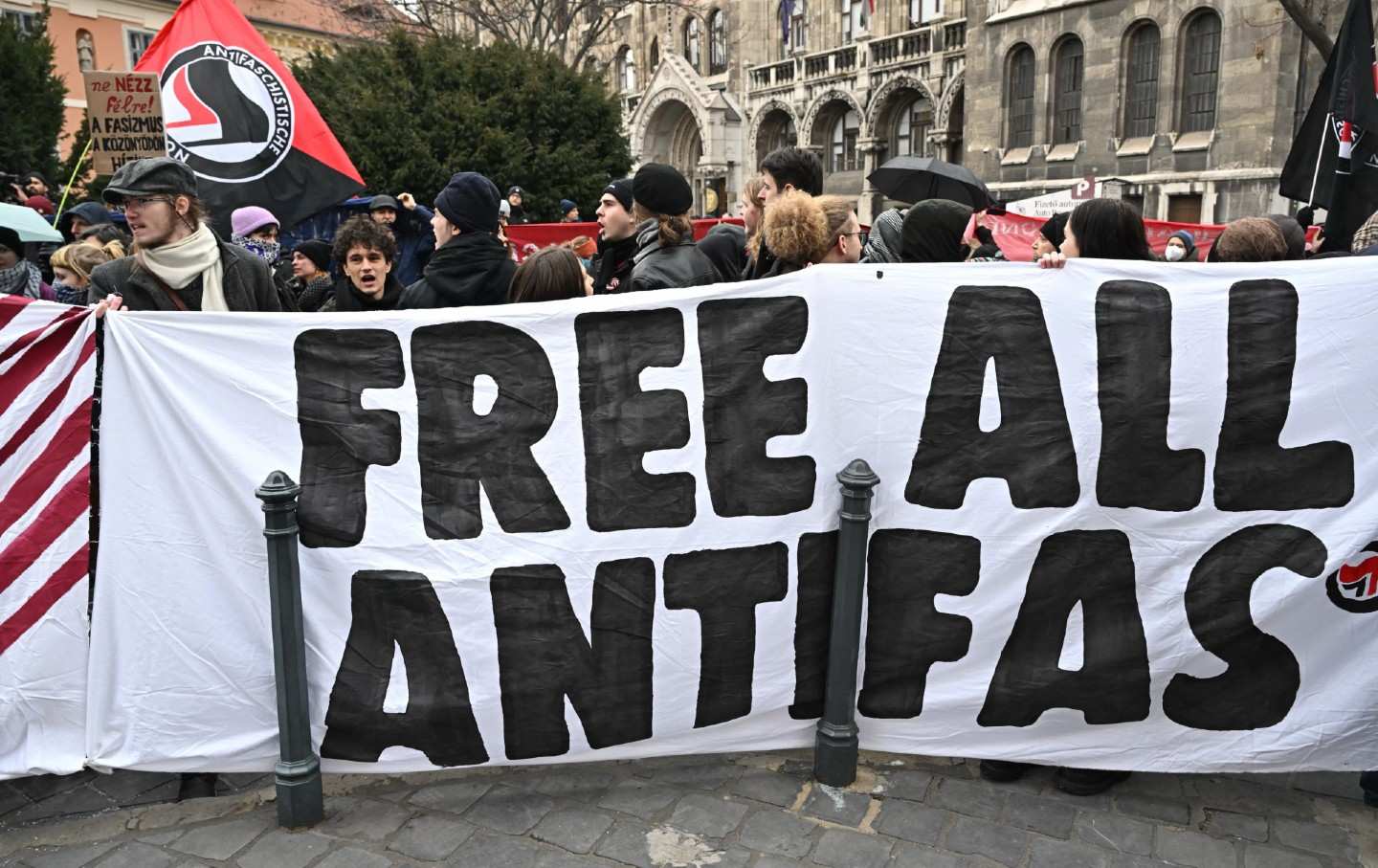
On February 11, 2023, neo-Nazis from across Europe descended on Budapest for the “Day of Honor” rally. The event commemorates an unusual set of martyrs: the German army and collaborationist Magyar fascists, defeated by the advancing Red Army during the siege of Budapest in the closing months of the Second World War. Thanks to the safe harbor provided by the authoritarian government of Hungarian Prime Minister Viktor Orbán, it has become an annual gathering. Hosted this past February 8, the 2025 edition again attracted some 4,000 sympathizers.
The 2023 Day of Honor has had a particularly long afterlife, however. That year’s rally saw violent clashes between neo-Nazis and antifa activists—a not-uncommon occurrence anywhere the extreme right takes to the streets. Left-wingers were also drawn to Budapest, coming to voice their opposition to yet another celebration of neo-Nazism in the heart of the Hungarian capital.
Under Orbán’s premiership, Budapest has become an epicenter of the European Union’s shift to the far right. After a first stint in office in the late 1990s and early 2000s as a leading figure of Hungary’s post-Communist political class, Orbán returned to power in 2010. He has since moved to tighten his grip over Hungarian society, concentrating media power among friends and attacking civil society and checks from the country’s judiciary.
The force of Orbán’s state apparatus has been on full display in its attempt to punish the 2023 counterdemonstrators. Hungarian authorities are now waging a concerted campaign to round up and seek punitive sentences against antifa activists, whom they accuse of violently assaulting Day of Honor attendees and inflicting what Budapest calls “life-threatening injuries” on the presumed neo-Nazis.
In the last two years, that campaign has even taken on the scale of a Europe-wide manhunt, as Budapest tries to use the EU’s internal extradition protocols to round up left-wingers in other countries of the bloc. In total, Orbán’s government has sought the arrest or extradition of over a dozen activists.
One such man is Rexhino Abajaz, more commonly known as Gino. Of Albanian nationality, the 32-year-old Gino has spent much of his life living in the European Union, predominantly in Italy and Finland.
Last November, Gino was arrested in the Paris suburb of Montreuil, by officers of the French police’s crack anti-terrorism unit. Gino’s arrest followed the French government’s reception from Budapest of a European Arrest Warrant, demanding that Gino be handed over to Hungarian authorities to stand trial for assault charges.
Deemed a flight risk, he was held for four months at the Fresnes prison south of Paris, although on March 26 Gino’s legal counsel won his release for the remaining duration of the trial. Gino had previously fled Finland for France when judges in the Scandinavian country moved towards his transfer to Hungary.
If a French court now authorizes Gino’s extradition, he will face a steep legal battle back in Hungary, where Orbán’s 15 years in power have twisted the country’s justice system to the whims of his government, whittling away at the basic norms and rights of criminal procedure. The sentence that Gino might face in the event of a guilty verdict could have him incurring as many 16 years in prison. Given the show trial–like nature of the Day of Honor cases that have already made it to Hungarian court, Gino’s supporters fear that that kind of sentencing may be a fait accompli if he’s handed over.
“The charges being leveled against antifa activists and the possible sentences against them are totally disproportionate,” Quentin, a representative of Gino’s solidarity committee, told reporters at a press conference in February. “Handing an antifascist activist over to Hungarian authorities would symbolize France’s willful collaboration with a regime that does not respect basic rights.” Gino’s allies are demanding his release and protection in France.
Gino is only one target in Budapest’s broader search of activists with alleged connections to the 2023 counterprotests. Hungary has sought the arrest of at least 13 individuals in total, including from leading European member states such as France, Italy, and Germany.
Ilaria Salis was arguably the first person to be caught up in the Hungarian government’s roundup. An Italian teacher and activist, she was arrested in the Hungarian capital after the 2023 counterprotest, hauled from a taxi by police in the center of Budapest. An initial search of the belongings on Salis’s person found nothing of potentially illegal or violent use. But in a second search, investigating officers produced a nightstick-like rod, which Salis claims had been placed there by authorities interested in building a case against her—and feeding the narrative of violent leftists bent on bringing chaos to the streets of Budapest.
“If Gino is extradited to Hungary, he will be put in the most inhumane detention conditions and would not receive a fair trial,” Salis, who attended a March 12 hearing in Paris over Gino’s case, told The Nation. “I know this because of what I went through: in Hungary, antifascists can expect nothing even close to fair treatment.”
Salis’s February 2023 arrest was the beginning of over 14 months of abuse in Hungarian prison and in the hands of the country’s ersatz justice system. She was repeatedly interrogated without an attorney or translator. Spending upwards of a month in solitary confinement, she was barred from any contact with friends and family back home for months on end and forced to sleep in a bug-ridden cell. Her legal team was repeatedly denied access to the case file, while government officials spoke publicly of her as already guilty. During court hearings, neo-Nazi activists in paramilitary garb intimidated people in the audience suspected of attending out of solidarity with the defendant.
Salis’s draconian treatment made her into a cause célèbre on the Italian left, however. The shock back in Italy eventually led to her selection—from jail—as a candidate for the June 2024 elections to the European Parliament under the country’s Green and Left alliance. After repeated prior requests, she was finally granted house arrest in May 2024 for the remainder of her trial, which was suspended because of her electoral victory and newfound immunity as a member of the EU parliament.
Orbán’s allies in the EU are currently brokering to unwind that reprieve, however, seeking a repeal of Salis’s immunity in Strasbourg. A closed-door vote on her status is expected in the coming weeks.
European governments have largely balked on intervening to prevent Orbán’s politically motivated roundup of leftist activists. As some speculate, that may in part be because of the fear of exacerbating the divisions that might arise from another spat with Budapest. Orbán has already been a thorn in the side for many of the EU’s key players and power brokers, whether for his opposition to European consensus on opposing Russia’s invasion of Ukraine or his open embrace of Donald Trump.
In any case, refusal to block these pursuits comes despite the by-now countless warnings and condemnations leveled against Hungary over Orbán’s attacks on the rule of law.
But the cruel irony now is that Orbán’s government is conducting its punitive roundup in apparent accordance with EU norms and procedure.
When the European Arrest Warrant was first introduced in the early 2000s, it was part of the march toward rationalization and simplification at the core of the European project. Here was a tool to harmonize the work of the justice systems in EU member states, streamlining the transferring across the bloc’s internal borders of individuals wanted for a crime. By facilitating what became known as “judicial surrender,” the EAW replaced what jurists now call “classical extradition,” which required the greenlighting from political authorities in foreign affairs and justice ministries.
Popular
“swipe left below to view more authors”Swipe →The goal was to create a “dialogue between judges,” says Hélène Christodoulou, a legal scholar and expert on the EAW at the University of Toulouse. Judicial authorities in one state submit an EAW to be acted on by their counterparts in a second country, thereby removing extradition from the purview of political officials. “Mutual confidence is the foundation of the system. The idea is that in the European Union we all have the same fundamental rights.”
That vision had a lot going for it in the early years of the European Union, when common sense assumed that history pointed toward the extension of liberal legal institutions and practices. But with the rise of the far right across the continent—a trend of which Hungary is perhaps the leading example—those assumptions are coming under strain.
According to Gino’s defense attorneys, there is ample legal ground for a French judge to block his handover to Hungary. For example, a 2016 ruling by the Court of Justice of the European Union (CJEU) stipulates that the execution of an EAW is conditioned on the assurance that the extradited individual would benefit from the full protection of their fundamental rights. Moreover, a bevy of European statutes and conventions set official standards for detention and incarceration—many of which have been violated in Hungarian jails, including by the individuals already caught up in Budapest’s Day of Honor roundup. French law likewise holds that an individual cannot be extradited for political reasons, something that could be said to not apply here given that the execution of an EAW is technically not extradition.
“The CJEU makes it very clear that you cannot send someone to a country where they will face a risk of degrading and inhumane treatment, or where there’s reliably objective evidence that they’re at risk of undergoing an unfair trail,” Youri Krassoulia, one of Gino’s attorneys, told The Nation.
Elsewhere in Europe, the battles over the extraditions have yielded mixed results. The EAW for the arrest of Gabriele Marchesi, an Italian man in his early 20s, was blocked by a court in Milan in 2024. But as with all Orbán’s targets, observers point out that nothing specifically prevents Budapest from issuing another warrant should Marchese travel from Italy to another EU country.
Another EAW ended with a victory for Hungary, although critics are calling foul. Maja T., a gender-nonbinary activist from Germany, was also sought by Hungarian authorities for their participation in the Day of Honor counterdemonstration. Following a German court’s greenlight for Maja’s extradition, they were handed over to Hungarian officials last summer. Maja’s extradition was contravened by the Germany’s Federal Constitutional Court, however, which sanctioned the lower court that authorized their surrender to Hungary, ruling that the risks to Maja’s rights were not taken into sufficient consideration.
By then it was too late: On February 21, Maja appeared in chains before a court in Budapest. “I stand accused by a European state because I am an antifascist,” they said from the bar.
In mid-January, the French appellate court charged with validating Gino’s handover to Hungarian authorities acceded to the demands from the defendant’s attorneys for supplementary information concerning the conditions of his potential detention and trial. Those alleged guarantees were the object of briefs submitted by Hungary and were debated on March 12.
Yet Gino’s attorneys are far from satisfied by Budapest’s assurances, which they decry as “lacunary” and “incomplete” in the court filing submitted prior to the March 12 hearing, and which The Nation was able to consult. “Given the proof of governmental sway over the judiciary in Hungary, there is a credible risk that judges will be used by the executive to intimidate opponents by bringing legal proceedings against them, not on the basis of the evidence of their involvement in any offence, but solely on the grounds of their real or supposed political opinions,” Gino’s attorneys write.
That the French judges sought supplementary information is a signal that there is doubt as to the legal grounding of Hungary’s demands. Gino’s attorneys likewise see hope in the French judge’s March 12 order to reconsider the terms of their client’s temporary detention. A March 26 hearing will debate Gino’s possible release to house arrest for the rest of the trial, with a verdict on his case expected this April.
Become a Sustaining Donor This September
Between the reemergence of right-wing red-baiting and Donald Trump’s use of the chilling National Security Presidential Memorandum–7 to criminalize left political organizing, we’re seeing McCarthyism reborn before our eyes.
This assault on democracy cannot be ignored or wished away. Resisting it requires bravery in the face of threats and repression, a steadfast commitment to the truth, and the unwavering belief that we can—and will—overcome this darkness.
We must have an independent media that sets the record straight, unearths corruption and abuses of power, and advances a politics of justice and dignity for all if we’re to win this fight.
That’s why I’m writing to you today. This September, The Nation needs to add 100 monthly donors to sustain our progressive journalism. Your contribution makes the next investigative report, the next truth-speaking column, and the next pathbreaking essay all possible.
I hope you’ll support our work with a recurring donation today. If you donate $10 or more a month, we’ll send you a brand new “Hands Off the Free Press!” sticker to recognise your commitment to our cause. Please, donate today.
Onward,
Katrina vanden Heuvel
Editor and Publisher, The Nation
More from The Nation

Pinochet: The Verdict of History in the Letelier-Moffitt Case Pinochet: The Verdict of History in the Letelier-Moffitt Case
An act of international terrorism on the streets of Washington, DC, still reverberates 50 years later.

How to Arrest Benjamin Netanyahu How to Arrest Benjamin Netanyahu
Make no mistake: The United States can seize Netanyahu for crimes under US law and prosecute him in US courts when he is in New York City this week.

In the Age of AI, Nuclear Weapons Abolition Is a Renewed Imperative In the Age of AI, Nuclear Weapons Abolition Is a Renewed Imperative
As long as we have nuclear weapons, the job of ending humanity will continue to be as easy as the push of a button—or an AI agent hacking into a nuclear command-and-control system...

These Students Are Shaping UN Human Rights Policy These Students Are Shaping UN Human Rights Policy
Princeton undergraduates are helping the organization develop standards for post-mortem digital privacy and death in custody.

The Peril of Trump’s Final Act: Would He Use a Tactical Nuclear Weapon in Iran? The Peril of Trump’s Final Act: Would He Use a Tactical Nuclear Weapon in Iran?
Trump is trapped in a war that has already been lost, a reality that he will never allow himself to admit.

A Spreading War Rattles Global Energy Markets A Spreading War Rattles Global Energy Markets
Analysts say the consequences for energy prices and the world economy may be more serious in this later phase of a war that many had expected to be largely over by now.

