When Russia Massacred Ukrainian Prisoners of War
In 2022, an explosion at a Russian penal colony killed dozens of surrendered Ukrainian soldiers. Families are still fighting for justice.
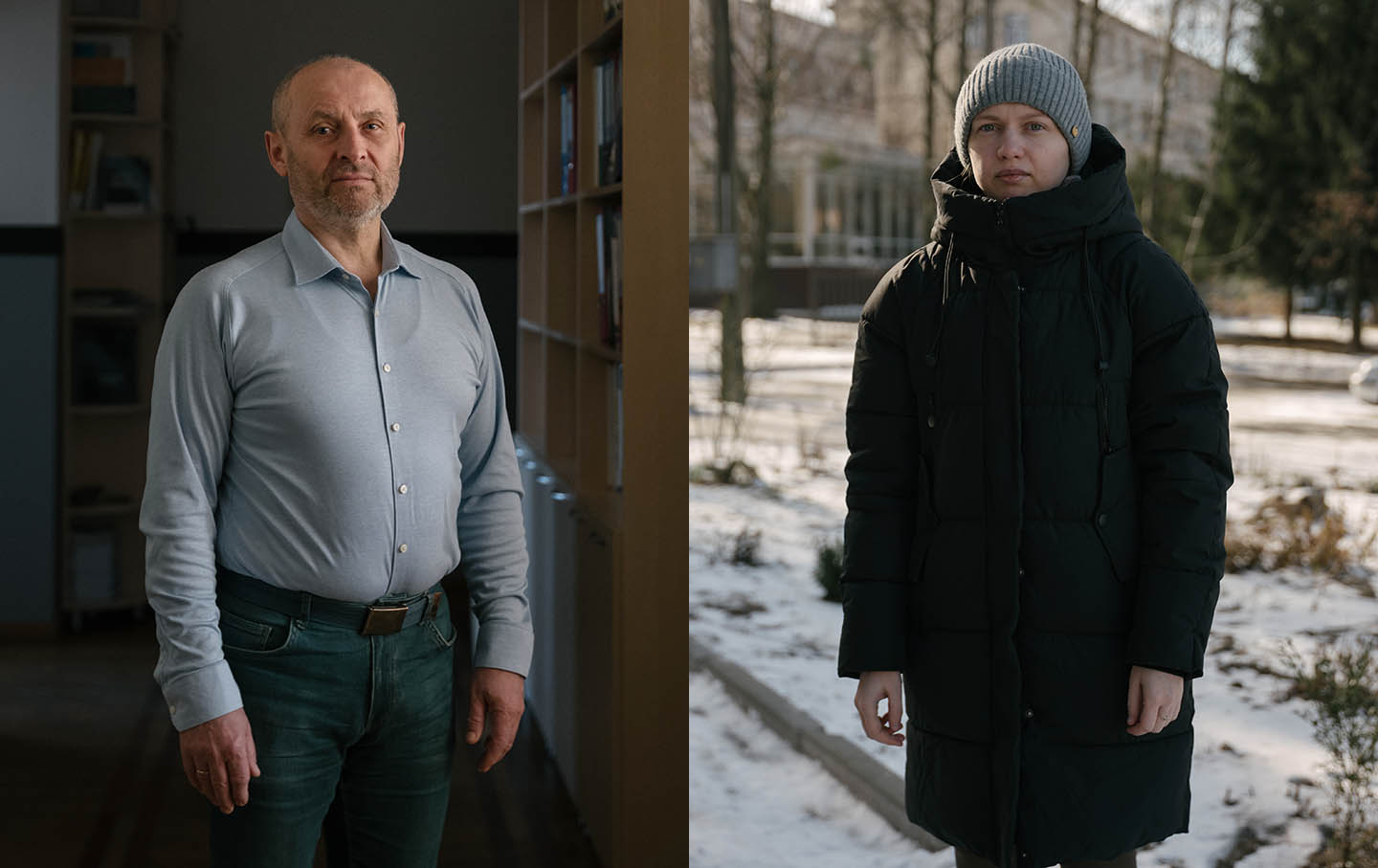
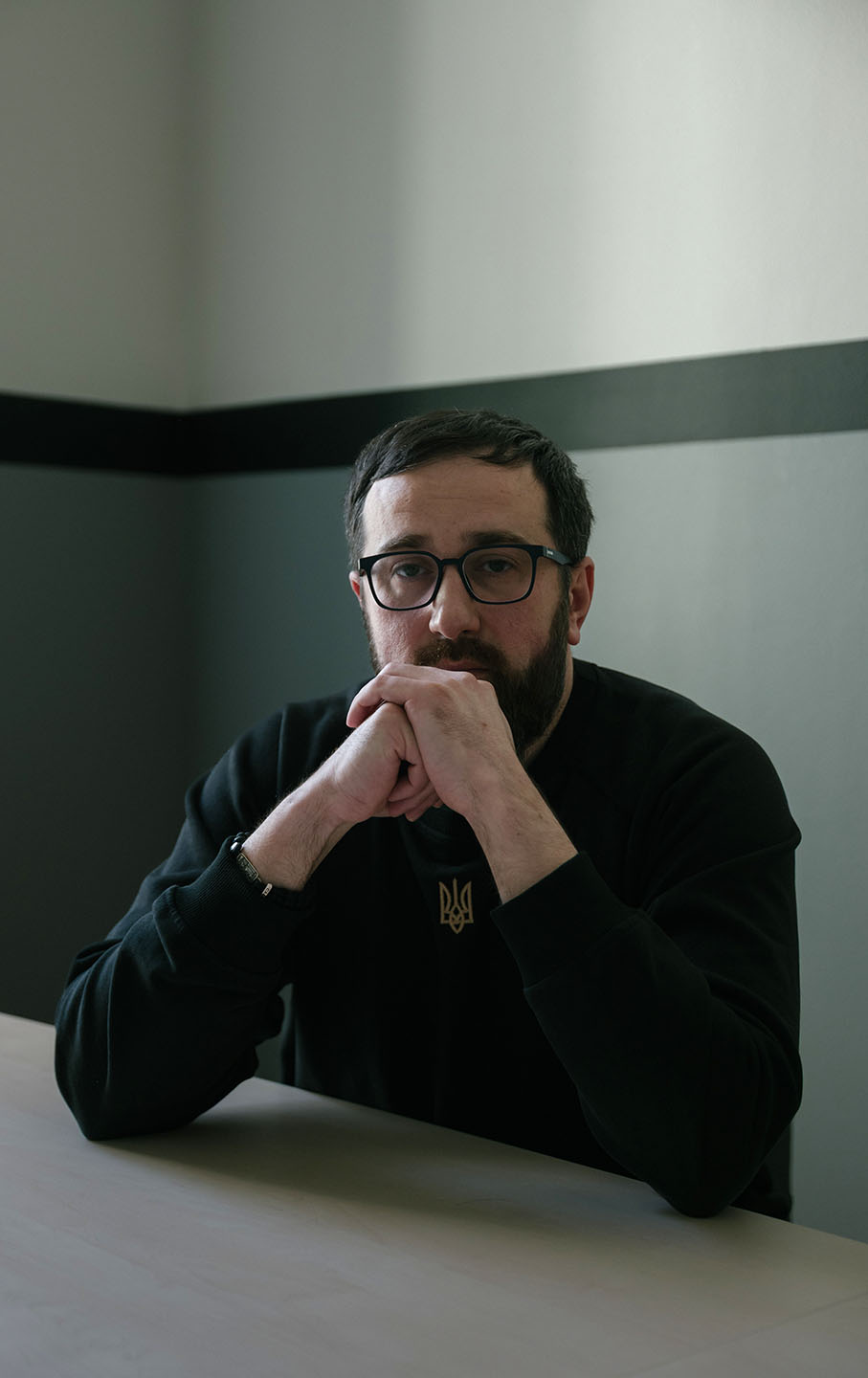
Roman Martynovskyy, left, attorney and legal expert at the Regional Center for Human Rights; Anna Lobova, right, whose husband remains in Russian captivity.
(Caroline Gutman)
Kyiv—Last summer, Anna Lobova got an unexpected call. Her husband, Oleh, a car mechanic who joined the military following Russia’s annexation of Crimea in 2014, had been part of the effort to defend Mariupol. Early in the 2022 invasion, Russian forces laid siege to the port city, situated on the Azov Sea. By controlling Mariupol, Russia would have a land route from Crimea to the remainder of the occupied Donetsk region.
As Russian forces obliterated the city—killing thousands of civilians—Ukrainian troops fortified a Soviet-era steel plant called Azovstal, where soldiers and civilians sheltered for 86 days. For 82 of those days, they were surrounded. On May 16, having run out of supplies, food, and medicine, Kyiv called on them to surrender. Oleh was among those taken into Russian captivity.
When the first wave of Azovstal prisoners were exchanged the following month, Lobova learned that her husband was being held at Volnovakha Correctional Colony No. 120, also known as Olenivka. He was alive. But on the night of July 28, an explosion destroyed part of the complex. At the time, Lobova was still living in the Russian-occupied Zaporizhzhia region and was reluctant to believe the reports by Russian news. But soon, she said, they began to show videos with remnants of the bodies, and she understood it was real.
The next day, Russia published lists naming those who were injured and those who were killed. Oleh’s name was on both. It wasn’t until August—when a video of hospitalized prisoners was released—that she learned that he had, in fact, survived. She saw his face, and sent a screenshot of it to several friends. “Am I sane?” she asked. “Is it him?”
But almost two more years would pass before she saw his face again, thanks to a brief, out-of-the-blue call facilitated by a Russian news site. The call was emotional; the connection, choppy. Lobova asked her husband if he wanted to see their daughter, Maria, who was weeks old when the war began. He said yes. But the girl, now a toddler, didn’t recognize her father and spent most of the call in tears.
Still, Lobova reassured her husband that no one had forgotten him, that their daughter bore a great resemblance to him, that everyone was well and waiting for his return. They hung up. She hasn’t seen or heard from him since.
On February 18, the same day that US Secretary of State Marco Rubio met his Russian counterpart Sergey Lavrov in Riyadh, Saudi Arabia, I met Lobova in Zhytomyr, a city two hours west of Kyiv, where she and her daughter now live. They left the Zaporizhzhia region in August 2022, when the route was still open, and lived briefly in Kyiv before deciding it was too dangerous. Until their phone call last summer, Oleh had no way of knowing if they were OK.
Lobova is petite and soft-spoken, but firm. “When defenders were leaving Azovstal, they were promised a certain order of exchange,” she told me via interpreter at a café near her home. People who were heavily injured were to be exchanged first. In the wake of the explosion, which killed an estimated 54 people and injured an estimated 139, she assumed those who survived, like her husband, would be exchanged next. Oleh suffered a head injury, bodily wounds, and lost the ability to use part of his hand, released POWs had told her. “But exchanges happened often,” Lobova said, and “injured people from Olenivka were not among them. So, I started to look for families of those who were also injured on my own.”
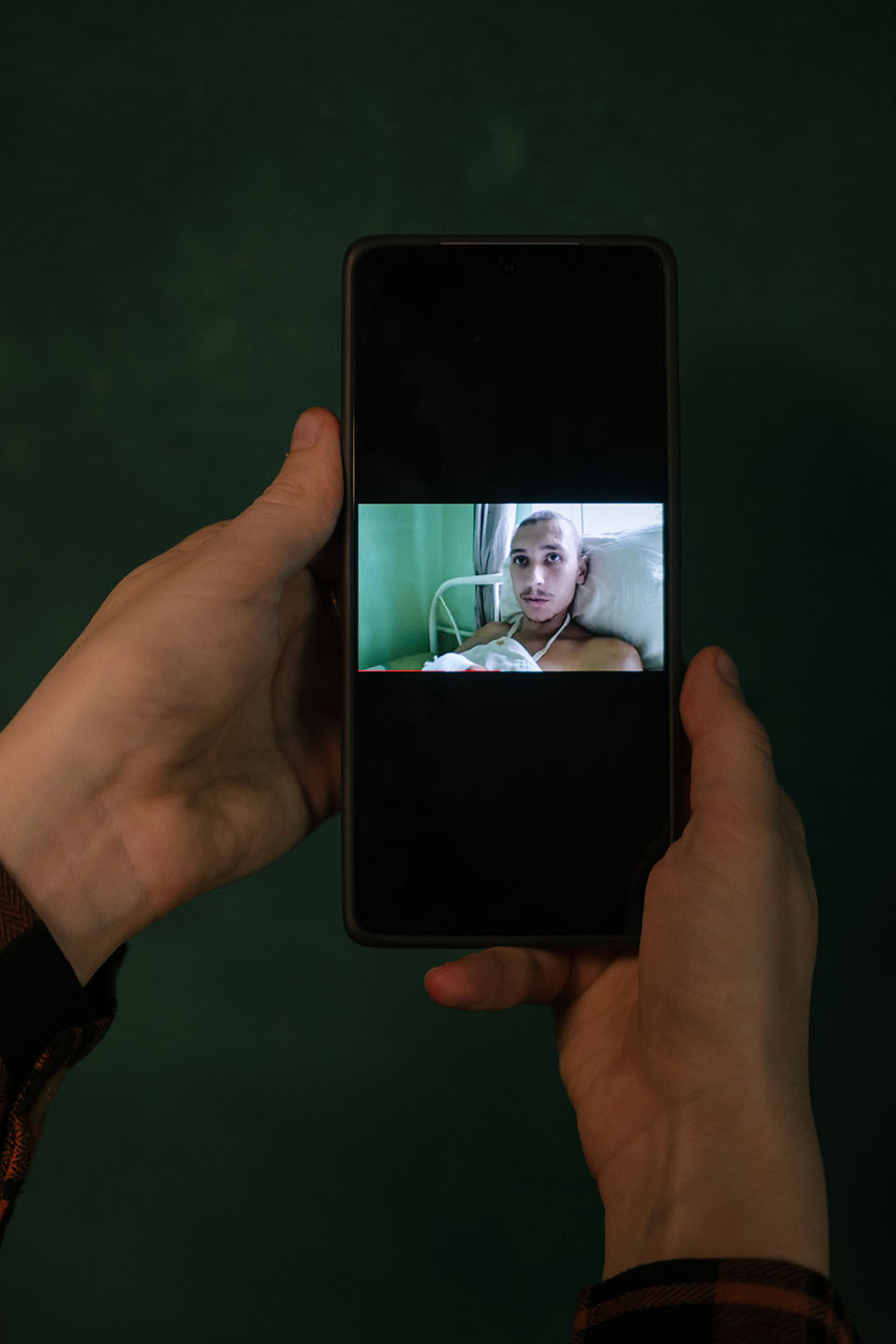
These efforts, among others, led to the creation of an NGO called Olenivka Community, which investigated the explosion and supports families affected by it. Oleksandra Mazur, whose partner died at Olenivka, founded the organization alongside Lobova and three others. The last time she saw her husband, Yaroslav Otrok, was in a video of their retreat from Azovstal. Initially, he was listed as injured. But Mazur later learned that he died from his wounds because he was not given medical care. “Our evidence shows [that the Russians] organized the attack, but also didn’t let those who could survive, survive,” she said.
Taras Semkiv, the deputy head of the Department for Combating Crimes Committed in the Context of Armed Conflict in the Office of the Prosecutor General, echoed the sentiment. “There was a medic among the prisoners, and he came out to the prison guard and said, ‘Those people are dying! They need to be helped!’ And the answer was, ‘Why do you need help? You are going to die here anyway. All of you,’” Semkiv said.
Ukraine has presented evidence that the explosion was no accident, and if Russia did kill these men, the massacre of surrendered soldiers is a war crime. On December 10, Olenivka Community was one of a handful of organizations that jointly submitted the Olenivka attack to the International Criminal Court. The Office of the Prosecutor General, meanwhile, has charged two men—one of whom was allegedly killed by a car bomb on December 9—for their roles at Olenivka, and expects to charge more. “From the day of the invasion, we’ve registered more than 160,000 war crimes,” Semkiv said. And Olenivka “was one of the worst.”
In January 2022, Mariupol was coated with snow. “It was really beautiful. Nobody knew what was to come,” recalled Anastasia Gondiul, who lived there before the invasion. By the time those at Azovstal surrendered, her husband, Artem, was already injured—his hip pierced by shrapnel.
Popular
“swipe left below to view more authors”Swipe →After the surrender, Russian forces loaded Azovstal defenders onto buses and took them to Olenivka, where they were held in 10 barracks across five buildings. Women and children were held in a facility across the way. Nearby was an industrial zone, separated by a chain-link fence. According to investigators, sometime in July, a large warehouse in the industrial zone was hastily made into another barracks. Bunkbeds were lined up, with little space between, while some heavy machinery remained.
On July 27, nearly 200 soldiers were transferred to the new barracks, which would come to be known as Barracks 200—a reference not to the headcount but to “Cargo 200,” Soviet military slang for the dead. According to surviving victims’ relatives, many thought they were being moved because they were about to be exchanged.
The first night, some soldiers found it too hot to sleep, Roman Martynovskyy, attorney and lead investigator for the Regional Center for Human Rights, told me from his office in Kyiv. So, they slept outside. The next night, prison guards wouldn’t let them.
The explosions came just before midnight. Russia alleges that Ukraine used a US HIMARS missile to kill its own, but the United Nations has ruled that out, determining that the projectile that caused the explosion traveled east to west. According to investigators, the back-to-back explosions were consistent with use of a thermobaric bomb. Many victims burned to death. Bunk beds melted into each other. Hot glass fell from the ceiling.
The soldiers that had been transferred to Barracks 200 had one thing in common: They were all members of the Azov regiment, a once-volunteer group that helped liberate Mariupol from Russian occupation in 2014. “When we hear Azovstal, Azov soldiers, that could be either people who served in the Azov regiment or people who were defending Mariupol but didn’t have anything to do with the Azov regiment. But this barrack was full of soldiers of Azov regiment only,” Martynovskyy explained.
Azov, which can refer to a broader movement or the specific regiment in question, used to make headlines for its neo-Nazi roots. The volunteer battalion’s early embrace of Nazi symbols and ideology has been well-documented in Western media, and its first commander allegedly said Ukraine was to “lead the white races of the world in a final crusade” against Jews. In 2017, Azov was barred from receiving US weapons—a ban reversed last year. In 2018, a street patrol formed by the Azov movement carried out pogroms against queer and Roma folks.
Russia has used Azov to paint Ukraine writ large as a Nazi stronghold—its explicit justification for the 2022 invasion—ignoring the fact that the country’s president is himself Jewish and that far-right groups have fared terribly at the polls. The month after the explosion at Olenivka, Russia designated Azov a terrorist group.
Many, Semkiv included, push back against allegations that Azov is teeming with neo-Nazis, dubbing them Russian propaganda. The brigade claims to have depoliticized itself since being formally integrated into the Ukrainian National Guard in the fall of 2014. But at the time of the siege on Mariupol, Azov remained helmed by group veterans with ultranationalist and white supremacist ties.
Regardless, a war crime is a war crime, and Putin’s war—rooted in imagined superiority and aimed at ethnic cleansing—is itself Nazi-esque. His violence, his fixation on Azov and the horrific nature of the attack on Olenivka have only served to buoy the sentiment that Azov members are patriots and heroes. “Free Azov” has become a rallying cry in Kyiv and beyond—one associated with support of Ukrainian POWs and general anti-Russian feelings. It can be seen spray-painted on walls, hanging in shop windows, scrawled on protest signs.
As political negotiations dominate headlines—and largely exclude Ukraine—the explosion at Olenivka and its aftermath offer a reminder of all that remains unresolved, of all the grief and hatred that will linger. Several victims’ wives described suffering panic attacks since hearing news of the explosion. Many are dealing with not just displacement but also the challenge of raising kids on their own.
Lobova said time moves differently when you’re waiting. She can only tell how much has passed when she sees how much her daughter has grown. “She doesn’t have the childhood that we wished for her,” she told me. Lobova dreams of not just reuniting with her husband but returning home. “Here we just exist,” she said. “Everything is foreign, even though it’s our country.”
Some, like Rusudana Pavlichenko, whose husband was killed instantly by the explosion, say going home would be too hard. She has been displaced to Cherkasy, about three hours from Kyiv. She buried her husband there and doesn’t want to leave him. Her daughter, who will soon be 12, dreams of growing up and joining Azov herself.
For others, like Gondiul, home is no more. “That was my life. My soul, my memories, my husband were [in Mariupol]” she said. “There is nothing that I can come back to because the city is smashed.”
Lobova is not optimistic that Russian-occupied territories—about 20 percent of Ukraine—will be returned. “There are people for whom it’s just a spot on the map, who decide the fate of us for whom it’s [our] whole life,” she said. “But I am ready to forget, as long as we save our people from captivity. People matter more.”
More than 900 Azvostal defenders remain in captivity.
Become a Sustaining Donor This September
Between the reemergence of right-wing red-baiting and Donald Trump’s use of the chilling National Security Presidential Memorandum–7 to criminalize left political organizing, we’re seeing McCarthyism reborn before our eyes.
This assault on democracy cannot be ignored or wished away. Resisting it requires bravery in the face of threats and repression, a steadfast commitment to the truth, and the unwavering belief that we can—and will—overcome this darkness.
We must have an independent media that sets the record straight, unearths corruption and abuses of power, and advances a politics of justice and dignity for all if we’re to win this fight.
That’s why I’m writing to you today. This September, The Nation needs to add 100 monthly donors to sustain our progressive journalism. Your contribution makes the next investigative report, the next truth-speaking column, and the next pathbreaking essay all possible.
I hope you’ll support our work with a recurring donation today. If you donate $10 or more a month, we’ll send you a brand new “Hands Off the Free Press!” sticker to recognise your commitment to our cause. Please, donate today.
Onward,
Katrina vanden Heuvel
Editor and Publisher, The Nation