The Most Important Thing You Need in Gaza Is a Backpack
Around the world, backpacks represent freedom. But here, they are what we use to carry what’s left of our lives.
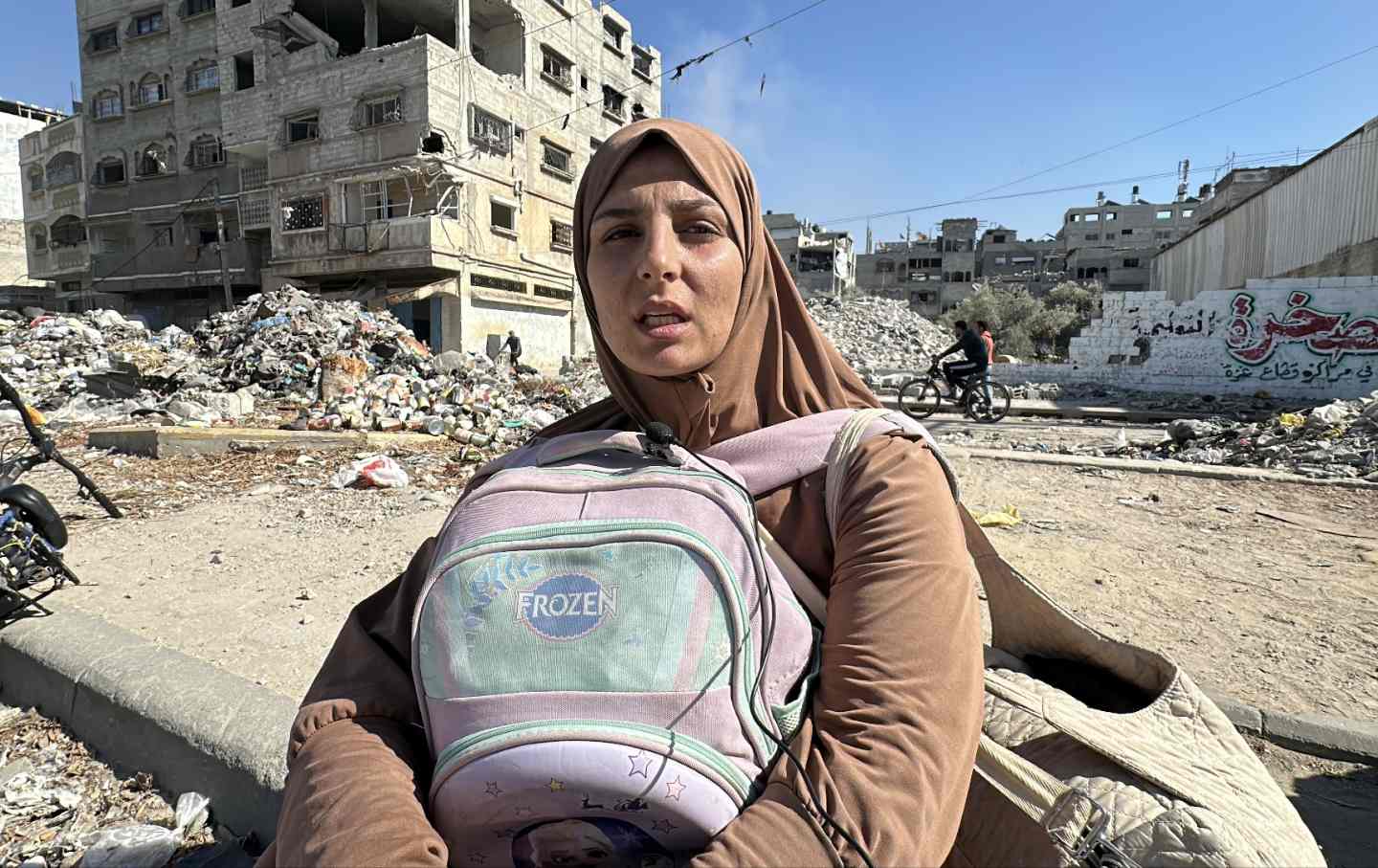
A Palestinian woman, carrying a backpack, arrives at Salah al-Din Road as the Israeli army forces Palestinians to leave Gaza City on October 22, 2024.
(Hamza Z. H. Qraiqea / Anadolu via Getty Images)Nearly 14 months have passed since the start of the genocide here in Gaza, but the fear and chaos still haunt us every day. The thought of being uprooted suddenly is terrifying. We have all been displaced over and over again; my family and I have had to move seven different times. That is why one of the most important objects any of us possesses is a backpack.
Around the world, backpacks represent freedom—school, work, adventure—but in Gaza, they have come to mean something entirely different. Backpacks are what we use to carry what’s left of our lives.
Our children sprint from place to place, not to learn, but to escape the very real threat of death that looms over us daily. The backpacks that once held books and lunches now hold meager rations like processed meats and beans—food that is hardly nourishing for growing children, barely enough to sustain us during these times of turmoil.
When the genocide began, many of us prepared a small bag with only essential documents—things like our identification, birth certificates, and medical histories. But as the fighting dragged on, and our displacement intensified, we switched to backpacks. We filled them with the fragments of our existence—our precious memories, our hopes, and what’s left of our normal lives.
Now, when evacuation orders come, parents tell their children to fill their backpacks with a few clothes, knowing they might have to leave everything else behind. And every time we are forced to evacuate, we carry a little less with us, and the backpacks get lighter and lighter.
Can you imagine that? Can you imagine the pain of squeezing your entire life into a single bag?
Last winter, we evacuated for the first time. I cried, my heart aching. I looked at my closet overflowing with clothes and shoes, wondering what I would leave behind. What about the things I love? The pictures of happier times, the books I’ve treasured, my favorite toys—they all seemed invaluable. I saw my parents trying to appear strong for us, but their silence spoke volumes; they were hurting inside too.
My younger siblings had just begun their new school year, excited and full of hope. I remember the pure happiness on their faces when I surprised them with new school supplies. My little sister had hugged me tightly, thrilled by her new Barbie backpack. Now the Barbie backpack had to be used to help my sister flee.
As we packed our bags with just a couple of clothes, my sister cried over her toys and colorful dresses, items that held cherished memories. I tried to be brave for them, saying, “Don’t worry! We’ll come back one day and find everything waiting for us!” Deep down, though, I knew that wouldn’t be true; we might not return to what we once had.
Even though backpacks can symbolize joy and learning, here in Gaza, they have become symbols of survival, filled with the sadness of what we’ve endured. We carry them not with excitement but a heavy heart, knowing they represent our fight against a world that often seems to overlook us.
In these backpacks lie more than just belongings; they carry the weight of our struggles and our dreams for a brighter tomorrow, a desire for peace, and a hope to return to the colorful lives we once knew. I think of the times we would picnic in the park, laughter echoing around us, and children would play games without a care.
Those carefree moments now feel like distant memories. Each time we pack, it’s not just about clothes; it’s about squeezing in pieces of our history, our culture, and our identity. The stickers my brother loved to collect, the drawings my sister made—all of these things tell our story. But now, we face a new narrative, one where survival and resilience intertwine with loss.
As I move from place to place, I see the same sorrow reflected in the faces of families around me. They too hold onto their backpacks tightly, hoping that within those straps lies a glimmer of hope, a dream of peace, or a memory that keeps them anchored amid chaos.
As we navigate this difficult journey, I find solace in the smallest moments—the sound of my siblings’ laughter when we share stories, the support of neighbors who understand our plight, and the unity that emerges in times of hardship. Though our lives are in constant flux, the love of family and community binds us together. We lean on each other, drawing strength from our shared resilience, and in those moments, the weight of our backpacks feels a little lighter.
In that way, our backpacks symbolize both loss and hope—a duality that defines our existence in Gaza right now. They are reminders of the innocence that has been stripped away and the dreams we are fighting to keep alive. As I look at my siblings, I see their determination to hold on to their dreams, despite the uncertainty that looms. I whisper to them about the future, painting pictures of what life could be like when the fighting ends. In this small way, I try to safeguard their innocence and keep the spirit of hope alive within our hearts.
Popular
“swipe left below to view more authors”Swipe →Our story may be one of struggle and survival, but it also reflects our unyielding spirit. In a world that often overlooks the plight of those in conflict, we will not be forgotten. Our backpacks will forever tell the tale of resilience, reminding us that even in the darkest times, we carry on.