When It Comes to Public Health, We Need to Tap Into People, Not Pundits
The future of our health under Trump is going to be bleak. But the solution lies in our communities, not individual personalities.
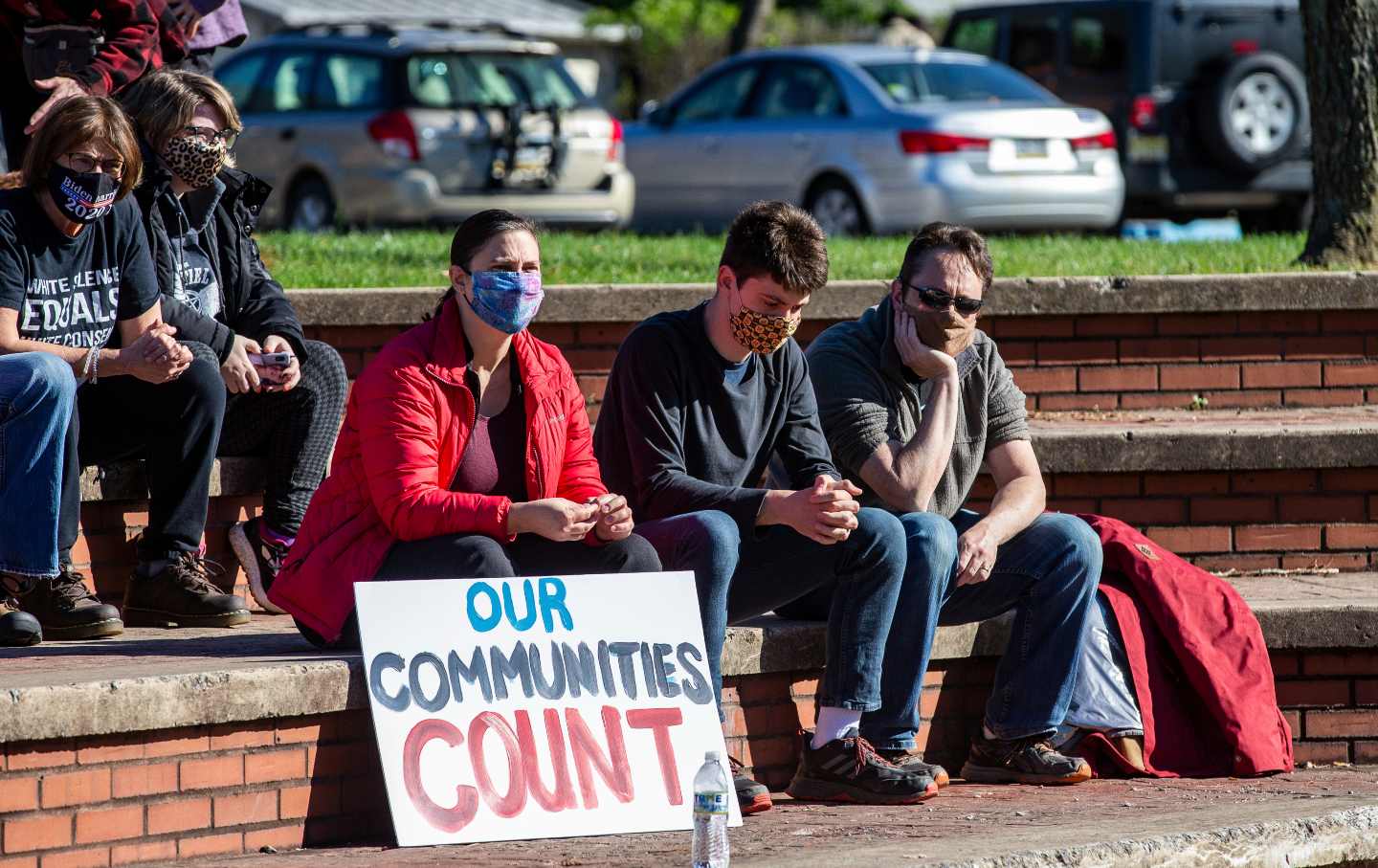
People gathered at Hufnagle Park in Lewisburg, Pennsylvania.
(SIPA / AP Images)
The next Trump administration is already turning out to be something that we really haven’t seen before in American history: a mixture of profound incompetence, deep zealotry, and, well, a desire to destroy, a desire to harm—where a profound nihilism is the point. As one commentator has put it: “The common theme is that he is constructing a kind of anti-government—not in the sense of being for smaller government, but in the sense of being government’s evil twin. Every appointee is selected as a deliberate negation, even a mockery, of the function of government he or she will be in charge of.”
The appointments rolling out in public health and adjacent roles only illustrate the thesis: Robert F. Kennedy Jr., who believes that vaccines cause autism, HIV doesn’t cause AIDS, and Covid was “ethnically targeted” to avoid Ashkenazi Jews and Chinese people. Then there is Dr. Mehmet Oz, the TV personality, hawker of quack remedies, and former faculty member booted from Columbia University’s medical school, who has been tapped to run the Centers for Medicare and Medicaid Services. Waiting in the wings are a host of Covid contrarians who advocated letting people get infected before vaccines were available, predicted that we’d reach herd immunity by April 2020, and likened vaccine and mask mandates to Nazi totalitarianism. In October, I wrote about this crew and mused that they were auditioning for posts in the Trump administration. Now the auditions are over and the play is about to begin. Most of these individuals, in addition to their conspiracy-addled views, have little experience or expertise for the posts they are about to take up. They also have suggested that they have been persecuted for their views and, like the man who will assume the presidency in January, are in the mood for retribution.
What Ben Mazer called the “sanewashing” of RFK Jr. and his ilk definitely doesn’t help. In his piece, Mazer rightly criticizes Leana Wen and Emily Oster, who suggest that Kennedy may have a point on fluoride, raw milk, and vaccines, when he is simply a “Grade A crank,” and if they’re looking for scientific engagement on these topics, they should look elsewhere. I would go a bit further. Wen and Oster are not new at this game: During the pandemic, they used their perches to elevate their own brands, as truth-tellers and antagonists to public health wisdom, and their pieces this month are more of the same—their argument being “public health doesn’t get it, I do”—even if it means drifting into the orbit of this lesser Kennedy. In the end, this is a form of appeasement and accommodation and is about staying in the game, being a “trusted” intermediary to the right, and remaining relevant in a debate that is tilting toward madness.
We’ll see a lot of this in the weeks and months ahead. And we’ll see people running for cover too—those who depend on the federal government for funding—will feel speaking up isn’t worth the price. Otherwise, we have two pieces of work to do.
The new and proposed appointees to the Trump administration each come with their own obsessions, and all have nothing good to say about the FDA, the CDC, or the NIH. While there are cases to be made for reform of these institutions, Project 2025 offers a template for what they will try to achieve: dismantling core responsibilities of these agencies, undermining their basic structure, which even if partially successful, will leave American biomedical science, drug regulation, and public health in shambles. If before the election, one was tempted to say that we shouldn’t take Trump’s rhetoric seriously, what has unfolded over the past two weeks since the election should put an end to that fantasy of salvation from his predations. This leaves us in damage control mode—it’s back to what I mentioned last week—doing what Tim Synder suggested: “defending institutions.” It also doesn’t help when Colorado Governor Jared Polis, New Jersey Senator Cory Booker, and RFK Jr. are sending each one another sweet little love tweets on social media. But RFK Jr., formerly a Democrat, has a following among some on the left, as I explained last year.
But if many of us are going to spend 4 years in the political wilderness, we do have a major task ahead: There will be occasions where we’ll find ways to get things done on the federal level. However, focusing on a set of narrow issues of overlapping interests right off the bat is not a first-order concern. We need to go back to basics.
Ed Yong wrote a prescient piece in The Atlantic in 2021 called “How Public Health Took Part in Its Own Downfall.” His thesis, supported by many historians of public health, was that our work in the early years of public health—the 19th century—was deeply tied to communities and to making people’s lives better. In that era, we were community organizers and campaigners fighting for sanitation, clean water, and better working conditions in the factories of the new industrial age to name a few. By the 20th century, the field got subsumed under the medical profession and the work of public health turned into an academic enterprise, which
assumed a narrower set of responsibilities that included data collection, diagnostic services for clinicians, disease tracing, and health education….. the field pulled away from allies such as labor unions, housing reformers, and social-welfare organizations that had supported city-scale sanitation projects, workplace reforms, and other ambitious public-health projects. That left public health in a precarious position—still in medicine’s shadow, but without the political base that had been the source of its power.
We need to rebuild public health from the ground up, in local communities, in the image of its founding principles, with broad ambitions, recreating the deep connections that “stretch across much of society,” as Yong put it, which gave us the ability to offer monumental changes for the better in people’s lives over a century ago. This is work that can be done far away from Washington, DC, so when the worst of the next few years is over, we can rise from it, from the ashes, into something better than we started with. This is about taking public health into our own hands—as citizens of neighborhoods, cities, and towns—realizing almost all of us have a role to play in this revival. It’s up to us, not the few.