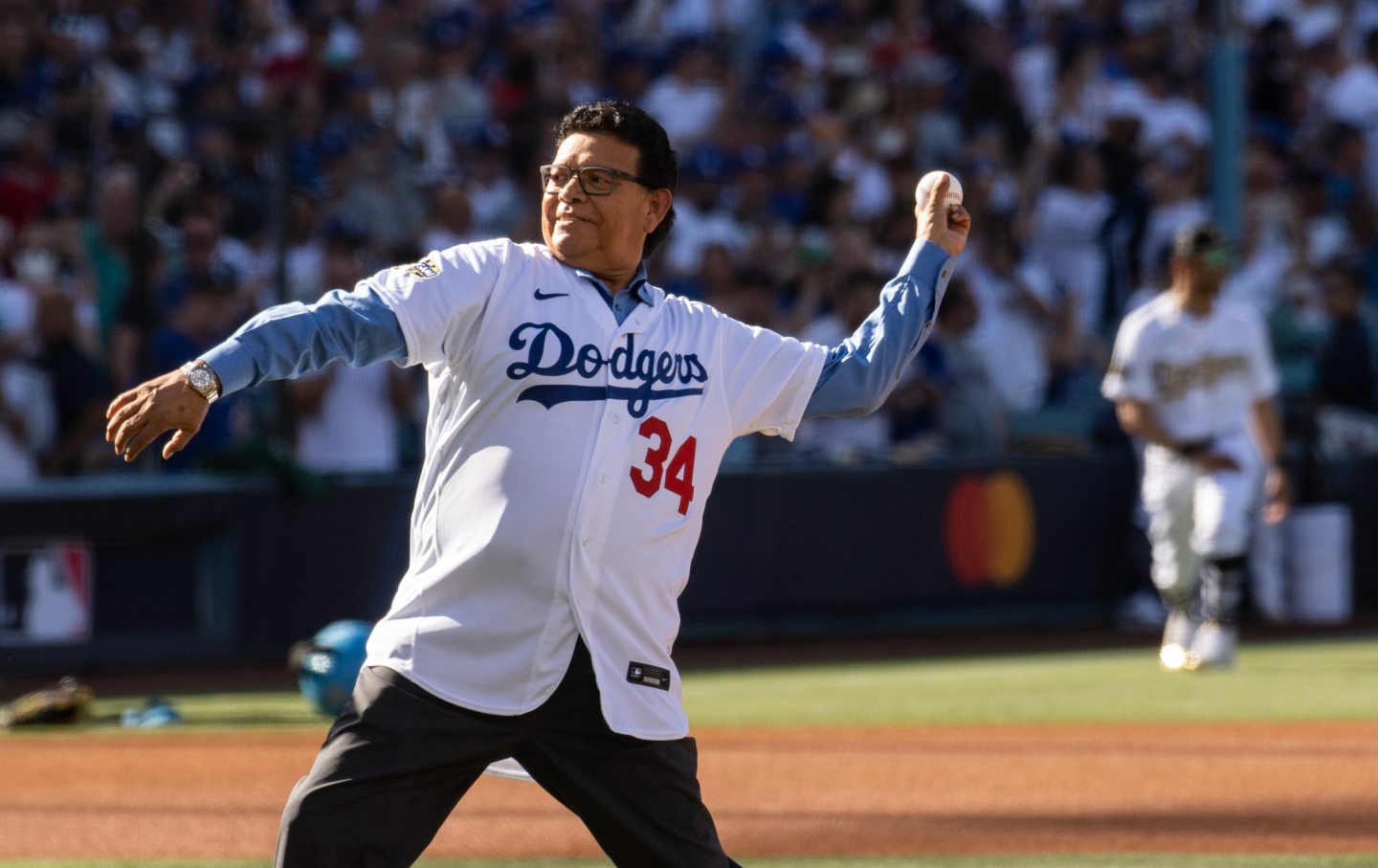
Fernando Valenzuela of the Los Angeles Dodgers throws out the ceremonial first pitch during the 92nd MLB All-Star Game on July 19, 2022 at Dodger Stadium in Los Angeles, California.
(Billie Weiss / Getty Images)
Three days before the Los Angeles Dodgers face off against the New York Yankees in the World Series, the star of the last Dodgers team to beat the Yankees in the Series, Fernando Valenzuela, died at 63 years old.
In a revival of what was once the greatest rivalry in team sports, the New York Yankees will play the Los Angeles Dodgers in the 2024 World Series for the first time in 43 years. A rivalry that used to be a near-annual occurrence in the days of Eisenhower and then revived itself in the 1970s is making its return to the Bronx and Chavez Ravine. As the recently departed James Earl Jones said in Field of Dreams, a hokey baseball flick that Jones elevated, “This field, this game—it’s a part of our past, Ray. It reminds us of all that once was good, and it could be again.” (If this sounds Trumpian, and in another actor’s mouth it might, Jones makes about the peace and joy of youth, not a longing look at more reactionary times.)
Yet there is no great drama without tragedy, even if its timing is something a screenwriter would reject. The symbol of that magical Dodgers 1981 season, which ended with the Dodgers smiting the hated Yankees, was a round-bodied rookie pitcher from the small town of Etchohuaquila, Mexico, named Fernando Valenzuela. Last night, the great Fernando died.
Young fans simply cannot comprehend what Fernandomania was like in 1981 when, as a 20-year-old, the unknown left-hander burst onto the scene. He was a true original, with a pitching windup that inspired poets. He twisted his thick body and stared up to heavens in a manner that was almost penitent, before releasing the ball. As Susan Sarandon’s character Annie Savoy said in the 1988 baseball flick Bull Durham, Fernando was breathing through his eyelids when he looked at the sky.
For this suddenly famous son of Mexico, communication was largely done in Spanish. If Valenzuela was a superstar in the United States, he became an icon in the baseball-mad Mexican and Mexican American communities in Southern California. Valenzuela captured everyone’s imagination, because his charisma, unique style, and the shock of his newness, was matched by the greatest rookie season in any sport. He started his career with five shutouts and eight straight complete games. His ERA over this stretch was an unfathomable 0.50. Valenzuela even won the “silver slugger” award in 1981 as the National League’s best hitting pitcher. He was the Rookie of the Year, the Cy Young winner, and, of course, ended the season by beating the hated Yankees for the World Series.
It is utterly impossible for young fans to understand the energy of Fernandomania, because of the central place of baseball in the culture. In 1981, baseball was at the front of the pack, with football, movies, and even music (stale in those 1981 days before Michael Jackson, Madonna, Bruce, and Prince took over the world) nipping at its heels. Now, baseball is just another sport, more regional than national in impact. Today’s greatest star is another Dodger who speaks English as a second language, Shohei Ohtani. Ohtani is perhaps the most skilled player to ever live. But Shohei is merely the king of the baseball world. Valenzuela was a rock-star. Valenzuela was Elvis.
Valenzuela’s emergence was amplified in a city like Los Angeles, always searching for the next big thing. But he meant so much more than a typical product of the star factory. Valenzuela made the Mexican and Mexican American communities visible and proud. He spoke to the public in Spanish, with the help of a translator, and showed that this was not a fetter to being embraced in the United States.
Valenzuela played for 17 years, making the all-star team his first six seasons until his sure-thing Hall of Fame career was derailed by a shoulder injury. But even though solid for the rest of his time on the mound, he never matched the dominance of that first legendary season. Valenzuela may not be in the Hall of Fame, but he remained an icon, retaining the glow of his youth and always ready to greet an adoring fan. He had stayed in the public eye as one of the Spanish-language voices of the Dodgers over the last decade. Valenzuela’s broadcast partner, Hall of Fame announcer Jaime Jarrin, said in 2023. “His charisma was unbelievable.… from the beginning, he was just amazing. And the people fell in love with him.”
1981 was special for another reason for young Valenzuela. That was when he married a schoolteacher from Mexico named Linda. They had been together ever since, and Valenzuela is survived by Linda, his two daughters, and seven grandchildren. But as we will see on the opening night of the World Series, when Valenzuela will undoubtedly be remembered, he is also survived by a community, a city, and a set of indelible memories. A Spanish-speaking 20-year-old Mexican from a town difficult to find on a map was once the king of Southern California. He gave this marginalized population hope and visibility. He will never be forgotten.
There is a particular layer of pathos in thinking of Valenzuela in 2024. In this election season, immigrants, particularly those from Mexico, are being slandered, demonized, and dehumanized by Donald Trump. The response from the Democrats has not been a full-frontal attack on this racism but an assertion that they have a better plan for halting immigration. In such a toxic climate, it is an act of resistance to remember and celebrate a person whose very existence gives lie to this endless defamation.
Popular
“swipe left below to view more authors”Swipe →This is a country that revered Valenzuela 43 years ago. Had he emerged in 2024, the right-wing hordes on social media would probably be calling for his deportation to “make baseball great again.” Valenzuela would also be excoriated for his lack of English skills. If this seems like an exaggeration, recall Stephen A. Smith, the voice of ESPN, slamming Shohei Ohtani for using an interpreter. (Smith apologized after the ensuing uproar.) It’s part and parcel of living in a time when the GOP talks casually about military action against Mexico, shooting people as they cross the border, and opening incarceration camps to house millions of undocumented—and, I guarantee it, documented—immigrants. The plan is to have “red-state police,” granted full immunity, go into “sanctuary cities,” rip people from their homes, and put them in camps. Almost half the country is fine with this.
Fernando Valenzuela is a reminder that at one time millions of people did not recoil at the presence of a Mexican baseball player. He wasn’t seen as an enemy because of the color of his skin and country of origin. Instead, he was broadly treated like the shining, shooting star that he was. Valenzuela mattered in 1981. His memory will matter going forward for those trying to push back against bigotry and oppression.
Fernandomania will never die, because he will be held in the hearts of those who are willing to imagine a a different kind of society than the dystopian, gray world of hate so many seem eager to realize. Valenzuela was bright colors streaking across the sky. The bigots will never notice that kind of beauty, because it’s tough to see the sky when you live in the sewer. Rest in peace, Fernando Valenzuela, and long live Fernandomania.