
Grad Students Are Unionizing in Droves. Can Postdocs Lead the Next Wave?
Postdoctoral fellows are vital to universities—running labs, training students, and writing grants—while being overworked and lacking adequate job protections.
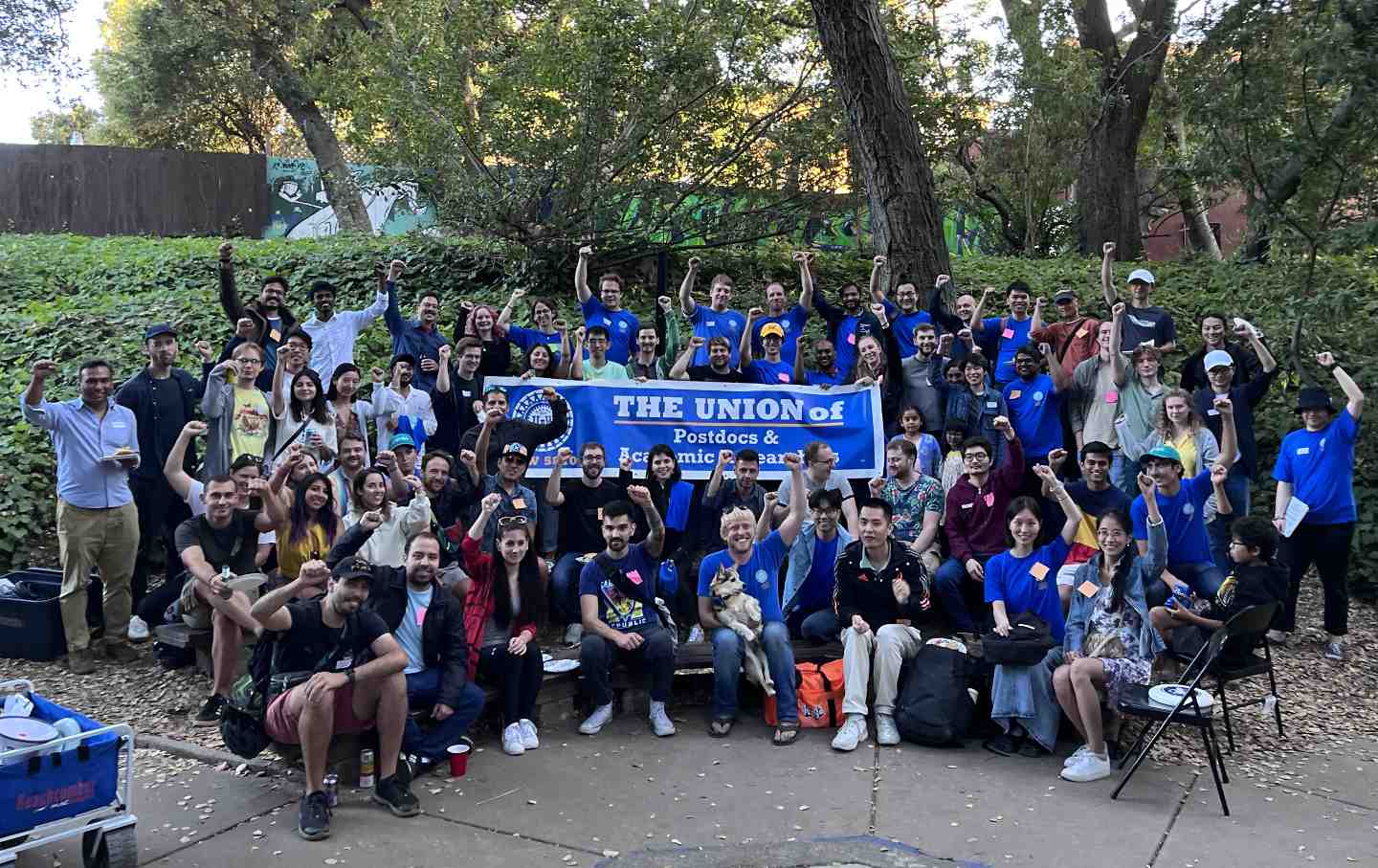
When Marjorie Levinstein, 35, began working as a postdoctoral fellow at the National Institute on Drug Abuse in 2021, she knew from the outset that she wanted to advocate for her fellow postdocs. At the University of Washington, where she had received her PhD in neuroscience, she saw firsthand “how the union really fought to improve our lives.” But the unionization movement at her new employer, the National Institutes of Health (NIH), didn’t have that infrastructure. In July 2021, it amounted to “five people on a Zoom call,” Levinstein told The Nation.
Now, she’s fighting for her union’s first contract in an over-5,000-strong collective bargaining unit, which won its vote by a nearly 98 percent margin last year.
In 2022, the pay increase and job protections won during the University of California system’s strike sent “ripple effects” across the country, Levinstein says. And in 2023, the strike by postdocs at the Icahn School of Medicine at Mount Sinai raised the salary floor again and secured an emergency fund for expenses related to childcare and housing.
“There’s been a real wave,” said Kevin Ng, a postdoctoral fellow at Rockefeller University, a private biomedical institute in New York where postdocs won their union vote in late September. Andrea Joseph, a postdoc researching women’s reproductive health and leading union efforts at Mount Sinai, spoke of a “movement of postdoc unions.” Since postdocs at Columbia University formed the first separate bargaining unit for postdocs at a private institution in 2018, postdocs at Mount Sinai, New York University, the Einstein College of Medicine, the Weill Cornell Graduate School of Medical Sciences, and now Rockefeller have followed suit in New York City alone. “We’ve been very closely coordinated, all of us. Our contracts are building off of each other,” Joseph said.
Unionization across higher education has surged over the past decade, with graduate student employee union representation up by over 130 percent since 2012, according to a recent report by the National Center for the Study of Collective Bargaining in Higher Education and the Professions at Hunter College. But within this landscape of labor organizing, postdocs are often overlooked.
At the beginning of January 2024, the report found that 10 separate bargaining units exclusively for postdocs represented a total of 11,471 employees across the country. But since then, at least seven more units became certified with United Auto Workers.
The postdoctoral fellowship marks a particularly leaky spot in academia’s so-called “leaky pipeline“—where women and people of color leave or are forced out of academia at disproportionate rates. This was echoed by many of the 13 current and former postdocs, as well as two experts on higher-education labor, who spoke with The Nation. “Most postdocs are right at that age where you’re thinking about ‘what do I want for my life?,’” Ng said. And the postdoc is definitionally a transitional period—“kind of like a warehouse until you find a permanent position,” said Burç Köstem, a postdoc at the University of Southern California from Turkey.
At the same time, postdocs are engaged in work vital to the universities. They’re often the ones running labs, training students, and writing grants and papers, while also driving projects of their own, Joseph said.
Yet in recent years fewer and fewer researchers are applying for postdoc positions. Almost 95 percent of postdocs surveyed by the US National Postdoctoral Association in December 2022 said their low pay negatively impacts their lives. The postdocs who spoke with The Nation cited wages, housing, childcare costs, and protections against bullying and harassment as some of postdocs’ top concerns. In a separate statement, the executive director of the National Postdoctoral Association said that the organization “does not maintain a universal position on postdoc unionization other than that it should be an option available to postdocs.”
International scholars—who make up 57 percent of the country’s STEM postdocs—are especially shortchanged. A recent study found that among 2,800 academic postdocs, temporary visa holders receive lower pay and less career support than their US citizen counterparts, despite being more productive on average.
The unique challenges faced by postdocs can have a compounding effect, making labor organizing much more difficult. Unlike graduate students, who typically enter at the beginning of an academic year as part of a cohort and have a guaranteed minimum length of funding, postdocs’ employment is more ad hoc and unpredictable, with many hired as the only postdoc in their lab, floor, or even department.
With high variability in contract length and few job protections, postdocs told The Nation that feelings of isolation are common. Especially for temporary visa holders, whose stay in the country is contingent on securing a permanent post, the postdoc can feel like an exercise in “how many years of precarity can you sustain,” said Köstem. “So inequalities of class, race, gender, all of those things, come to bear on your postdoc position in a very significant way.”
But some postdocs whose unions have successfully won their votes and achieved key concessions at the bargaining table said they’ve managed to turn some of those challenges into advantages. “One symptom of the temporal nature of the job is the fact that postdocs don’t tend to have as strong a sense of community across their job title,” said Sujay Nair, a physics postdoc at University of California, Berkeley, where postdocs voted to unionize back in 2008, sending shock waves through US academia at the time. “Of course that’s a challenge for union organizing because that’s all about ‘how many postdocs can you talk to?’ But at the same time, I think this is also the remedy for it.”
Several postdoc organizers said that their peers were excited about attending union gatherings because they doubled as sources of the camaraderie that they had been lacking. Hosting in-person union orientation programs for incoming postdocs, and being willing to adapt to newcomers’ schedules to conduct those individually as needed, has made a “huge difference,” said Julia Falo, another postdoc and union leader at UC Berkeley.
Likewise effective has been forming community with postdocs doing this work at peer institutions, sharing strategy and building on one another’s contracts. “Definitely reach out to other unions,” said Andrés Morera, a postdoc and union leader at Rutgers University. “We all want to help each other organize.” Within higher education, successful organizing seems to build on itself—like Levinstein, some of the postdocs leading union work at their institutions first experienced the effects of unionization as a graduate student.
To Morera, too many postdocs are overworked and just don’t have the bandwidth for organizing. But ultimately, although a unionization drive is a numbers game, postdocs said that some of the most important work can also be the least time-consuming, like distributing union authorization cards to your labmates. “You don’t need every person to be super, super involved at a high level,” said Kelsey Tyssowski, a postdoc at Harvard University, where 93 percent of postdocs, academic researchers, and non-tenure-track faculty voted to unionize in April. “What you need is a lot of people who care a little bit.”
Popular
“swipe left below to view more authors”Swipe →If the postdoctoral fellowship years can be a critical juncture during which scholars debate whether to leave academia or commit for the long haul, unionizing can feel like a leap of faith. So to some of the postdocs organizing on their campuses, the root of their motivation goes beyond securing a salary bump or guaranteed parental leave—even as those remain vital, if bare minimum, priorities. To them, this fight can instill optimism about academia’s future.
“I think every postdoc I know, we are very passionate about our jobs, we love what we are doing, and there is a reason why we are still in academia,” said Juliane Grimm, a third-year postdoc at the Albert Einstein College of Medicine. “But I would just really hope for the next generation of scientists that they don’t have to choose between a job they really love and are passionate about, and also having a full private life, because, unfortunately that’s at the moment a reality for the majority of us.”
More from The Nation

The Accidental Activists of Data Center Alley The Accidental Activists of Data Center Alley
These would-be rebels in Northern Virginia joined the fight against data centers mostly to stop the encroachment on their homes and exclusive private communities.
An Effective Movement for Palestine Needs Allies Like Zohran Mamdani An Effective Movement for Palestine Needs Allies Like Zohran Mamdani
In order to build a broad-based coalition, we need to work together—not practice purity politics.

The First Amendment Applies to Concert Stages Too The First Amendment Applies to Concert Stages Too
Protests like that of Macklemore on Palestine should never be silenced by billionaire owners.
France’s Students Won’t Back Down France’s Students Won’t Back Down
Without full-time teachers, temperature-regulated classrooms, or school nurses, French students are turning their grievances into a national movement.
Inside Cornell’s Week of Protest Inside Cornell’s Week of Protest
“We won’t be silenced anymore. Our university needs to start protecting us, like they should’ve with Jane Doe and all other survivors on campus.”
Netanyahu Came to New York. New Yorkers Were Ready for Him. Netanyahu Came to New York. New Yorkers Were Ready for Him.
Scenes from the defiant protest against the genocidal leader’s UN speech.

