
Keir Starmer, Loser
The UK’s new prime minister has been comically terrible in his first few months in office.
The UK’s New Prime Minister Seems Horrible at His Job
Keir Starmer has been comically terrible in his first few months in office.
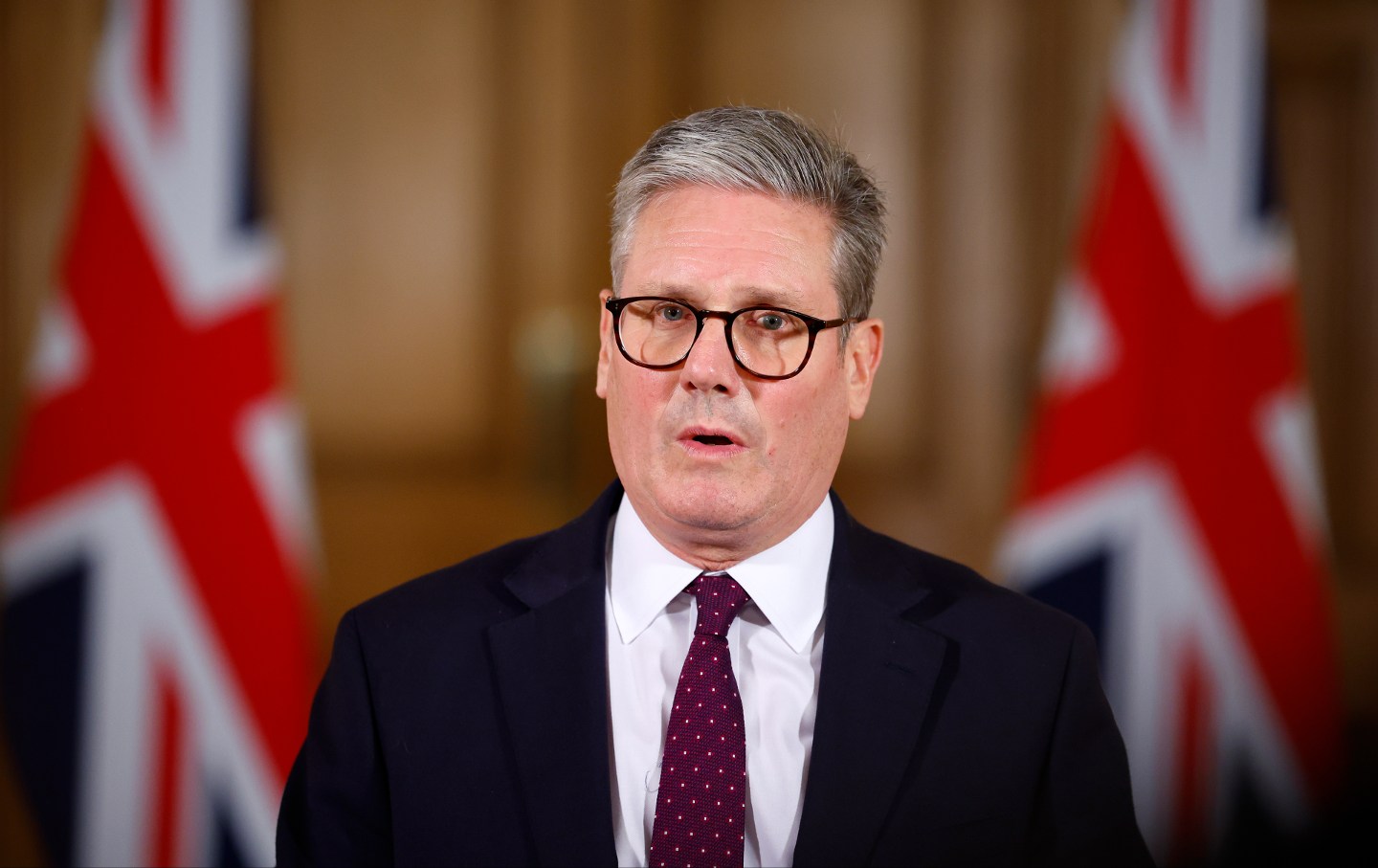
In the months before he became the UK’s 58th prime minister, Sir Keir Starmer dutifully toed the American and Israeli line on the genocide in Gaza.
Starmer, then the leader of the Labour Party in opposition, was deep in the middle of his campaign to portray himself as a sensible and serious leader—in contrast to the so-called loony left of his predecessor Jeremy Corbyn and the collapsing Conservative government in power. His “premier-in-waiting” act was intended to appeal both to his future allies and disaffected Tory voters.
So Starmer did what he thought a man on the road to power should do. He defended Israel’s supposed right to enact collective punishment on civilians in Gaza. He demonized anti-war protesters as antisemites and did nothing to counter the Tory narrative that they were conducting hate marches. He personally suspended a left-wing Labour MP for issuing a mild statement calling for peace, while his party enforcers purged local councillors who supported a ceasefire.
Yet after Labour’s landslide victory in July’s general election, Starmer changed tack—slightly. He and his new foreign secretary, David Lammy, bowed to months of public pressure and initiated a review of the UK’s military exports to Israel. In early September, the government announced the suspension of 30 arms export licenses due to the risk that they may be used in violation of International Humanitarian Law in Gaza. This was, in principle, a significant step forward and one that few governments around the world have actually taken—and the United States is not one of them.
But the list of 30 licenses conveniently omitted the UK’s primary contribution to the death and destruction: components for 15 percent of each F-35, a fighter jet described by Lockheed Martin as “the most lethal” in the world and used extensively by Israel in Gaza and Lebanon.
Suspension of these specific parts was central to pro-Palestine campaigning and supported by leading human rights charities. Starmer’s decision to discard this key concern has led to continued legal challenges in British courts and resulted in only one possible conclusion: “Starmer is still arming genocide.”
And nevertheless, despite this hollowed-out half-measure, he has also lost friends on the right. As if receiving no credit for his year of bootlicking, Starmer was recently excoriated by Israeli Prime Minister Benjamin Netanyahu for “embolden[ing] Hamas” and then snubbed in New York by both Netanyahu and Ron Dermer, Israel’s minister of strategic affairs.
This, in microcosm, is the story of Starmer’s flailing premiership. In just a few months, across a range of issues, Starmer has managed to alienate practically everyone and achieve practically nothing. It is why he is now polling as less popular than the historically unpopular man he just removed from power.
On the surface, the election that swept Starmer into Downing Street roughly 100 days ago was a massive triumph. The Conservatives, after 14 years of disastrous rule, were decimated, crashing out of power with the worst defeat in their nearly 200-year history. Labour entered government with a 174-seat majority.
But while the sheer margins of Labour’s victory made the headlines, it was immediately clear that these results were a mirage.
For one, the party’s vote share was the lowest for any election-winning party in the last 60 years. Labour actually received fewer votes than in 2019, as turnout dropped significantly.
Analysis of individual constituencies revealed that Labour’s ability to flip historically Conservative seats was not because of a rise in support for Starmer’s party. In fact, Labour’s vote did not increase in many areas of the country and actually decreased in London.
Rather, the Tories lost votes to third parties, including the far-right Reform UK party led by Trump ally Nigel Farage, which, thanks to the same distortions of the first-past-the-post system that benefited Labour so much, ultimately won 14 percent of the vote share but only 1 percent of seats in Parliament.
Starmer himself faced an unexpectedly fierce challenge in his own constituency from independent candidate Andrew Feinstein, an anti-apartheid campaigner and former ANC MP. Feinstein significantly reduced Starmer’s own vote by 17 percent compared to the prior election, while a string of other independent candidates running on a pro-Palestine platform managed to win or seriously threaten seemingly safe Labour seats across the country.
Such a dearth of active support meant that Starmer and his regime were only going to ride on not being the Tories for so long. At some point, it was clear, he would actually have to generate some level of enthusiasm on his own merits.
Last week’s polling, showing that more voters now prefer former Prime Minister Rishi Sunak’s government to Starmer’s (31 percent to 29 percent), reveals not just the degree to which he has failed to activate new support but also the impressive speed at which he is actively turning voters against him.
This poll was published in the midst of a Labour “freebies” scandal, the latest in a series of missteps that began as confounding but now feel like an inevitable outgrowth of Starmer’s flawed project.
Starmer and government ministers have received hundreds of thousands of pounds in gifts ranging from Arsenal football and Taylor Swift tickets, to clothes, to apartment access.
This has now dovetailed with recent reporting revealing Labour’s pay-for-access scheme. The government has, for example, sold breakfast with the business secretary to corporate bosses for up to £30,000, and also appointed a new climate envoy employed by a charity with direct ties to an offshore hedge fund invested in fossil fuels, which happened to give the party its largest-ever donation just before the election.
Starmer’s seemingly genuine shock at the backlash to this grubby dealing (given that he “followed the rules” in letter, if not in spirit) is itself genuinely shocking, given that he explicitly campaigned on cleaning up Tory sleaze. What’s more, these revelations came just as his new government was pursuing an aggressive program of austerity specifically targeting society’s most vulnerable.
What other possible reaction could the public have when Starmer cites his children as an excuse for accepting access to a central London flat while at the same time refusing to scrap a Tory policy that limits welfare payments to two children per family, and indeed going so far as to suspend seven Labour MPs who broke from his line out of their desire to decrease child poverty?
Popular
“swipe left below to view more authors”Swipe →And why would the outrage dissipate when Starmer continues to insist on making “the tough choice” to cut winter fuel payments to pensioners—a deeply unpopular, demonstrably harmful decision—even as, again, his own party rebels against him?
To be fair to the man, Starmer is occasionally able to reject unpopular and profoundly evil policies. For instance, he did discontinue Sunak’s failed plan to send asylum seekers to Rwanda and announced that the government would not renew the contract for asylum seeker detention on the Bibby Stockholm barge.
However, immediately after making these decisions early in the summer, Starmer’s Home Office announced that it would intensify immigration raids, detention, and deportation. Following fascist riots across the country targeting asylum seekers, Muslims, and people of color, Starmer did not simply fail to repent for his and his party’s contribution to widespread xenophobia and Islamophobia. He then met with far-right Italian Prime Minister Giorgia Meloni and discussed, apparently with great interest, Italy’s own offshoring plan with Albania and its agreements to support violent security forces in Tunisia and Libya tasked with preventing migration in the first place.
As it turns out—and despite his supporters’ prior insistence—a Starmer government is not better than, or even meaningfully different from, the Starmer opposition. To have made that case was to believe that we hadn’t already seen the real Keir Starmer. But in reality, he never hid his trademark combination of authoritarianism and vacuity.
Rather, it was on full display when he tactically instrumentalized antisemitism to root out the party’s left, or when he regularly abandoned key progressive positions and integrated right-wing notions of nationalism and patriotism, and, finally, when in his victory speech he declared his newly elected government to be “unburdened by doctrine.”
He is exactly who he promised to be. Rerouted deportation flights, cronyism during austerity, supplying only the weapons absolutely needed for genocide, and now a chaotic scramble to reshuffle his administration rather than change policy: This is Starmerite technocracy. Who, other than business and themselves, is it really for?
More from The Nation
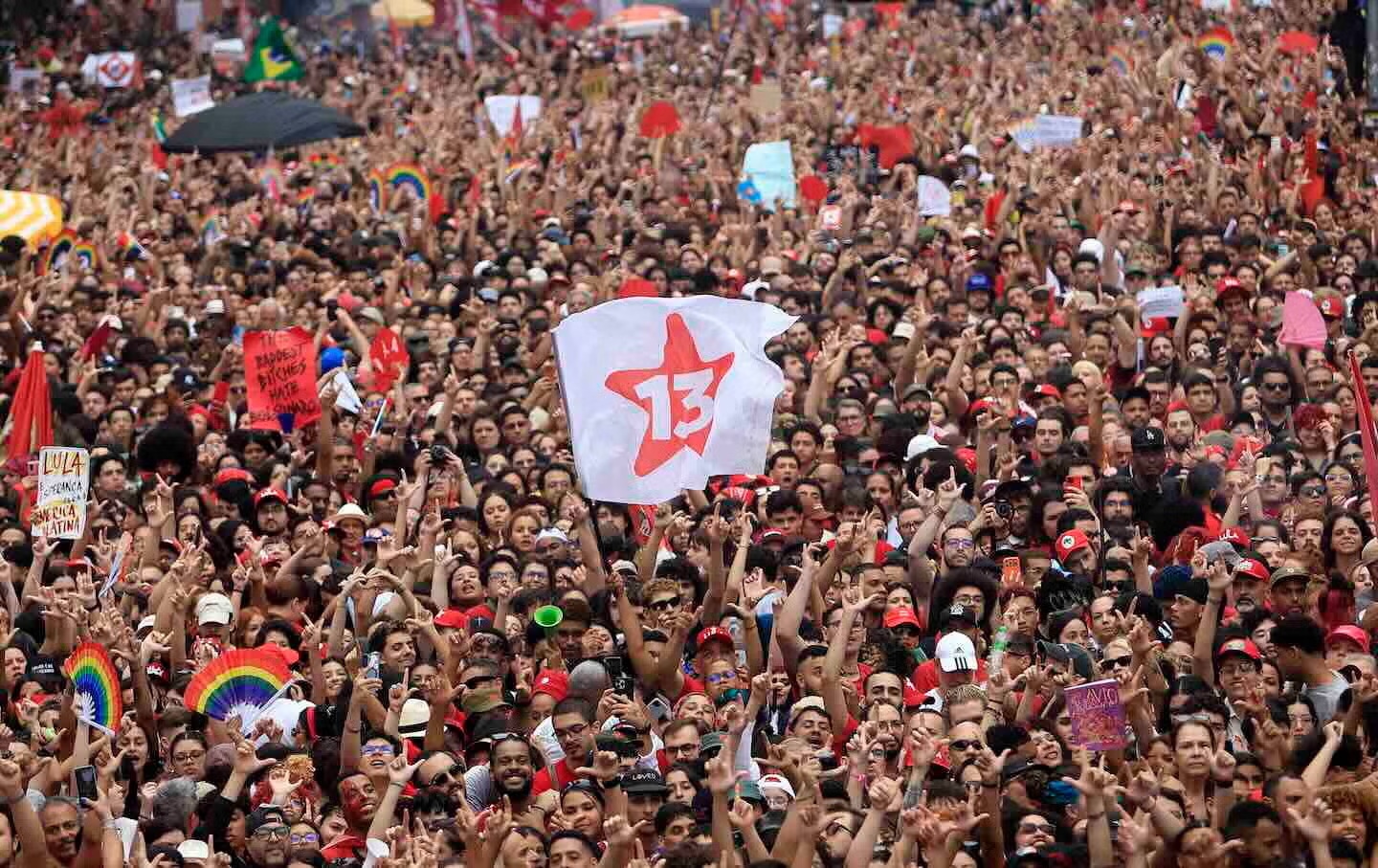
Brazil’s Workers’ Party Is Not Stopping Brazil’s Workers’ Party Is Not Stopping
With just a few days remaining before the runoff election, supporters of Lula’s party are doing everything possible to rally support behind the president.
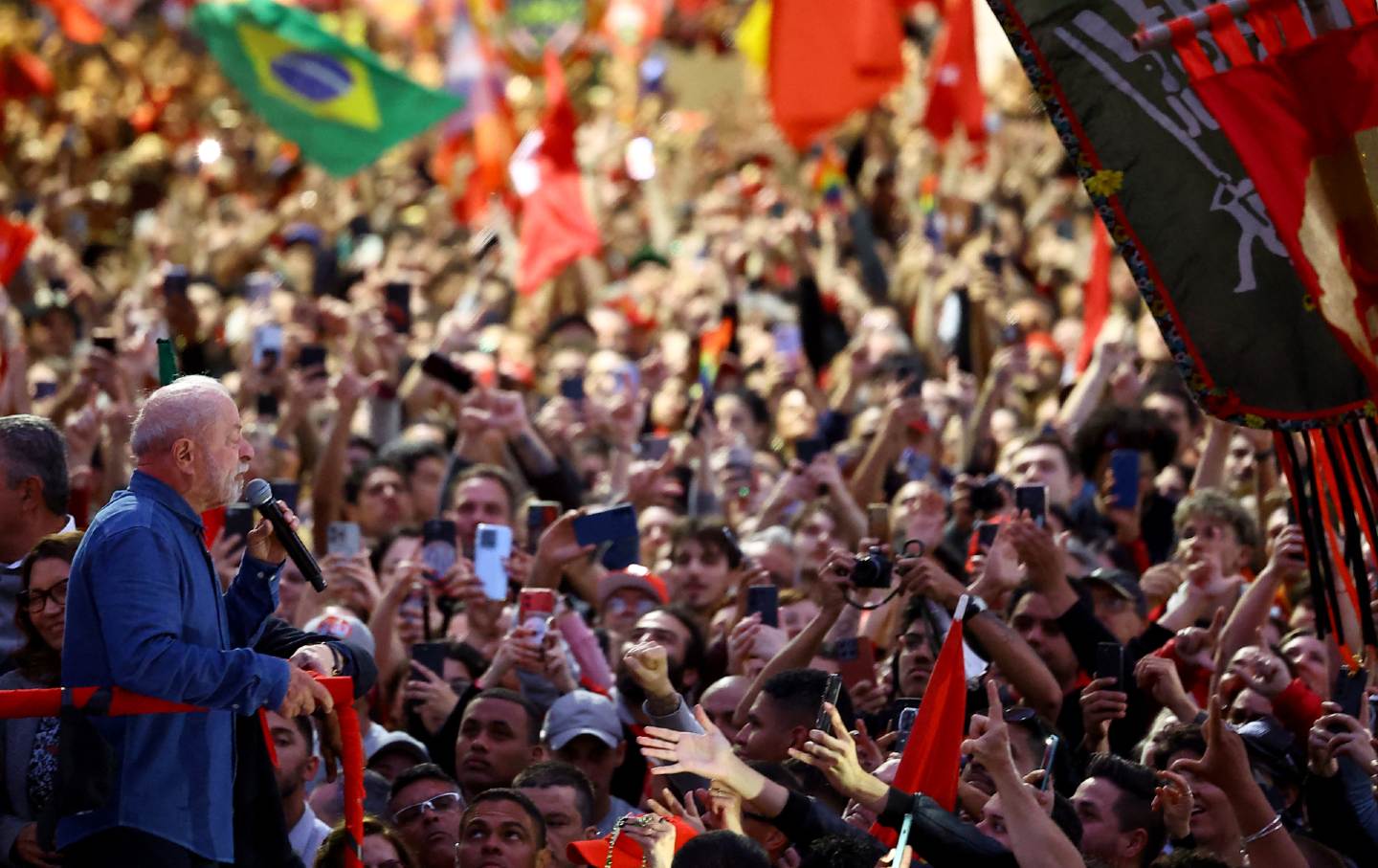
Brazil’s Decision Brazil’s Decision
The moral compass and basic humanity of political leaders really does matter.
Albanian Student Strikes Spur a Political Crisis Albanian Student Strikes Spur a Political Crisis
A new round of protests against the ruling party’s corruption has Prime Minister Edi Rama giving cops bonuses to crack down on dissent.
Inside India’s Gen Z Cockroach Janta Movement Inside India’s Gen Z Cockroach Janta Movement
Young Indians are challenging the purge of voter rolls by Modi’s right-wing government. Shrishti Khanna, who was detained by Delhi police while covering the protests, explains.

The Clarion Call of “NAZA” The Clarion Call of “NAZA”
Yuval Abraham and Rachel Szor’s new film not only documents the horrors of the present but gives us a glimpse of a possible future too.

