
JD Vance Is Working Hard to Be Hated
For the Republican candidate, riling up the right-wing base outweighs alienating everyone else.
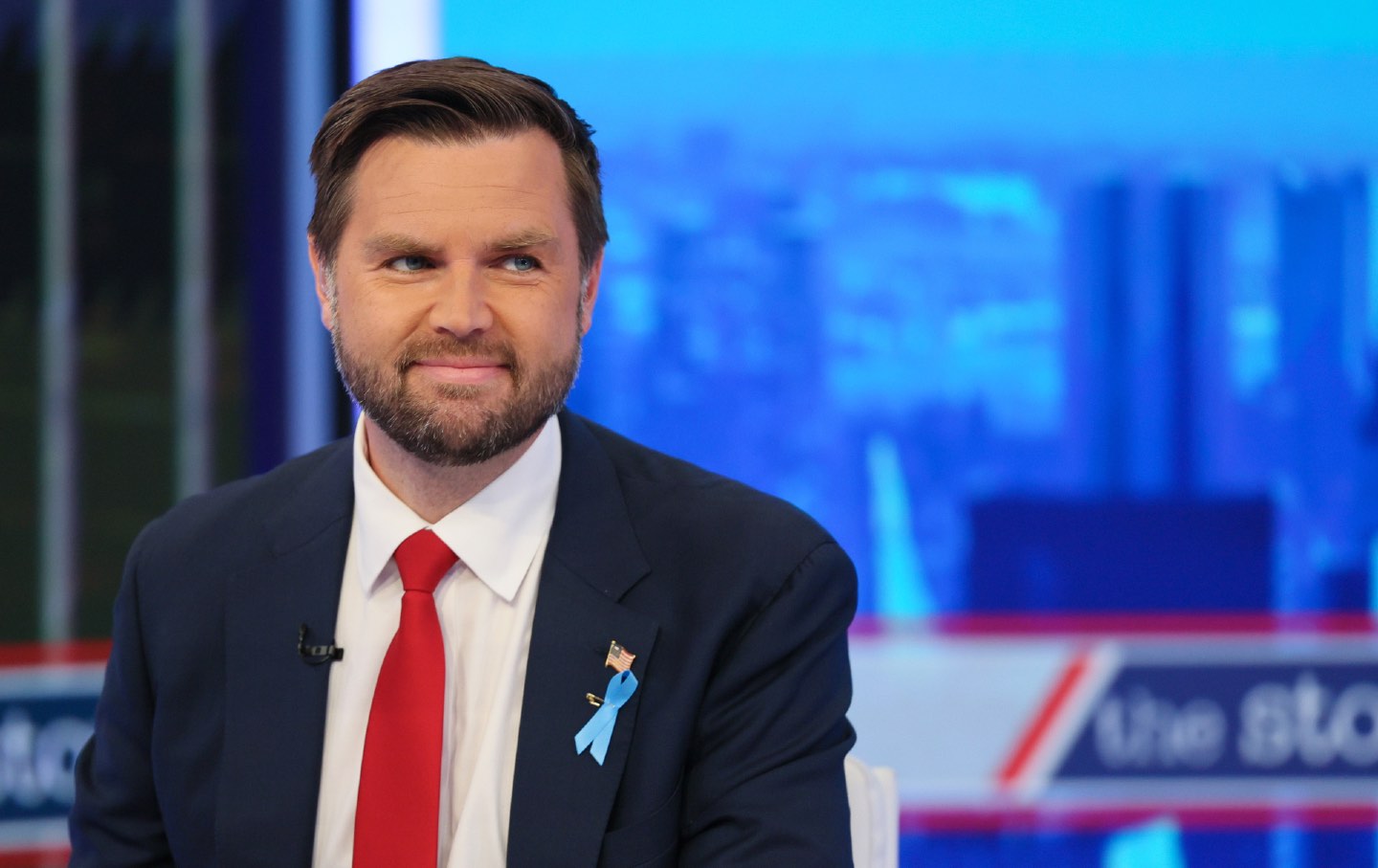
A skilled opportunist who has risen by sheer ambition from genuine poverty to the brink of the White House, JD Vance has spent a lifetime ingratiating himself to the powers that be. He’s been strikingly successful at pleasing centers of influence of various stripes, ranging from his professors at elite institutions to his military commanders to Wall Street employers to anti-Trump centrists, to Hollywood bigwigs, to Silicon Valley plutocrats—and finally Donald Trump and the MAGA movement itself. A cynic might say that Vance is the ultimate apple-polisher, ever ready with the words that other people want to hear, even if they contradict his earlier pronouncements.
As my Nation colleague Chris Lehmann astutely observed, Vance first sold himself, in his best-selling Hillybilly Elegy (2016), to liberal media elites as the native informer with the lowdown on the white working class, the refugee from Appalachia who could explain all the depraved people who voted for Trump. In this incarnation, Vance offered a mixture of self-help (the other hillbillies just needed to study hard, avoid drugs, and, one presumes, go to an Ivy League school) and warnings of Trump’s dangerous demagoguery. This was a message designed to please centrist and liberal elites who wanted to keep Trump out of power—but didn’t want to substantially change the economic order.
But once it became clear that Trump had remade the GOP in his own image, Vance was shrewd enough to realize that he now had to ingratiate himself with the man he once compared to Hitler. As before, Vance applied his considerable skill at disingenuous flattery. He started echoing hard-right talking points, including expressing suspicion of vaccine mandates. This earned Trump’s attention, then his endorsement to be Republican senate nominee in Ohio in 2022, and eventually Vance’s elevation to being the vice-presidential running mate.
Since becoming Trump’s sidekick, Vance has relished the role of MAGA enforcer, making remarks that are every bit as incendiary as Trump’s. It was Vance who pushed into national prominence the racist lie that Haitian immigrants are eating cats and dogs. More recently, Vance has embraced Christian nationalists such as Lance Wallnau, whose event Vance attended on Saturday. Wallnau, an open theocrat, has described Harris as a demonically supported “Jezebel.”
Yet, even as his skill at pleasing the targets of his ambition was as its pinnacle, Vance discovered that being serially ingratiating was also a good way to become more widely unpopular. At the end of the day, no one likes an apple-polisher. Remaking yourself to please others is a good way to earn distrust.
In an age of negative polarization, it’s easy enough for a politician to be hated, but Vance excels at it. Of the four major candidates on national tickets this year, Vance is the most unpopular—even more than his running mate. According to the polling aggregation of FiveThirtyEight, Vance is viewed favorably by 34.7 percent of voters, against an unfavorable rating of 45.7 percent, for a net of minus 11 percent. By contrast, Trump’s numbers are 42.9 percent favorable, 52.6 percent unfavorable (net minus 9.6). Kamala Harris’s numbers are 45.4 percent favorable versus 47.1 unfavorable (net minus 1.7). Harris’s running mate, Tim Walz, is the only national figure with positive approval. His numbers are 40.1 percent favorable versus 36.4 unfavorable (net plus 3.7 percent).
Vance’s numbers are even worse when you look at specific demographics that he is supposed to appeal to the most. At age 40, he’s meant to be a youthful counterpart to Trump, with the ability to attract younger MAGA supporters. Yet, among most young people, Vance has the opposite effect. A Harvard Youth Poll released on Tuesday showed that among voters age 18–30 Vance was rated favorable by 18 percent and unfavorable by 46 percent (for a net of minus 28 percent). In this poll, Trump was a little more unpopular (net minus 30), while Harris had net plus 2 and Walz a net of plus 14.
On Saturday, The New York Times reported:
Gov. Tim Walz of Minnesota, the Democratic vice-presidential nominee, is viewed more favorably than his Republican counterpart, Senator JD Vance of Ohio, in three Midwestern states, according to polls from The New York Times and Siena College.
The polls, taken as the two men were preparing to face off in a debate on Tuesday, found that Mr. Walz was viewed favorably by 44 percent of likely voters in Ohio, Michigan and Wisconsin and unfavorably by 41 percent. Mr. Vance was viewed favorably by 42 percent of likely voters in those states and unfavorably by 48 percent, the polls found.
Even in Ohio, Walz’s approval is 1 percent higher than Vance’s.
The Trump campaign would argue that these dismal numbers are irrelevant. Vance, the theory goes, is being strategic in deliberately polarizing the electorate. By raising hot-button issues, he’s energizing the GOP base, which, if combined with more moderate Republicans who don’t like Democrats, gives Trump and Vance a real shot at the White House. As one Trump adviser told CNN, “He’s an attack dog. That’s part of why he was brought on, and it’s what he does well.”
Republican strategist Josh Holmes echoed this argument, telling The New York Times, “The Republican ticket required a younger voice, one that could connect with lower-propensity, young males in the base. We’re talking the 25- to 50-year-old Trump fans, and Vance is just very comfortable with them.”
It would be foolish to dismiss the argument out of hand. This type of polarization with an unpopular candidate is exactly how Trump won in 2016. But the big advantage the GOP had in 2016 was the intense hatred millions of Americans had for Hillary Clinton, stoked by decades of culture war with her as the main villain of right-wing propaganda and as the defender and proponent of some of her husband’s most unpopular policies, like free trade.
In 2024, Kamala Harris is at worst mildly disliked, while Tim Walz actually enjoys net approval. That’s a very different environment.
This time, the Trump/Vance campaign is taking a gamble, betting that the number of voters attracted to Vance’s culture-war bigotry will outweigh any moderates who are turned off. Conversely, the Harris/Walz campaign is also making a bet: that Americans are ready to move on from culture wars. While Harris is currently in a good position to win, the closeness of the race should give us pause. Vance has risen very far by being agreeable. This year, he may get even farther by being nasty.
Popular
“swipe left below to view more authors”Swipe →More from The Nation
The White Man Can Always Take What You Have The White Man Can Always Take What You Have
In this week's Elie v. US, our justice correspondent breaks down the real message of the attacks on Ilhan Omar. Plus: the anti-trans case that will come for us all.

Where Is the Outrage Over Trump’s Racist Targeting of Ilhan Omar? Where Is the Outrage Over Trump’s Racist Targeting of Ilhan Omar?
The establishment press and some Democrats are strangely mute over the president’s flagrant abuse of the legal system.
America’s UN-Healthcare Treatment America’s UN-Healthcare Treatment
The UnitedHealth group CEO’s savings plan.
Gina Hinojosa Is Showing Democrats How to Run Against Republican Grifters Gina Hinojosa Is Showing Democrats How to Run Against Republican Grifters
The Democratic gubernatorial candidate has closed the gap in Texas by focusing relentlessly on Greg Abbott’s corruption.

