At-Will Employment Must End. Our Civil Rights Depend on It.
New York City can become the first major US city to require employers to give workers advance notice of termination and a written explanation of their firing.
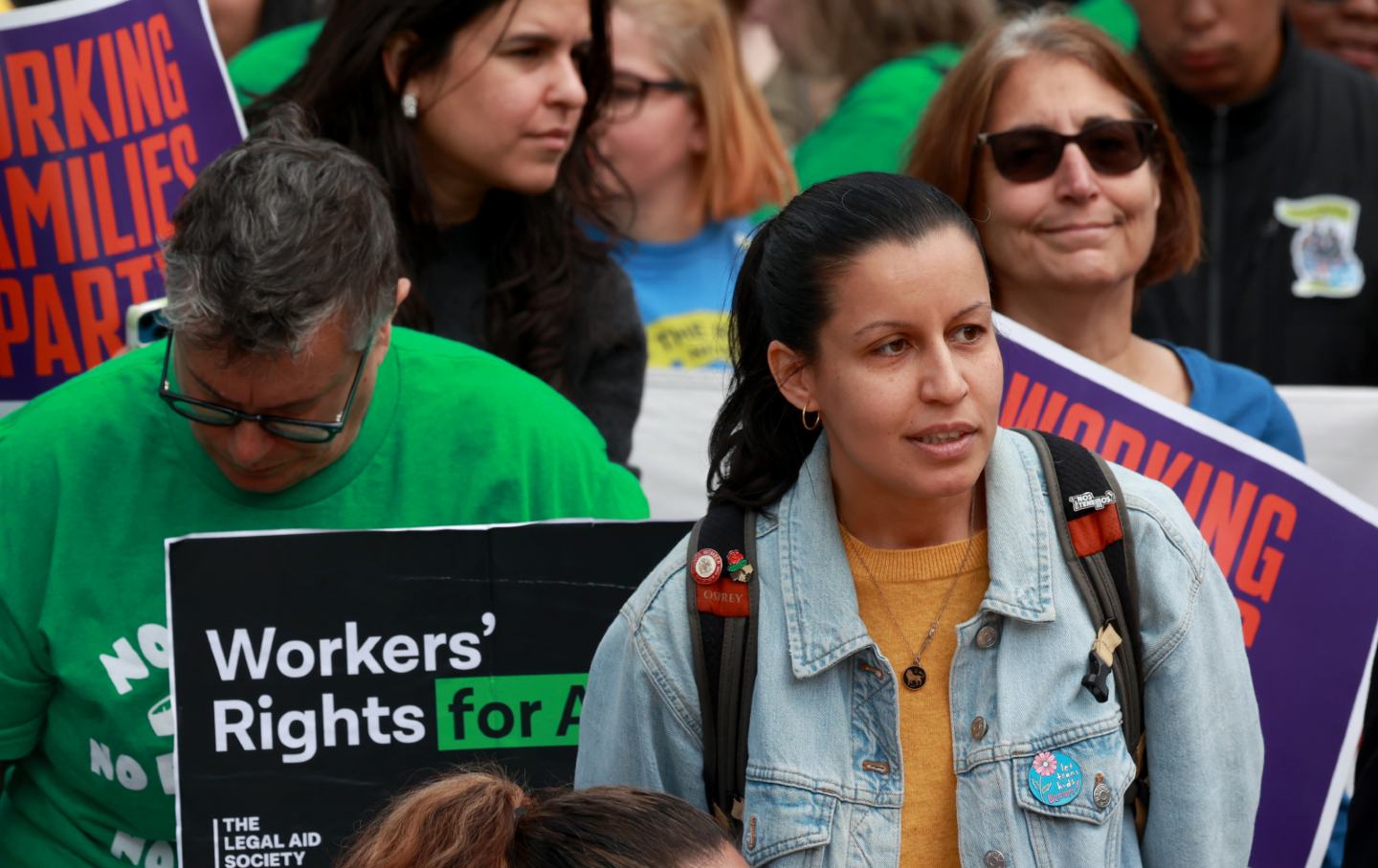
New York City Council member Tiffany Cabán and hundreds of workers gather for a May Day rally for labor protections on May 1, 2023.
(Luiz C. Ribeiro for the NY Daily News / Getty Images)
The harassment started when Tiffany Jade Munroe’s coworkers found out she was transgender. Then she was fired from her warehouse job with no explanation and no warning. And there was nothing she could do: In New York, it is almost always legal to fire a worker with no reason and no recourse. This is known as at-will employment.
You might be asking: Isn’t discrimination in hiring and firing illegal under the Civil Rights Act? It is. So why have so many New Yorkers—one in four women and one in 10 men, to be exact—endured sexual harassment at work to avoid being disciplined or fired? And if they did speak up, why were so many of them (one in seven) fired or disciplined for speaking up about workplace concerns?
What happened to Munroe is not an outlier. At-will employment allows discrimination to run rampant in the workplace. If employers don’t need to provide a legitimate reason (or any reason) for a firing and there are few mechanisms for recourse, anti-discrimination laws like the Civil Rights Act are incredibly difficult to enforce.
Luckily, there is a solution that has already been tested on the fast-food industry and is supported by 79 percent of New Yorkers: the Secure Jobs Act.
Int 909, also known as the Secure Jobs Act, would end at-will employment and expand the labor rights that were granted to NYC’s fast-food workers in 2020, and which are already held by many union workers, to all workers in New York City. If this bill became law, it would be a major shift in American labor law.
At-will employment does not exist in almost any other country. Montana, with its population of 1 million, has banned at-will employment, and now it’s time for a city of 8 million to follow, proving that in rural and urban areas around the country, every job can and should be a secure job. New York can become the first big city in the US to require all employers to give workers advance notice of termination and a written explanation of their firing, as well as the opportunity to appeal termination decisions and be reinstated.
Under at-will employment, many workers are afraid to speak up about unsafe conditions or come together with their coworkers for fear of being fired. Union members are protected from unjust firings by provisions in their contracts, but most working Americans are forced to live under the constant threat of being fired for any reason, or no reason at all, with no warning, explanation, and recourse.
The power of organized labor comes from one essential value: solidarity. For any of us to be free and dignified, we must all be. If ending at-will employment is good for union members, it is good for all workers.
Popular
“swipe left below to view more authors”Swipe →In New York, half of all working New Yorkers are one or two paychecks away from losing the ability to pay rent, afford medicine, food, or childcare. Every working New Yorker—every working American—deserves job security and peace of mind, not vulnerability and precarity.
The Secure Jobs Act flips the burden of proof in workplace discrimination and retaliation cases. Instead of requiring the worker to explain their firing, the Secure Jobs Act would place the responsibility on the employer to show that there was a good reason for the firing.
In the fast-food industry, these protections are already working: In July of 2021, Austin Locke, a Starbucks barista and union organizer, was fired unfairly. In March 2023, Austin was reinstated and received $21,000 in back pay because the City of New York had his back. Every New Yorker—in every industry—deserves that level of job security.
While the overwhelming majority of New Yorkers support ending at-will employment, massive corporations like Amazon are leading the fight against it. They’re hiding behind the very mom-and-pop businesses that they’re squeezing out of existence, saying new labor protections would result in waves of storefront closures. That is exactly the line that fast-food corporations pushed before the same protections were applied to them in 2020. And guess what: The closures they fearmongered about never happened.
Ending at-will employment does not threaten small businesses. Owners will still be able to lay workers off in times of economic hardship or terminate the job of any worker who violates policies or fails to fulfill the terms of their contract—each of which qualifies as a valid reason for termination under the Secure Jobs Act.
Ending at-will employment is a crucial missing piece for making our civil rights laws enforceable. It will strengthen the labor movement by creating an environment where workers can more readily come together and speak up. Everyone should have a stable job they can count on and enough security to plan their life. As elected officials and labor leaders, we’re ready to rewrite the rules so that every job is a secure job.