
A Native Movement Hopes to Get Out the Vote. But Some Native Americans Say, “No Thanks!”
Democrats in Indian Country are organizing under a slogan: “Voting is sacred.” But some Native Americans wonder why they should participate in a system that ignores them.
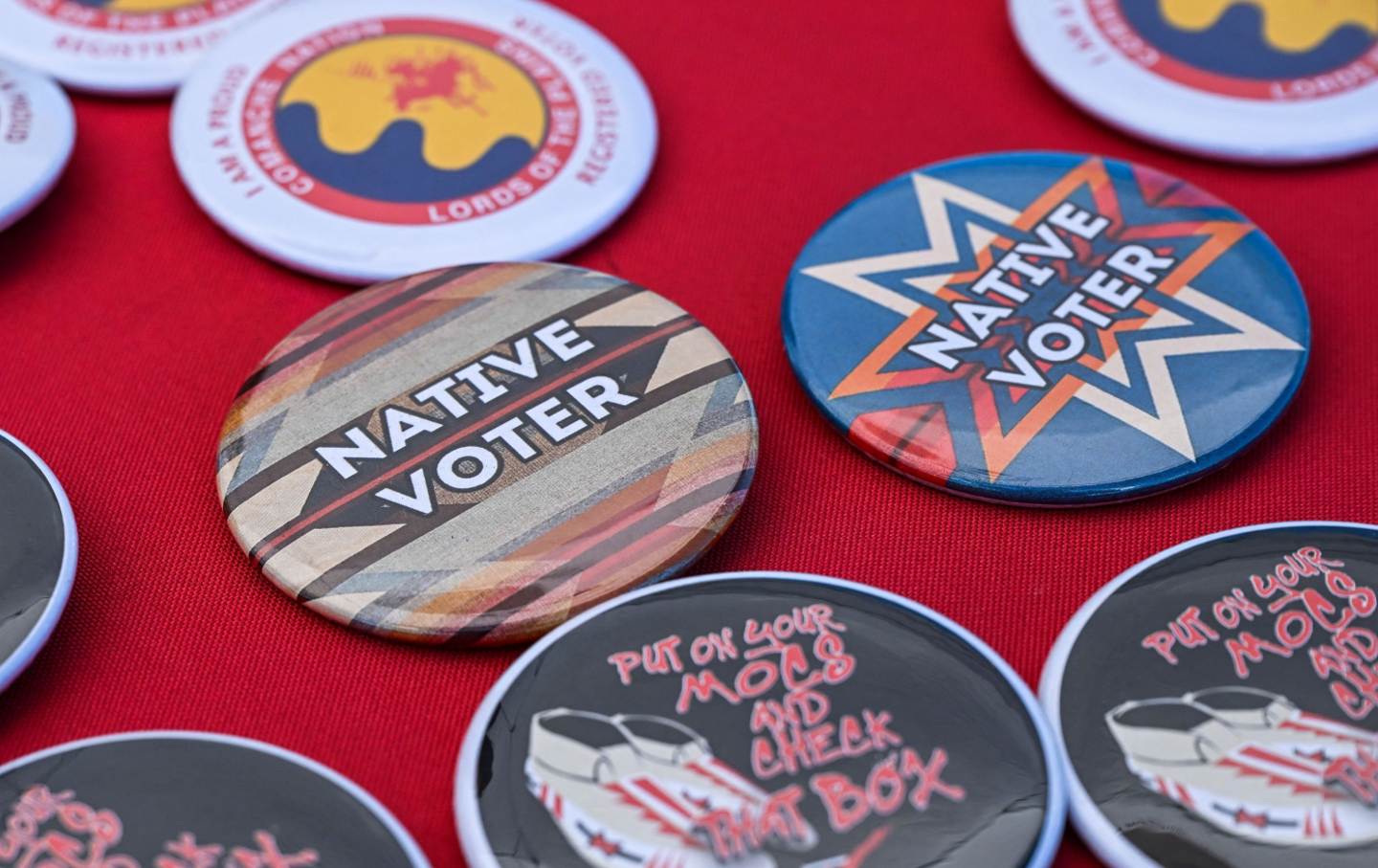
“Are you going to vote?” I asked Diannah Reid, a full-blooded Navajo and a survivor of an Indian boarding school. She has scars on the back of her hand where her teacher would smack her with a ruler when she spoke her language.
“No,” she said. “Why? If I do, are they going to give us the land back?”
During the presidential debate between Kamala Harris and Donald Trump, Black and Hispanic Americans were mentioned, but Native Americans were not.
“They don’t see us,” she said. “Just our existence alone makes them uncomfortable. They know they’re on stolen land—all of them—and voting is not sacred.”
Reid, 31, was referencing a slogan and movement led by young Native Democrats in Indian Country that proclaims, “Voting is sacred.”
She said democracy existed in what people call “the New World” long before colonial invasion, and on the reservation voting “in the old way” is sacred. “White people love to say the Greeks gave us democracy,” she said. “We had it here for centuries before they ever accidentally stumbled to our lands.”
“But I’ll play along,” she said. “So, if I vote, will they abolish Columbus Day? Will they give the Black Hills back to the Lakota or stop poisoning our water with fracking? Of course they won’t.” (Harris said during the presidential debate that as president she would not ban fracking.)
Reid, who was born on the Navajo Nation in an area called the Western Agency, said the erasure of Indigenous voices is evident in speeches by both presidential candidates and in the news media. “Watch MSNBC,” she said. “How many Natives do they have on there? Did they mention that asshole who said we’re drunk at 8 am and throw Coors cans? No.”
Recently audio of Tim Sheehy speaking at a private fundraiser in 2023 leaked. In it, the Trump-backed Republican candidate trying to oust Montana’s Democratic senator, Jon Tester, referred to Native Americans as drunks.
“Great way to bond with all the Indians, to be out there while they’re drunk at 8 am,” he said, talking about the Crow Nation. “They let you know whether they like you or not—there’s Coors Light cans flying by your head riding by.”
Sheehy has yet to issue an apology for his comments.
In Montana, the Native vote could help the Democrats keep the Senate; Native Americans make up about 6.5 percent of the state’s population, enough to sway a close election. Yet Tester is starting to fall behind Sheehy, according to polls. If Sheehy wins, it could shift the Senate from blue to red.
Regarding Sheehy, Reid told me that “when it comes to Natives you can be as racist as you want in America and get away with it. Just look at the [Kansas City] Chiefs and the tomahawk chop. It’s American racism on prime-time TV and clearly in politics.”
Popular
“swipe left below to view more authors”Swipe →In the media, displays of Native Americans as Indian mascots are ubiquitous, but on the hard news side, there is almost no Native representation. It’s either racist caricatures or nothing at all. I was told again and again that this can and does translate to Natives, especially young Natives, deciding not to vote in presidential elections. To feel like voting matters, you have to feel seen, and many Natives don’t.
During the 2020 presidential election, for example, CNN listed white, Latino, Black, and Asian, but Natives were counted as “something else.” Elders across the country were livid, because they feared that the erasure of this country’s first peoples from the media could dissuade Natives from voting in a presidential election.
Sonny Skyhawk, a Sicangu Lakota and an advocate for broad representation of Natives in media, said Americans’ subconscious dislike of Indians is born from Hollywood, specifically Western movies. “They had to create a bad guy, and we’re still that bad guy,” he said.
With regard to mainstream news pundits’ rarely mentioning the racist comments by Sheehy, Skyhawk said, “To them, we’re not important enough to consult with.”
And according to NBC Universal, only 0.4 percent of its workforce identifies as Native—self-identified “Indians”—meaning anyone on staff can claim to be Native American by checking the box, including people known in Indian Country as “box-checkers” or “high-cheekboners.”
Skyhawk, 80, does, though, disagree with Reid on one topic—voting. He believes voting can do some good for Natives: “Native peoples aren’t part of the equation, and consequently don’t participate, but you have to participate in the system in order to make the system change and create that change.”
Elections in many Native nations and tribes are very different from ones at the US state and federal level. For instance, voting for the Lakota begins with the women’s council. For centuries, women have chosen the candidates. It’s a sacred process, not only because it’s an ancient practice but also because it’s tied to Lakota spirituality.
It also makes sense politically, Walt Pourier, an Oglala Lakota artist, told me. “There is no better judge of a man’s character than a woman,” he said. “Men like to pound their chests and be manly with one another. Women know your vulnerabilities and weaknesses behind closed doors. And they’ll tell you if you’re weak and vulnerable; they know if you’re the kind to lead. So they ultimately chose our chiefs.”
Pourier’s daughter, Leala, 23, said, “The [American] system doesn’t include us—Natives.” She said that while “we can’t have a Trump,” Harris’s position on the genocide in Palestine is why she hasn’t decided if she’ll vote this November.
“They’re demonizing Indigenous peoples here and across the sea,” she said. “For me, it comes down to Palestine.” Leala said if Harris and Trump can’t and won’t acknowledge the genocide of Palestinians, how will either ever acknowledge the genocide of Natives on the land they live on?
“You can’t even acknowledge the Natives here, and you’re being complacent with genocide in Gaza,” Leala said.
Yet Allie Young—a fellow full-blooded Navajo, a screenwriter and founder of “Ride to the Polls,” a campaign where Natives ride on horseback and go door-to-door across the rez to encourage voting this presidential election—said that even though white people have yet to wholeheartedly believe in the Native vote, “we’re still showing our political power.”
“But MSNBC?” I asked. “Oh, yeah, them. Well, we’re fighting to be seen,” she replied.
Deb Haaland, the secretary of the interior and a citizen of the Laguna Pueblo in New Mexico, wrote in an op-ed in Indianz that she believes voting is sacred and that “we must use our voices in every election.”
Haaland, who in 2020 became the first Native appointed as a cabinet secretary, added that Indigenous people would honor their ancestors by voting, including in the US presidential elections: “Our ancestors and relatives survived against seemingly insurmountable odds, which is why we owe it to them to make our voices heard at the ballot box.”
Rae Fancher, the first Alaska Native female to graduate from the Naval Academy, will vote this year, but she understands why other Alaska Natives won’t. She said she also feels invisible to the news media and politicians. “I can’t remember the last news story that had Alaska Natives as it’s focal point,” she said. “I’ve gotten, ‘I thought you all were dead’ multiple times throughout my life—my people as a whole are taught as past tense.”
She told me, “To vote is important and vital, but white people are going to get what white people want.” Fancher added that she’ll vote for Harris in November, if only to protect her ancestral home from extractive industries in northern Alaska: “So we can protect our way of life, the way we’ve lived for thousands of years.”
Reid, like many others I spoke with, said the mainstream media ignores Native voices, and that when you’re disregarded, when so much of the media is willfully oblivious to your political desires, why would participating in the electoral process be sacred? Why, Reid wondered, would you participate at all? “You don’t see us? Fuck you back,” she said.
Indigenous people, old and young, are working diligently across the country to get out the Native vote, but on November 5, Reid will do something that she considers more productive—“some self-care.”
“I’ll probably sit at a coffee shop and sketch,” she said. “Others can vote for a president if they want. I’m not obligated.”
More from The Nation
The White Man Can Always Take What You Have The White Man Can Always Take What You Have
In this week's Elie v. US, our justice correspondent breaks down the real message of the attacks on Ilhan Omar. Plus: the anti-trans case that will come for us all.
Where Is the Outrage Over Trump’s Racist Targeting of Ilhan Omar? Where Is the Outrage Over Trump’s Racist Targeting of Ilhan Omar?
The establishment press and some Democrats are strangely mute over the president’s flagrant abuse of the legal system.
America’s UN-Healthcare Treatment America’s UN-Healthcare Treatment
The UnitedHealth group CEO’s savings plan.
Gina Hinojosa Is Showing Democrats How to Run Against Republican Grifters Gina Hinojosa Is Showing Democrats How to Run Against Republican Grifters
The Democratic gubernatorial candidate has closed the gap in Texas by focusing relentlessly on Greg Abbott’s corruption.

