
We Rejected Monarchy in 1776. The Supreme Court Just Brought It Back.
King George III was tossed aside 248 years ago. Now the court seeks to impose King Donald I.
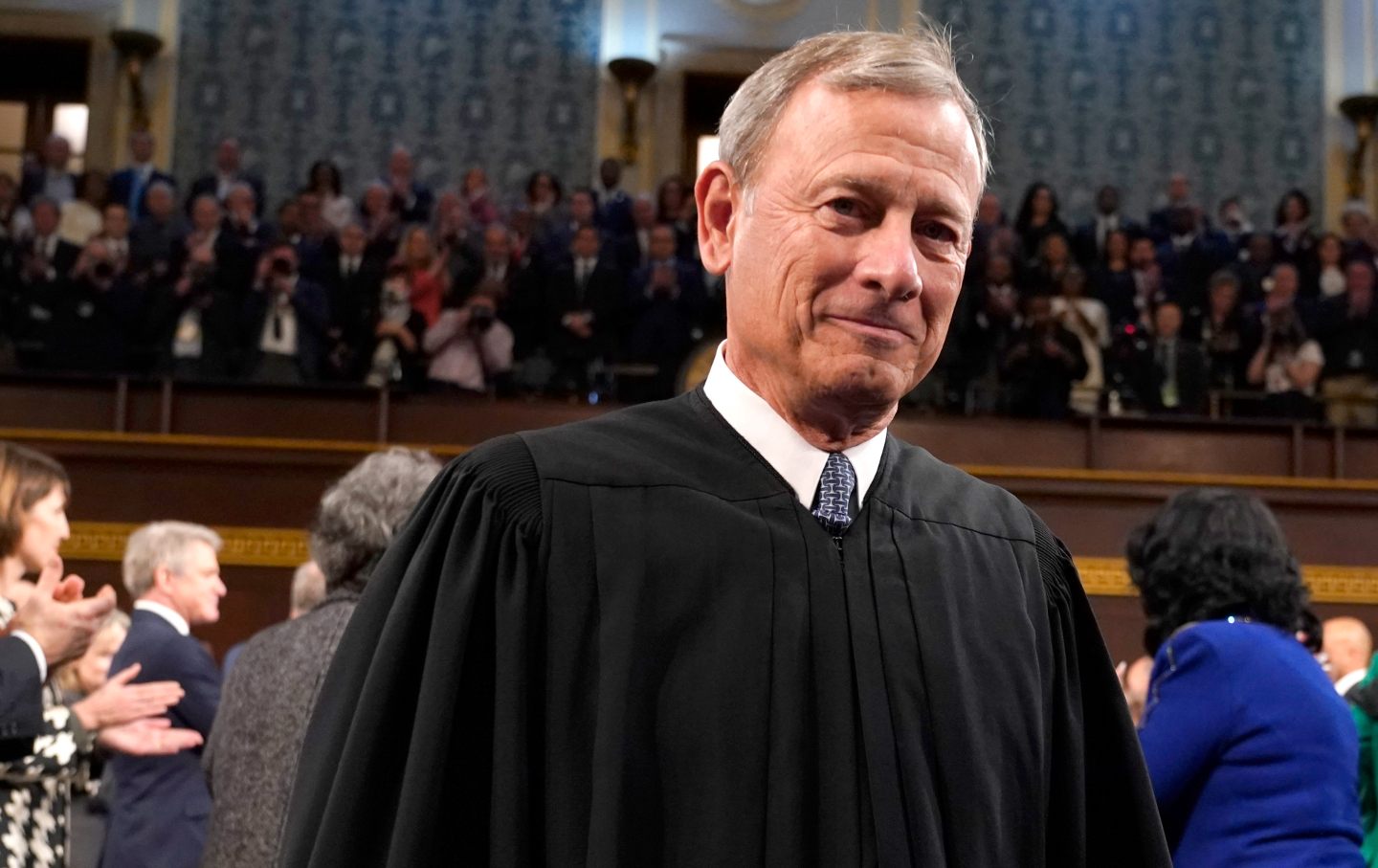
Chief Justice of the United States John Roberts attends the State of the Union address on February 7, 2023.
(Jacquelyn Martin / Pool via Getty Images)“There are no kings in America,” declared President Biden after the United States Supreme Court reinterpreted the Constitution to afford monarchical immunity powers to American presidents.
Biden’s point was true enough, at least for the moment. But there have been kings in this land before. A lot of them. From 1607 to 1783, the eastern seaboard of the North American continent was governed by King James I, King Charles I, King Charles II, King James II, King William III, Queen Mary II, Queen Anne, King George I, King George II, and, finally, King George III, who like many of his predecessors, was a raging madman.
The greatest contribution to the progress of humanity made by the colonialists forging the United States was their revolt against King George III and the brutal lie that imagined a “divine right of kings.” Theirs was an Enlightenment-inspired revolution whose finest champion, Thomas Paine, described as “the cause of all mankind.”
“The sun never shined on a cause of greater worth,” wrote Paine in Common Sense, his revolutionary call to arms. “’Tis not the affair of a city, a county, a province, or a kingdom, but of a continent—of at least one eighth part of the habitable globe. ’Tis not the concern of a day, a year, or an age; posterity are virtually involved in the contest, and will be more or less affected, even to the end of time, by the proceedings now.”
With the American Revolution against monarchy and empire, argued Paine, “a new era for politics is struck; a new method of thinking hath arisen.”
To this day, we celebrate that new thinking on July 4, as the moment when, again borrowing Paine’s language, the choice was made “to begin the world over again.”
After this revolution succeeded, the founders of what would come to be known as the American experiment wrote a Constitution that contained some fundamentally flawed ideas—from the grotesque calculus that accepted human bondage to the establishment of an Electoral College that is subverting our democracy to this very day. Yet the founders got one thing very right. Because of their bitter experience with monarchy, they established a system of checks and balances that was designed to guard at every turn against monarchical excess.
The Congress, particularly the elected House of Representatives, was to be supreme. As House Judiciary Committee member Jamie Raskin, the Maryland Democrat who is the House’s great constitutional scholar, says,
We are not a coequal branch. We are the first among equals. We are in Article 1 of the Constitution. We are the representatives of the people. When you look at the powers of Congress, they are comprehensive and abundant. The president’s core job is to take care that the laws are faithfully executed, not thwarted and circumvented, much less violated.
To check and balance such violations, the Congress was given the power of the purse, as well the ultimate power to impeach and remove presidents and errant executives—a power it has failed, repeatedly, to embrace with the energy and determination that was intended by the founders or required by the moment.
But legislative oversight was not the only method of checking presidential power that was outlined in the Constitution. The courts were given their own authority to constrain presidents and their administrations.
Even with those constitutional guardrails, however, the wisest founders worried. It is reported that Benjamin Franklin, following the signing of the Constitution in September of 1787, was asked by Elizabeth Willing Powel, “Well, Doctor, what have we got, a republic or a monarchy?”
Franklin famously responded, “A republic, if you can keep it.”
The United States Senate failed to keep it in 2021, when Republicans who—after Trump had been impeached by a bipartisan majority in the House—cast a sufficient number of votes to block the conviction of Trump for his efforts to overturn the results of the 2020 election. At the time, Senate minority leader Mitch McConnell (R-KY) justified this dereliction of duty by claiming, “The Constitution gives us a particular role. This body is not invited to act as the nation’s overarching moral tribunal.” Instead, McConnell suggested, “We have a criminal justice system in this country. We have civil litigation. And former presidents are not immune from being held accountable by either one.”
But on July 1, 2024, 72 hours before Americans would celebrate the 248th anniversary of the Declaration of Independence, a 6-3 majority of Republican-appointed conservative legal activists on the Supreme Court determined — at the behest of Donald Trump — that presidents and former presidents have broad immunity from criminal prosecution for “official acts” while in office. Chief Justice John Roberts spelled it out when he announced that “the nature of presidential power entitles a former president to absolute immunity from criminal prosecution for actions within his conclusive and preclusive constitutional authority.”
While Americans were looking up the definition of “preclusive,” Justice Sonia Sotomayor explained that, with its decision in the immunity case, the court’s majority “makes a mockery of the principle, foundational to our Constitution and system of government, that no man is above the law.”
Then, Justice Sotomayor pointed to the fundamental reality that extends from the court’s decision: “In every use of official power, the President is now a king above the law.”
Sotomayor concluded her response to the court’s decision by announcing: “With fear for our democracy, I dissent.”
Benjamin Franklin and his compatriots gave us a republic, if we could keep it. As of now, we are not keeping it. This is the truth that should be acknowledged on July 4, 2024. And it is the threat that should be addressed on November 5, 2024.
This is, to put it mildly, a politically turbulent moment, but one truth is self-evident: Unless Americans elect a president who respects the Constitution’s written constraints on his power—as opposed to the reinterpreted fantasy of the current Supreme Court—the monarchical threat will be realized. And even if that threat is averted this fall, the work of the republic will be incomplete. Until a constitutionally inclined president and an allied Senate move to expand the membership of the high court so that a new majority can undo the damage done on July 1, 2024, this country’s revolutionary promise will remain in a new variation on the peril that led Thomas Paine to observe, “These are the times that try men’s souls.”
Popular
“swipe left below to view more authors”Swipe →More from The Nation

James Talarico Is Preaching a Gospel of Pluralism James Talarico Is Preaching a Gospel of Pluralism
He’s not the only progressive doing it.
Even Republicans Are Waking Up to Trump’s Corruption Even Republicans Are Waking Up to Trump’s Corruption
And, somewhat shockingly, so are Democratic elites.


Mamdani Can No Longer Avoid the Issue of the NYPD Mamdani Can No Longer Avoid the Issue of the NYPD
The mayor has been able to put difficult questions about policing on the back burner—until now.

Why Democratic Leaders Keep Waging War on the Young Why Democratic Leaders Keep Waging War on the Young
The party's silver-haired establishment is caught up in an existential culture war.

The White Man Can Always Take What You Have The White Man Can Always Take What You Have
In this week's Elie v. US, our justice correspondent breaks down the real message of the attacks on Ilhan Omar. Plus: the anti-trans case that will come for us all.

