There Is No Universal Free Speech
PEN America hides behind the false universalism of free speech, but institutions always choose whom to protect.
Israel’s assault on Gaza has shuttered every one of its schools and universities, many of which have been reduced to rubble. Israel can cut off Internet and other forms of communication at any time. Air strikes have killed more than 100 journalists, many of whom Israel appears to have targeted. This is in addition to the tens of thousands of Palestinians killed by Israeli bombs (often manufactured by American companies), for whom there is, of course, no freedom of expression.
In every conversation about Palestine, it is important to begin with these stakes. Because the material reality in Gaza is often lost in the debate over the appropriate response in the United States. As liberal organizations and universities in the US hem and haw over the merits of street protests, cultural boycotts, and campus occupations, the conversation gets mired in the abstract in questions about freedom of speech—all while those with the least freedom of speech and expression have been sidelined, silenced, or killed.
These debates about freedom of speech—in America’s op-ed pages, on college campuses, and within organizations supposedly dedicated to the freedom of speech—obfuscate who actually has the power to effect change in Gaza. When liberal organizations are threatened, they fall back on appeals to “universal” values. But what has become clear is that these values are not nearly as universal as these organizations would like us to think, and that these organizations exist not to protect the universality of those values but to protect the status quo.
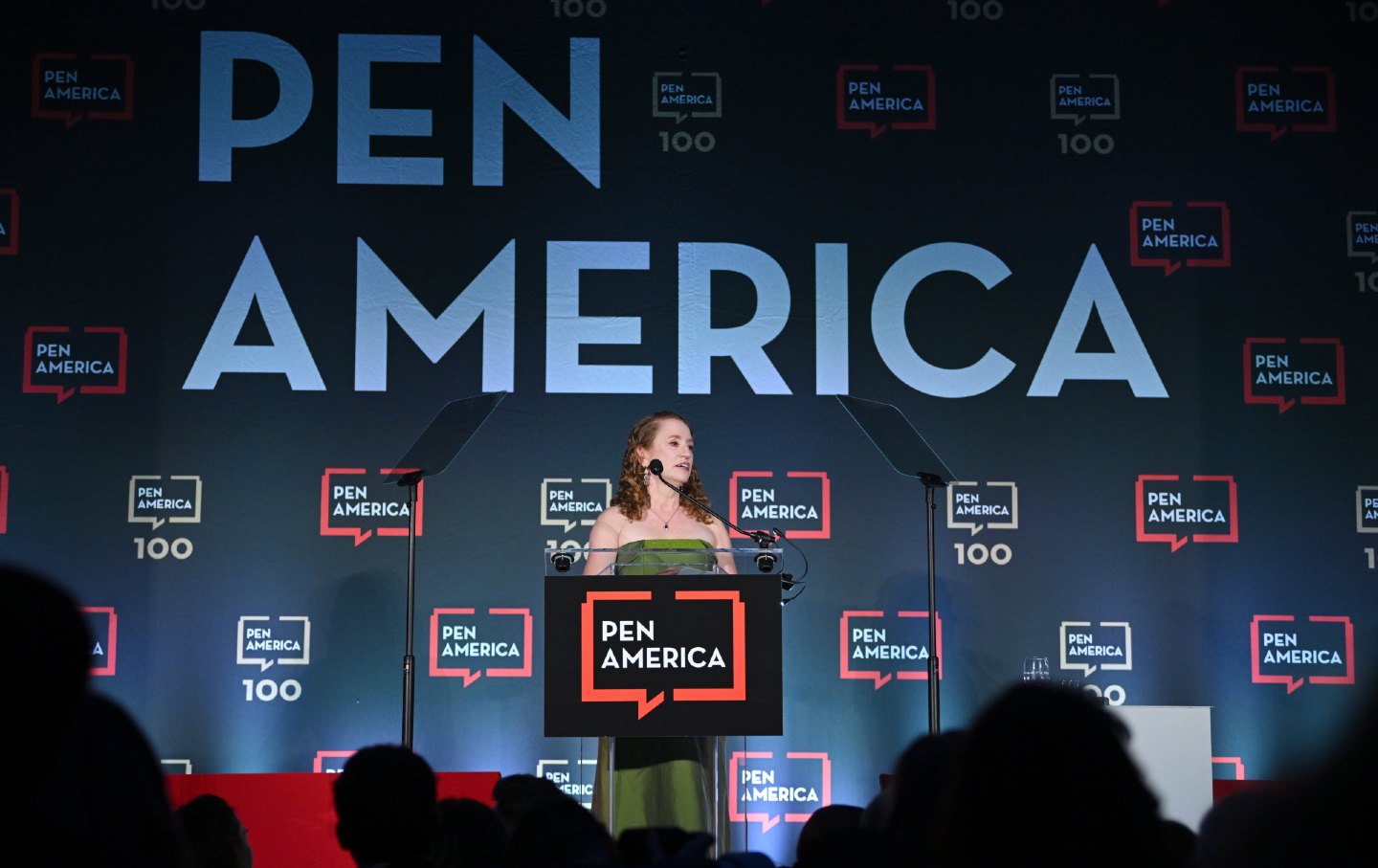
Since October 7, groups like Writers Against the War on Gaza have been calling out these organizations’ hypocrisy for supporting the supposedly universal value of free expression while remaining largely silent on or even stifling dissent about Palestine. One target of their campaign has been PEN America, the prestigious literary organization with a mission to safeguard the rights of writers and artists around the world. In late January, protesters from WAWOG disrupted a PEN event at which the actress Mayim Bialik, who publicly supports Israel’s war on Gaza, was scheduled to speak. For months, WAWOG had been calling on groups to condemn the killing of journalists, writers, and poets and the destruction of schools, libraries, and other cultural institutions in Gaza by Israel.
But PEN’s response to these calls has shown how little it really cares about the freedom of expression. PEN used private security to eject one of the WAWOG protesters, the Palestinian American writer Randa Jarrar, and released a statement saying that it supported the right to protest but that protests “cannot be allowed to shout down, shut down, or obstruct the speech of others.” This has more or less been the standard response by institutions when asked about their response to demonstrations against Israel’s war.
What liberal organizations deem acceptable speech and what they deem disruptive action is not a matter of what kind of speech is being used, but a matter of those in power deciding what kind of speech is worthy of defense. PEN America, for instance, had no problem supporting boycotts of Azerbaijani events, though it came out forcefully against any cultural boycott of Israel.
Universal free speech does not exist and has never existed. Private property rights, for example, usually override free speech law—you have no right to protest in a Walmart. And the right to free speech is not equally distributed. Those with more money have more of a right to speak and be heard than those without (see Citizens United), while people in prison have essentially no right to free speech.
As much as Americans like to think of their country as a beacon of free expression, the history of progress in the US is largely a history of institutions deeming free speech that challenges the status quo over-the-line or illegal. The origin of the free speech axiom “You can’t shout fire in a crowded theater” had nothing to do with fires or theaters. It was about anti-war protesters handing out pamphlets during World War I. The Supreme Court ruled that the pamphlets presented a danger (the danger of not being able to draft Americans into war) and that jailing their distributors was therefore legal. Many of the rights Americans now take for granted—the right to organize, to protest, to be free from racial or gender discrimination—only happened because of speech that was considered to have crossed into violence. While it’s easy in hindsight to say those fights were righteous, it seems much harder for institutions to support the same sorts of boundary-challenging actions today.
PEN America does good work—advocating against book bans and on behalf of writers who face government censorship. But like most progressive institutions, it has a blind spot when it comes to Israel and Palestine. It chooses to hide behind the false universalism of free speech rather than acknowledge that all speech is political and therefore potentially disruptive, and thus that there is no way to not choose sides when it comes to deciding whose speech is worthy of institutional protection. Indeed, by attempting to not choose a side, they already have.