
New Polling Shows Significant Ukrainian Support for Diplomacy to End the War
There is more dissent from the Zelensky government’s war aims than may appear.
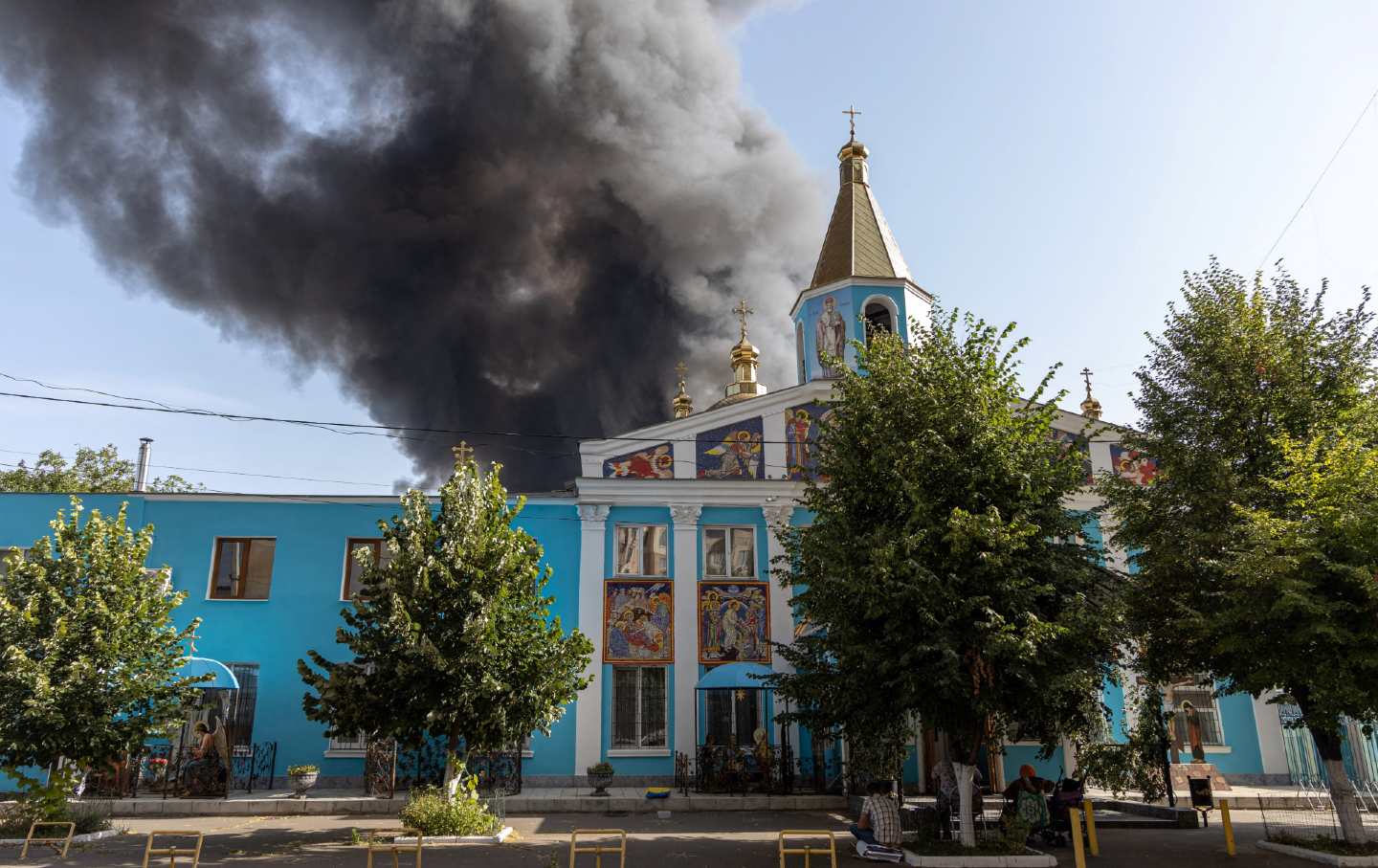
A peace summit held on the weekend of June 14 in Switzerland reaffirmed Kyiv’s commitment, against the backdrop of mounting skepticism among key international players, to a maximalist set of war aims as Russia’s invasion of Ukraine grinds into its third year.
Ukrainian President Volodymyr Zelensky has repeatedly said that his country must keep fighting—no matter the costs—until its 1991 borders are restored. The presumption that the vast majority of Ukrainians share this goal underpins the West’s tacit support for the Zelensky administration’s war aims.
But new polling showing significant Ukrainian support for diplomacy to end the war—paired with a closer look at other indications that Ukrainians are rejecting risking everything for victory—challenges this understanding.
The narrative of totally unified Ukrainian opinion is premised on polls from the earliest days of the war showing nearly unanimous Ukrainian support for the government and its handling of the war effort. This seeming consensus has steadily eroded since the peak of Ukraine’s battlefield successes in 2022, when 70 percent of survey respondents affirmed that Ukraine “should continue fighting until it wins the war.” That number dropped to 60 percent in the summer of 2023, according to Gallup. Polling since the failure of Ukraine’s 2023 offensive shows that 44 percent of Ukrainians favor entering into talks with Russia and only 48 percent—still a plurality but, notably, no longer a majority—believe Ukraine should fight on. Other recent polling shows that even in Kyiv, where Ukraine’s elite and bureaucracy is concentrated and political investment in the war effort is at its highest, complete confidence in Ukrainian victory is weakening.
Tellingly, recent surveys—including a new poll from the Carnegie Endowment for International Peace— suggest that the share of Ukrainians open to a negotiated settlement has dramatically risen over the past year and, if present trends hold, is well on the way to becoming a majority-held view.
These findings are reinforced by a decline in Zelensky’s approval rating and loss of public trust in the national TV Marathon, a platform of media channels that report on the war from a pro-government stance. Ukrainian bloggers with much more critical perspectives on Kyiv’s handling of the war are amassing large audiences on social media.
Another key metric of public investment in the nation’s war effort is support for mobilization. A plurality of Ukrainian men said in a February poll that they are not prepared to fight. One Ukrainian soldier told the BBC late last year, “It’s a total nightmare. A year ago, I wouldn’t have said that, but now, sorry, I’m fed up. Everyone who wanted to volunteer for war came a long time ago—it’s too hard now to tempt people with money. Now we’re getting those who didn’t manage to escape the draft. You’ll laugh at this, but some of our marines can’t even swim.”
Kyiv took the drastic step earlier this year of suspending consular services for men aged between 18 and 60 to contend with military recruitment problems. A staggering 11,000 Ukrainian men have opted out of participating in the war by illegally crossing into Romania, one of seven countries bordering Ukraine.
A closer look at the views of those who are not being captured by these polls suggests a likelihood that there is far more dissent from the Zelensky government’s maximalist war aims than it may appear.
The views of the roughly 6.5 million Ukrainians who have left the country of 44 million since the war’s outbreak are not accounted for in national polls. While we can’t presume to know the extent of support for maximalist war aims among refugees, they have effectively voted with their feet against active participation in the war. Likewise, the views of Ukrainians living in the territory controlled by Russia—Crimea and large portions of the Donbass—are typically not counted. But we do know from polls taken prior to the invasion that this population has consistently demonstrated a higher prevalence of pro-Russian attitudes.
Ukrainians living along the contact line are also vastly undercounted owing to the functional difficulties in reaching them in the midst of a war. Research does suggest that Ukrainians most directly affected by the war are markedly less likely to support the government’s maximalist positions. Ukrainians in active war zones who bear the brunt of the fighting are much more likely than their counterparts in western and central regions to support an immediate cease-fire and negotiations with Russia.
Beyond methodological issues, the results of wartime polls—regardless of where the war is being prosecuted—are skewed by overt and implicit domestic pressures. Wars produce a well-established “rally ‘round the flag” effect, which is clearly present in Ukraine, but not all proclamations of support for the Ukrainian war effort and the Zelensky administration’s war objectives can be taken at face value. Even in democratic societies, dissenting from mainstream views in a wartime context can invite a wide range of social sanctions, including loss of employment and community ostracism.
Popular
“swipe left below to view more authors”Swipe →Compounding these social pressures are legal ones. Ukraine’s sweeping collaboration laws criminalize, among other things, calling for “for support of decisions and actions of the aggressor state” and the “refusal to recognize Ukraine’s state sovereignty over the temporarily occupied territories.” It is unclear whether merely the act of calling for trading land for peace is enough to qualify as a criminal offense under this statute, but many Ukrainians may not want to take that chance in the context of heightened restrictions on types of political speech that contradict the government’s war aims.
There’s no question that Ukrainians have shown incredible courage and determination in resisting Russia’s invasion. But their fortitude cannot reverse the emerging grim realities in their society and on the battlefield. Ukraine now boasts the lowest fertility rate in the world; half of the country’s power generation capability has been destroyed. To sustain its struggling economy and stalling war effort, Kyiv is now auctioning off large state assets to the highest bidders. And on the front lines, Russia continues making steady advances, with eyes toward capturing strategic high grounds that risk propelling further advances. It’s increasingly clear that the longer this war persists, the worse off Ukraine will be.
In view of these long odds, continuing to conflate the interests of the Ukrainian government with the hopes and aspirations of the Ukrainian people is a way of ducking responsibility. Refusing to see how this ruinous war is driving Ukrainian appetites for an end to the bloodshed allows Western policymakers to fall back on oversimplified, unfounded presumptions about Ukrainian public opinion, rather than develop a coherent, viable, and humane strategy for ending this war.
Caricatures of a totally unified Ukraine behind the Zelensky government only help gloss over real and growing challenges facing the nation—often in service of war aims that are becoming more impossible by the week. It’s time policymakers outside the line of fire recognize these realities and begin forging a strategy to push all sides toward peace and begin rebuilding this decimated country.
Become a Sustaining Donor This September
Between the reemergence of right-wing red-baiting and Donald Trump’s use of the chilling National Security Presidential Memorandum–7 to criminalize left political organizing, we’re seeing McCarthyism reborn before our eyes.
This assault on democracy cannot be ignored or wished away. Resisting it requires bravery in the face of threats and repression, a steadfast commitment to the truth, and the unwavering belief that we can—and will—overcome this darkness.
We must have an independent media that sets the record straight, unearths corruption and abuses of power, and advances a politics of justice and dignity for all if we’re to win this fight.
That’s why I’m writing to you today. This September, The Nation needs to add 100 monthly donors to sustain our progressive journalism. Your contribution makes the next investigative report, the next truth-speaking column, and the next pathbreaking essay all possible.
I hope you’ll support our work with a recurring donation today. If you donate $10 or more a month, we’ll send you a brand new “Hands Off the Free Press!” sticker to recognise your commitment to our cause. Please, donate today.
Onward,
Katrina vanden Heuvel
Editor and Publisher, The Nation
More from The Nation
Japan’s Far Right Is Courting Young Voters Japan’s Far Right Is Courting Young Voters
Sanseitō has attracted young voters through a robust social-media strategy, Charlie Kirk–like public speaking events, and anti-establishment messaging.
This AI Panic Is Nothing New This AI Panic Is Nothing New
In the 1940s, The Nation asked questions about the atomic bomb we’re asking of artificial intelligence today.
The Decades-Old Roots of Trump’s War on Iran The Decades-Old Roots of Trump’s War on Iran
An interview with historian Behrooz Ghamari-Tabrizi about the generations of US presidents who have tried to destroy the Iranian regime.
Emmanuel Macron’s Turbulent Exit Emmanuel Macron’s Turbulent Exit
Between a budget crisis and a cost-of-living squeeze, Macron is leaving a country feeling more insecure than ever—and ready to take to the streets.
Israel’s Election Can’t Fix What Netanyahu Broke Israel’s Election Can’t Fix What Netanyahu Broke
The fundamental problem is not the name of the prime minister, but rather the actions of the Israeli government and the urgent issues that need to be addressed.
The AfD’s Rise Isn’t Just About East Germany The AfD’s Rise Isn’t Just About East Germany
The Alternative für Deutschland has a stable national poll lead, including in the former West Germany. Its rise owes to much more than Eastern grievances.

