
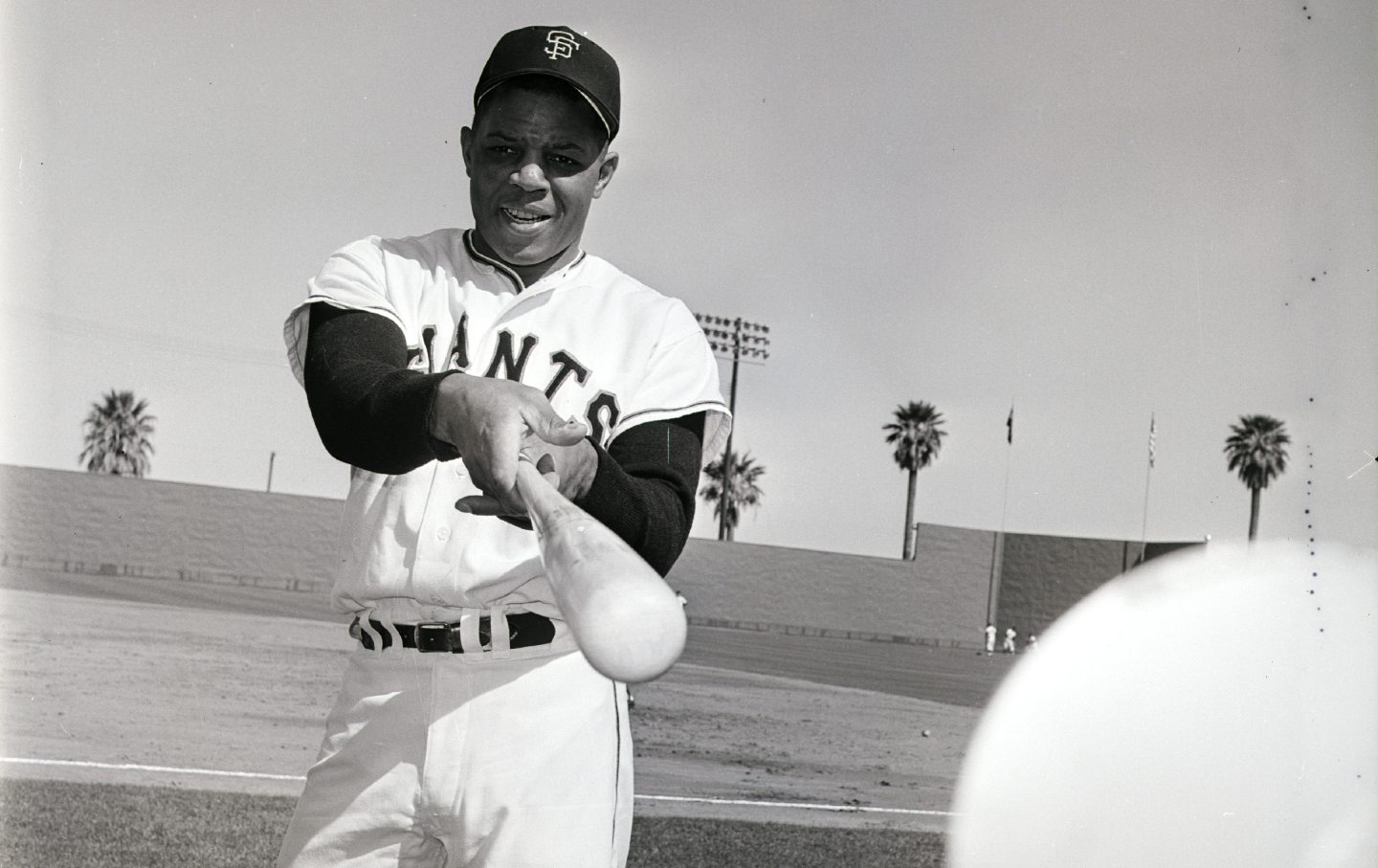
San Francisco Giant center fielder Willie Mays swings his bat during spring training in Phoenix, Arizona, on February 24, 1961.
(Bettman via Getty Images)
Willie Mays, the baseball superstar who played for 22 years with the Giants and Mets, died on June 18, 2024. He was 93. With his death, the era of the living, mythic baseball hero is over. During his heyday, Mays’s cultural status was only rivaled by that of the Yankees’ Mickey Mantle. Both players combined unprecedented speed and power, but it is Mays who left us with the more thrilling and memorable plays, particularly in the field and on the basepaths. Mays also took better care of himself than Mantle, and as an All-Star Game starter in his early 40s was proud to wear the same waist size as he had 20 years earlier. Those who saw him play widely regard Mays as the greatest five-tool baseball player ever (batting, batting for power, baserunning, fielding, and throwing).
Mays was the last surviving star who began his career in Black baseball. Raised in Fairfield, Alabama, by his father, Arthur Mays, who played semi-pro ball for a steel mill, Mays was a member of the Birmingham Black Barons at 17. His dad, nicknamed “Kitty Cat” for his athletic quickness, schooled Willie in the rudiments of the game. The Barons and other Negro League elders shared more diamond wisdom with the prodigy: how to run bases strategically, when and where to throw to make an important defensive out and why. When Willie was 19, the Barons shared Rickwood Field with an affiliate of the Boston Red Sox. Boston scout George Digby wanted to offer Mays $4,500 to join the Red Sox system, but owner Tom Yawkey and general manager Joe Cronin passed, because they didn’t want a Black player on the team. If you’re imagining Mays patrolling center field in Fenway Park while Ted Williams played in left, you realize there was no Curse of the Bambino.
Impressive as Mays’s statistics were—he is the last player to hit at least 20 home runs, 20 doubles, 20 triples, and steal 20 bases in a season; he won league MVP awards 11 years apart, had seasons of 50 or more home runs 11 years apart, 12 Gold Gloves, and 24 All-Star Game appearances—his impact on society transcended sport. From his entrance on the national stage as a New York Giant, Mays was infantilized by the sporting press, who labeled him “the Say Hey Kid” for addressing people with “Say hey” and emphasized his smile and the joyful attitude with which he played.
The real Mays basked in luxurious suburban homes and had a penchant for tailored uniforms and buffed fingernails. In the late 1950s, Dodgers announcer Vin Scully asked Mays if baseball was more a business to him, or a game. “It’s a business, Vin,” deadpanned Mays.
After Mays’s rookie season in 1951, Southern racial politics intruded on his joy. Birmingham announced that October 27 would be Willie Mays Day and that the city would commemorate him with a parade. Thousands of people showed up, but city safety commissioner and former sportscaster “Bull” Connor canceled the event. In later years, Mays said he bore no ill will toward Birmingham and even called Connor a “pretty good” announcer. Connor would not return any good will to Black athletes. In 1953, Connor banned a team led by Jackie Robinson featuring Black and white major leaguers from playing in Birmingham. Robinson played the game anyway, benching three white players. In the late 1950s and ’60s, Connor, of course, would go on to violently enforce segregation, closing city parks rather than integrate them and allowing Ku Klux Klan members to attack Freedom Riders.
Some people at the time thought that Mays was unconcerned with the serious political issues of the time. But while Mays wasn’t public with his politics, he wrote a letter of encouragement to Autherine Lucy, the first Black student to enroll at the University of Alabama.
Mays took his role-model status seriously. When a 14-year-old youth baseball catcher named Orenthal Simpson came before a juvenile court judge for possible detention center service, it was Mays who asked the judge to give the boy another chance. When the Hunter’s Point section of San Francisco erupted in racial rebellion in September 1966, Mays taped a radio message encouraging fans to stay home and watch the Giants play the Braves in Atlanta. He never mentioned the uprising. The spot aired 300 times, on Bay Area stations. An hour before the game, there was a shooting in Hunter’s Point, and a large fire was set. After the first pitch in Atlanta, the city calmed. San Francisco’s mayor and police chief credited the radio spots with helping to ensure the peace.
Mays also personified style. Though powerful, he moved with grace. “He even looks good striking out,” sportswriters were fond of saying. In national magazines, Mays modeled Petrocelli suits. He sported fashionable knit shirts and pleated slacks while playing stickball with children in his Harlem neighborhood. He had shed all outer associations with being “country.”As his celebrity rose, Mays endorsed cigarettes; was a guest on What’s My Line?, The Donna Reed Show, and Bewitched; and was one of three bachelors competing for the attention of (hidden from them) actress Judy Pace on The Dating Game.
On or off the diamond, Mays seldom allowed a situation to get the better of him. On August 22, 1965, 11 days after the beginning of the Watts Rebellion, the San Francisco Giants and Los Angeles Dodgers met in Candlestick Park. San Francisco trailed LA by a game and a half in the pennant race. Dodger Maury Wills had a bunt single in the first inning. In the second, Giants ace pitcher Juan Marichal threw a brushback pitch high and inside at Wills. In retaliation, Sandy Koufax sailed a second inning pitch over Mays’s head. Later, Marichal nearly plunked Ron Fairly. The home plate ump issued a warning. While Marichal was batting in the third, Dodger catcher Johnny Roseboro threw a ball back to Koufax, so close to Marichal, that the air from the ball grazed his ear. Marichal cursed Roseboro, who rose in anger. Marichal struck the catcher with his bat, opening a cut on his forehead. Both dugouts emptied in response. Mays, a former star high school quarterback, spotted his 6′ 2″, 210-pound teammate Orlando Cepeda rushing toward the fray wielding a bat. Mays dropped Cepeda with a flying tackle, preventing him from escalating the fight. He then turned his attention to his friend Roseboro. Cradling his opponent’s bloody head under his shoulder, Mays murmured, “You’re hurt, John,” and began escorting the catcher from the field.
Mays is renowned for “the Catch,” which he made in deep center field off a Vic Wertz drive during the 1954 World Series, but a lesser-known play in 1972, when Mays was a 41-year-old Met, better demonstrates his baseball IQ. Mays was on first base against the Montreal Expos when Ted Martinez smacked a long shot to right center field, sending two outfielders in pursuit of the ball. As Mays ran, he evaluated the pace of the outfielders’ strides. Convinced they were content to play the ball off the wall, he rounded second base. Headed to third, he abruptly stopped and watched the players retrieving the ball. This was a ruse. Mays’s stall was calculated to induce an errant throw, and give Martinez enough time to reach third base himself. Suddenly, Mays took off, and in scoring barreled over the Expos’ catcher. The harmless throw home caromed into the Montreal dugout. Martinez had a triple. Ever mindful, Mays stood, in case he needed to remind the ump that base runners are granted an extra base when a ball enters the dugout. Two runs, manufactured by the mind of Mays. Every beat writer who covered Mays shared similar stories of his acumen.
Mays never sought to use that mindset as a manager of a Big League franchise. He was a Mets batting instructor in 1979, a position he relinquished to accept a promotional job at Bally’s Casino in Atlantic City. Baseball Commissioner Bowie Kuhn banned Mays from baseball employment, but Mays was later reinstated by Commissioner Peter Ueberroth. What little controversy shadowed Mays’s career stemmed from his being an encouraging godfather to the maligned single-season home-run-record-breaker Barry Bonds. Mays had taken Bonds’s outfielder father, Bobby, under his wing when the latter was a young Giant.
More obituaries:
The elderly Mays was wheeled out to commemorate landmark moments in baseball history. Some criticized his mercenary attitude toward autographs and sports memorabilia shows, but Mays was always an unapologetic businessman. When a moment called for showmanship, he delivered, yet he was also dependable when his home state, his adopted city, or his country called. Mays missed most of the 1952 season and all of 1953 serving during the Korean War. While he was not as vocal about racial inequality as a Jim Brown or a Bill Russell, in fairness, no contemporary in baseball—except Jackie Robinson—really was. When Bull Connor raged and terrorized, Mays was the most famous native of Greater Birmingham in the country, but Mays felt more comfortable motivating youngsters through school visits, baseball clinics, and his exemplary work ethic.
In 1968, the musical duo Simon and Garfunkel released the song “Mrs. Robinson,” which contained the lyrics “Where have you gone, Joe DiMaggio?” famously questioning why a certain type of US hero—a person who wasn’t necessarily political but was a figure everyone could admire and look up to—had disappeared. DiMaggio hated the song, since he was very much alive. But DiMaggio, a San Francisco native and center fielder, could have also pointed to the superstar playing in his hometown at his position. He could have responded, “But you have Willie Mays.”
More from The Nation

The Jewish Case Against AI The Jewish Case Against AI
Haredi rabbis and the secular left agree: This technology is a threat to the entire social fabric.
The Fight for Educational Equality Is Also a Fight for a Just Supreme Court The Fight for Educational Equality Is Also a Fight for a Just Supreme Court
The court has severely weakened our ability to make an education system that fulfills the promise of Brown.
The Fall of “Scientific American” The Fall of “Scientific American”
When the beloved science publication got too political, its corporate owners stepped in. Now its future is uncertain.

The Bookstore Revolution in Taiwan’s Conservative Heartlands The Bookstore Revolution in Taiwan’s Conservative Heartlands
After Taiwan legalized same-sex marriage, gender-themed bookstores are working to build the social acceptance that the law alone couldn’t deliver.
Jalen Hurts Deserved Better. We All Do. Jalen Hurts Deserved Better. We All Do.
In a country that treats workers as expendable parts, Hurts’s playing through a blood clot is just the highest-profile example of the price workers pay in an oligarchy.

The Terrifying Future of States’ Criminalizing Pregnant People Is Already Here The Terrifying Future of States’ Criminalizing Pregnant People Is Already Here
The idea of charging people who have abortions with murder is gaining traction on the right. But a report finds that people are already being prosecuted for their pregnancy outcom...

