
A Just-Released Watchdog Report Makes the Case for Eliminating Land-Based Nuclear Missiles
Land-based missiles are redundant and dangerous.
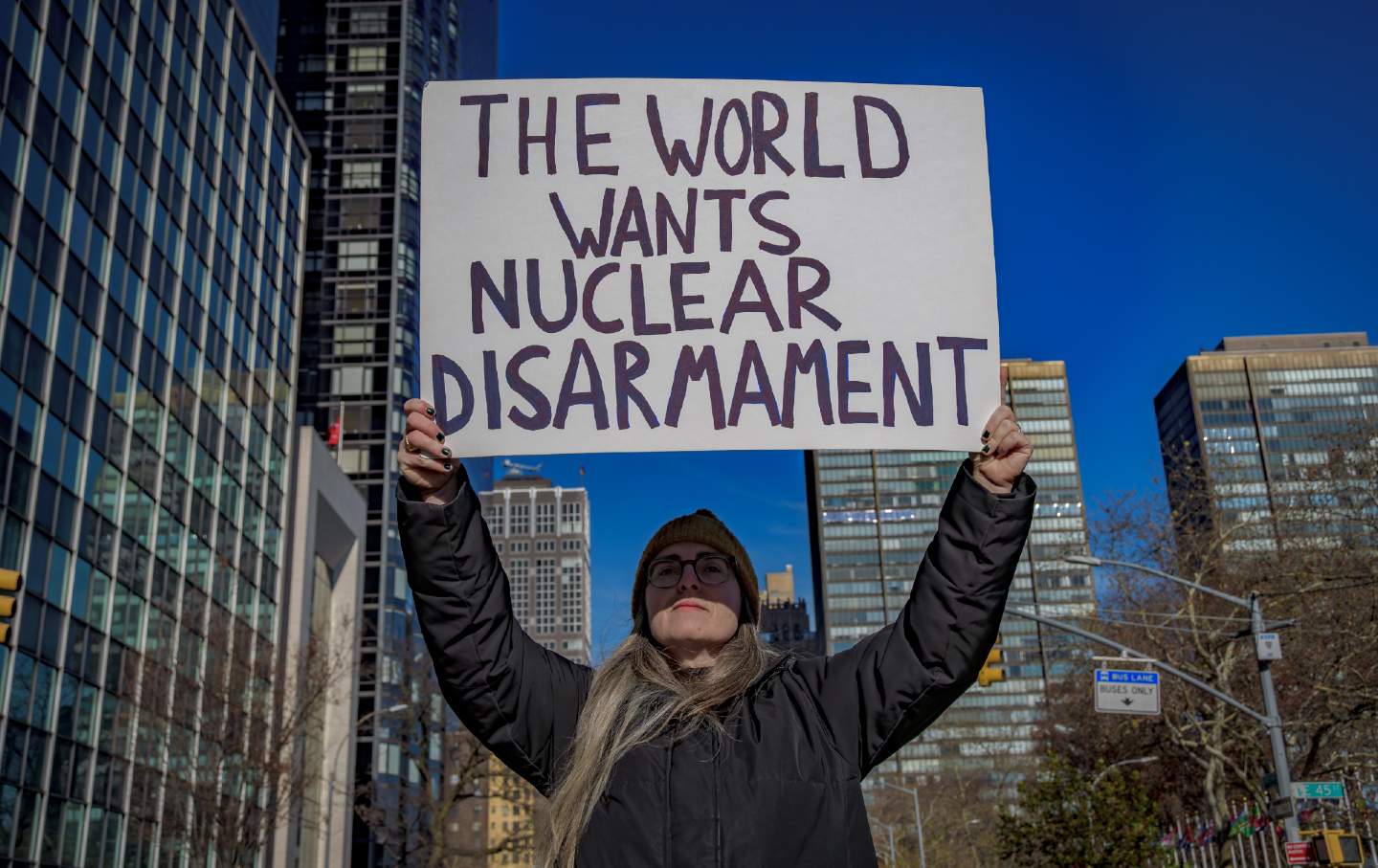
Nuclear weapons are back in style in official Washington. The Pentagon is in the midst of a $2 trillion, three-decade-long effort to build a new generation of nuclear-armed bombers, missiles, and submarines, and the weapons lobby and its allies in Congress are pressing to spend even more.
Thankfully, a new report from the government watchdog group Taxpayers for Common Sense (TCS) offers a refreshing counterpoint to this rush towards a new nuclear arms race, explaining in persuasive detail why the centerpiece of the Pentagon’s new buildup, the Sentinel ICBM, is dangerous, unaffordable, and unnecessary. The late Daniel Ellsberg and Norman Solomon made this point forcefully in an October 2021 piece in The Nation, noting that eliminating ICBMs was the easiest and fastest way to reduce “the overall danger of nuclear war.”
Being the good taxpayer protection group that it is, TCS starts by pointing out the immense cost of the Sentinel program, which is now estimated to be at least $315 billion over the lifetime of the system, including an astonishing 37 percent increase in projected acquisition costs over just the past two years. The cost overrun is so large that it has triggered a reevaluation of the program under the Nunn-McCurdy Act, which serves as a sort of early warning system regarding runaway weapons costs. A Pentagon report on the issue is due early next month. This is a perfect moment to think twice about whether to build a new ICBM, or whether ICBMs are needed at all. The TCS report does just that.
The bottom line of the new analysis is that nuclear warheads deployed on bombers and submarine-based ballistic missiles are more than sufficient to deter any nation from attacking the United States. Steve Ellis, the president of TCS, underscored this point upon the release of the organization’s new report: “We have over 1,300 nuclear warheads deployed on ballistic missile submarines, bombers, and fighters, many of which are more powerful than the warheads planned for deployment on the Sentinel. At a projected cost of $315 billion over its lifecycle, the Sentinel is a redundancy we don’t need at a price we can’t afford.”
Not only are land-based missiles redundant but, as former secretary of defense William Perry has noted, they are “among the most dangerous weapons we have,” because a president would have only a matter of minutes to decide whether to launch them upon warning of attack, greatly increasing the risk of an accidental nuclear conflict based on a false alarm.
Eliminating ICBMs makes good sense in terms of the future security of the planet, but it faces a tough political environment in Washington. As I have written elsewhere, the ICBM lobby—spearheaded by contractors like Northrop Grumman working with senators from states like North Dakota, Montana, Utah, and Wyoming that have major ICBM bases or substantial work on the Sentinel program—has been a powerful force for decades in shielding land-based missiles from reductions in numbers or funding. Given the serious security challenges facing the United States in the decades to come, many of which do not have military solutions, the time to break the stranglehold of special interests over our nuclear weapons policy is now. Canceling the Sentinel program would be an excellent place to start.
Some arms control advocates, while acknowledging the costs and risks associated with maintaining an ICBM force, have limited their demands, for the moment, to a call for canceling the Sentinel while extending the service lives of existing ICBMs. While this would certainly save many billions of dollars, it would not address the destabilizing effects of ICBMs themselves. By contrast, if the new ICBM is canceled but the old ones remain in place, the risk of an accidental launch would remain, and any possible timeline for substantial reductions in the US arsenal—with the ultimate goal of eliminating nuclear weapons altogether in line with global norms established by the Treaty on the Prohibition of Nuclear Weapons—would recede far, far into the future.
The question is whether it is possible to generate a potent enough political counterforce to defeat the ICBM lobby and overcome the mythology that holds that a “nuclear triad” of land-, sea-, and air-based nuclear weapons is an essential pillar of US defenses. Although many residents of states that host ICBM bases, like North Dakota, Montana, and Wyoming, welcome the economic benefits they bring, there is a history of opposition to ICBMs going back to the 1980s campaign against the MX missile (officially and ironically named “The Peacekeeper”) that was supported by everyone from conservative ranchers to the Mormon Church. The MX was ultimately deployed for almost two decades until it was deactivated under the administration of George W. Bush, but the opposition to it was part of a larger surge in favor of nuclear arms reductions that led to a sharp scaling back of the US Cold War arsenal. Huge cost growth on the new ICBM, noted above, has brought increased scrutiny in Congress and energized efforts by a wide array of local and national arms control and disarmament organizations to cancel the system and reconsider whether to retain ICBMS at all.
At a time when the country and the Congress are deeply divided about everything from the future of democracy to the appropriate approach to current wars in Ukraine and the Middle East and a possible future conflict with China, coming to consensus around a major shift in US nuclear policy and spending will be no small challenge. But the alternative—a nuclear arms race on autopilot, with a rising risk of a nuclear confrontation—is too dangerous to ignore.
Past changes in US nuclear policy, from the end of atmospheric nuclear testing to the sharp reductions in the size of the US arsenal since the end of the Cold War, have had their roots in citizen activism, from the ban-the-bomb movement of the 1950s to the Nuclear Freeze campaign of the 1980s. We are far from a 1980s-level of concern about nuclear weapons at the moment, but the debate over the issue has grown in line with developments like the success of the biopic Oppenheimer, stepped-up activity to compensate the victims of radiation from past nuclear testing, and continued efforts to sound the alarm about the nuclear danger through vehicles like the Bulletin of the Atomic Scientists’ Doomsday Clock, which now stands at a frightening 90 seconds to midnight. The Bulletin’s most recent statement about the risks we face could not be more clear:
Ominous trends continue to point the world toward global catastrophe. The war in Ukraine and the widespread and growing reliance on nuclear weapons increase the risk of nuclear escalation. China, Russia, and the United States are all spending huge sums to expand or modernize their nuclear arsenals, adding to the ever-present danger of nuclear war through mistake or miscalculation.
Bold action is required if we are to avert the worst-case scenario outlined by the Bulletin. Canceling the Sentinel program would be a major step in the right direction—a forceful note of sanity in the midst of a nuclear policy debate in Washington that has been far too skewed toward promoting Cold War–style nuclear buildups instead of implementing measures aimed at reducing the risk of a nuclear conflict. Shifting course will require us to go well beyond business as usual in Washington, but given the stakes, it is well worth the effort, and time is of the essence.
More from The Nation


Brazil’s Decision Brazil’s Decision
The moral compass and basic humanity of political leaders really does matter.

Albanian Student Strikes Spur a Political Crisis Albanian Student Strikes Spur a Political Crisis
A new round of protests against the ruling party’s corruption has Prime Minister Edi Rama giving cops bonuses to crack down on dissent.

Inside India’s Gen Z Cockroach Janta Movement Inside India’s Gen Z Cockroach Janta Movement
Young Indians are challenging the purge of voter rolls by Modi’s right-wing government. Shrishti Khanna, who was detained by Delhi police while covering the protests, explains.

The Clarion Call of “NAZA” The Clarion Call of “NAZA”
Yuval Abraham and Rachel Szor’s new film not only documents the horrors of the present but gives us a glimpse of a possible future too.

The Specter of Lepenism Looms Over France’s Social Crisis The Specter of Lepenism Looms Over France’s Social Crisis
Joining forces with the “yellow vests,” youth demonstrators are raising the alarm in a country falling to the far right.

