With Trump’s Conviction, the 2024 Presidential Election Is Finally Launched
The Manhattan court case clarifies the stakes—and gives a chance for a Biden reboot.
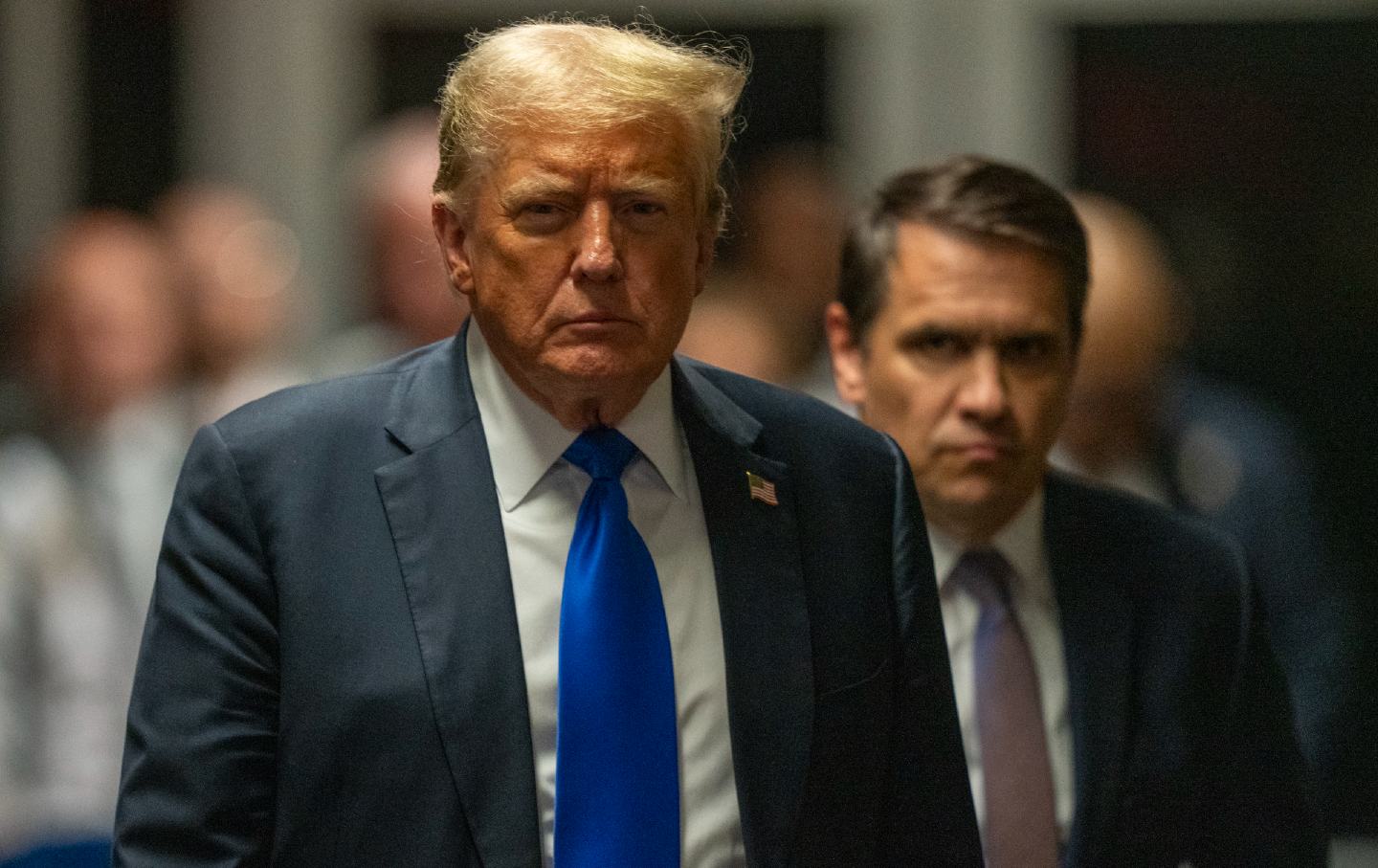
After a lifetime of relentless chicanery, business fraud, thuggery, tax evasion, all-purpose crookery, and sexual assault, Donald Trump is finally—belatedly, but still gratifyingly—a convicted felon. The impunity that Trump has enjoyed, thanks to his status from birth as a rich white man, has always been galling. It’s been an affront to common decency and the hope that the universe has at least a modicum of justice. Trump’s evasion of the law has fed a poisonous cynicism, one that saps the will to make the world a better place.
Given these facts, our reaction to the jury’s verdict of guilty on 34 counts of falsifying business records as part of a cover-up of a sex scandal has to be not just political but emotional too. Like the liberated munchkins of Oz, it’s easy to imagine breaking out into song: “Ding-dong, the witch is dead!” Of course, Trump hasn’t breathed his last yet, so perhaps we should save that particular celebratory rite for a future happy day. But Trump has been wounded, in a way that will change the political dynamics of his vindictive bid to return to the White House.
Because of the pervasive cynicism Trump has always inspired—and also because he has so long evaded accountability—there is already a knowing, wise-guy deflation of the impact. People who have excessive pride in their own cleverness are downplaying the news, suggesting that a criminal conviction, especially for a complicated paperwork crime growing out of an ancient sexual peccadillo, won’t hurt Trump at all. The suggestion has even been made that his status as a convicted felon could actually help Trump, with his supporters so fired up by grievance politics that they flood to the voting booths to vindicate their hero.
Thus, New York Times columnist Frank Bruni argues that, while an ordinary politician would be sent to the “political grave” by a criminal conviction,
I could see [Donald Trump] skipping out of the cemetery, all the way back to 1600 Pennsylvania Avenue. I could see “guilty” being a mere bump in the road. I could even see it being an accelerant, as his indictment arguably was.
The element of truth here is that Trump was in fact helped in the Republican primaries by his numerous indictments. But the Republican primaries were dominated by MAGA voters, particularly non-college-educated whites, who shared Trump’s brand of anti-system politics. For such voters, Trump’s indictments were indeed a positive: They showed he was up against pro-establishment forces, the “deep state” of Trump’s imagination (in truth, to the extent that there is a deep state in law enforcement and the permanent bureaucracy, it has usually given Trump a free ride).
Anti-system voters of this sort are increasingly strong in the Republican base—but they are by no means numerous enough to win a general election. The one election Trump won was in 2016, when he was not running against the deep state but rather had a tightly focused message of economic populism that resonated with Midwestern voters who had been hurt by Bill Clinton’s trade agreements. In 2024, Trump has been running a very different campaign, and the difference will only intensify as the fact of his criminal conviction starts to define him as a candidate. This time around, Trump is running not as a tribune—however fraudulent—of economic populism but as the candidate of personal grievance and revenge. The premise is that his reelection will redeem both himself and the lawbreakers who tried to overthrow the 2020 election results on January 6, 2021. Trump’s current campaign of payback has a less broad appeal than his earlier voicing of anger at economic injustice. If he’s currently leading in the polls, its because of nostalgia for the pre-Covid robust economy rather than any program he’s offering. As such, Trump would be more vulnerable now to an anti-nostalgia campaign that reminds voters of the many reasons he was unpopular in the past.
Trump’s criminal conviction clarifies the election—and raises the stakes. Do Americans really want a convicted felon as president? Like my colleagues Joan Walsh and Sasha Abramsky, I am skeptical.
The political analyst Josh Cohen, who blogs at Ettingermentum Newsletter, notes that polls show Trump losing votes if convicted, but with some variation: A New York Times poll asking what would happen if Trump were convicted and imprisoned showed a 14-point shift away from Trump. This would amount to a landslide for Biden. But it’s unlikely that Trump will be jailed before the election. A Wall Street Journal poll asking only about conviction shows just a five-point shift from Trump, significant enough to win the election for Biden, but no landslide.
As Cohen writes:
Do we have any proof that these swings may happen? Well, the polls—the same exact polls that have shown Biden down for more than half a year—say they will. While Race To The White House’s national polling average currently has Trump slightly ahead by less than one point, their average of a Biden v. Convicted Trump race has Biden up by 5. It may not be the gargantuan swings some of us hoped for, but make no mistake. If this is true, it will completely transform the race from a tossup to one where Biden is on a clear path to victory.
The Biden campaign had been flailing before the conviction, with many Democrats starting to panic at the president’s persistent weakness in swing states. Trump’s conviction is a chance for a Biden reboot, launching a campaign that offers a stark choice between Trump and Biden, with all of Trump’s least appealing qualities—his dishonesty, his self-centeredness, his belief that he doesn’t have to play by the normal rules that apply to other people—now at the center of attention. This alone won’t win the election, which is likely to remain close. Biden will still need to repair his support with groups that have been alienated by his presidency: progressives, young people, and people of color. But Biden now has an opportunity to launch a new campaign, to win over those voters—and keep a convicted felon out of the White House.
Prior to the conviction, most Americans had tuned out the political news. This will be impossible now. In a real sense, Trump’s conviction is the true start of the 2024 presidential race.