Counting the Negro League Records Is About More Than Numbers
One player in particular is laying waste to the Major League record book: Josh Gibson.
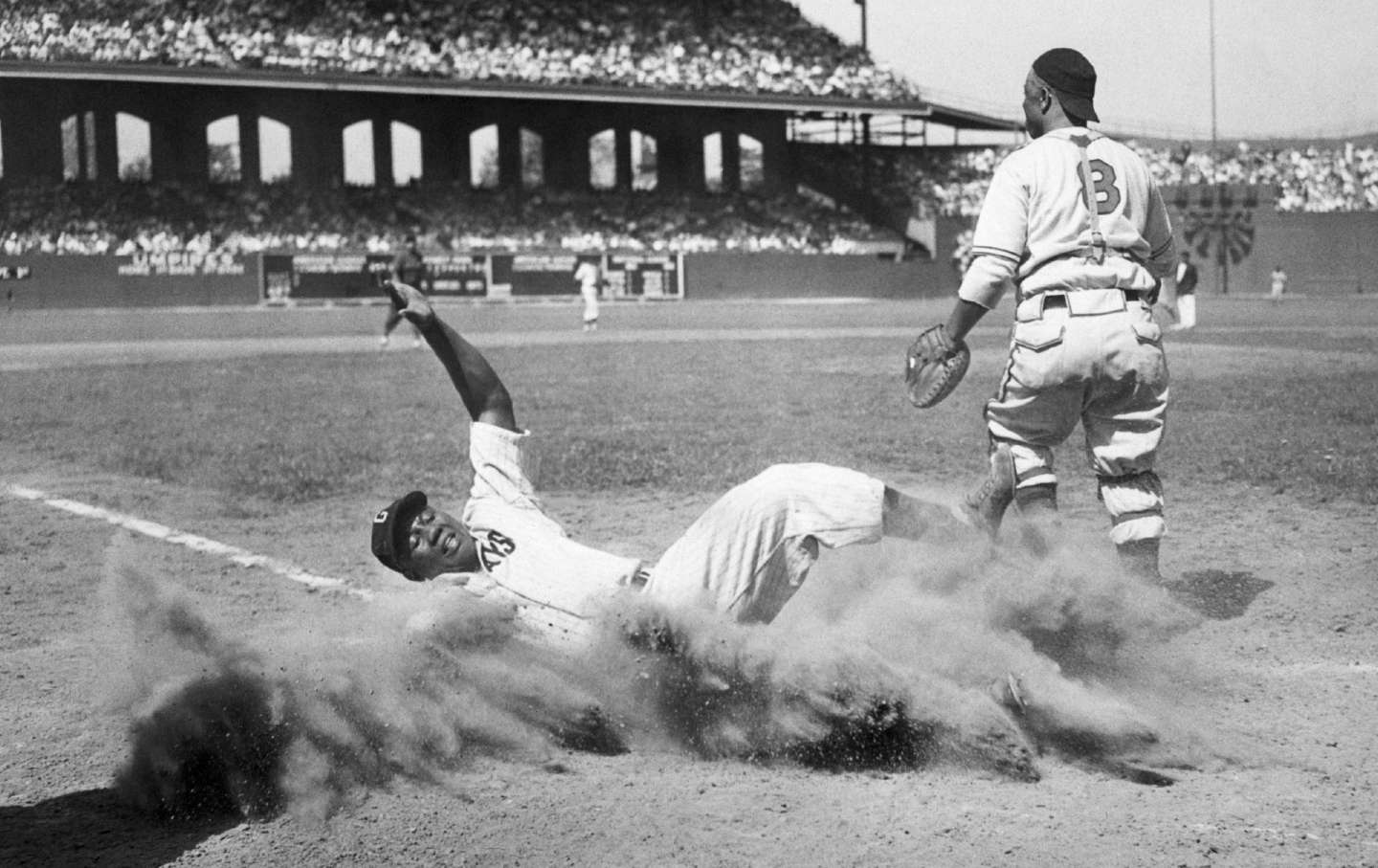
Negro Leagues superstar Josh Gibson creates a cloud of dust as he slides into home plate during the fourth inning of a 1944 game in Chicago.
(Bettmann via Getty)In 1962, legendary South African activist Dennis Brutus helped launch the South African Non-Racial Olympic Committee (SAN-ROC). One of its aims was to relentlessly point out the hypocrisy of apartheid officials speaking about “South African” sporting records when the only marks being counted and feted were those by white athletes. Government forces jailed, tortured, and exiled SAN-ROC members for speaking this truth. But they could not be crushed and kept organizing international sports boycotts until the fall of apartheid. It has taken until 2024 for Major League Baseball to achieve what South Africa did in the early 1990s.
At long last, the records set in the Negro Leagues prior to 1948 will be integrated into the official MLB ledgers. No longer will the incredible baseball feats of the Negro Leagues be relegated to a separate and unequal category. No longer will the accomplishments of legendary players like Leroy “Satchel” Paige, Oscar Charleston, and James “Cool Papa” Bell be dusted off only during Major League Baseball’s thin-gruel salutes to Black History Month.
It has taken a shockingly long time for MLB to arrive at this point—a delay that falsely gives the impression that competition in the Negro Leagues was somehow below that of the Major League. But thanks to the tireless work of historians, activists, and organizations like the Negro Leagues Baseball Museum in Kansas City, the MLB has finally entered the mid-20th century.
One player in particular is laying waste to the baseball record book: Josh Gibson. No longer is baseball’s all-time leader in batting average Ty Cobb and his mark of .367. It’s now Gibson, who in his remarkable career hit .372. No longer is the single-season record for batting average held by Rogers Hornsby and his .424. It’s now Gibson and his staggering .466. The Pittsburgh Crawfords and Homestead Grays catcher now is also the all-time leader in career slugging percentage (over Babe Ruth) and slugging in a single season (over Barry Bonds). That Gibson was able to accomplish these hitting feats as a catcher—a position that wears down great hitters with the stress it puts on the knees and back—makes his prowess even more remarkable. What would Gibson have batted as a designated hitter if such a position had existed in yesteryear? It boggles the mind.
More on baseball:
In announcing this long-overdue move, Major League Baseball Commissioner Rob Manfred said, “We are proud that the official historical record now includes the players of the Negro Leagues. This initiative is focused on ensuring that future generations of fans have access to the statistics and milestones of all those who made the Negro Leagues possible. Their accomplishments on the field will be a gateway to broader learning about this triumph in American history and the path that led to Jackie Robinson’s 1947 Dodger debut.”
Manfred did not add that the debut of Robinson was also the first step toward MLB’s destruction of the Negro Leagues, strip-mined for talent. Teams were left without their main attractions, like young hitters Willie Mays and Henry Aaron. Crowds dwindled. And just like that, the grand possibility that entire Negro League teams could be integrated into Major League Baseball, including Black ownership, Black management, and Black laborers, was dashed. To this day, there has never been a Black team owner in Major League Baseball, and the paucity of Black front-office leaders and managers remains an embarrassment. How different the future may have looked if, on the eve of the civil rights movement, a group of Black executives were given a well-earned seat as part of the power structure in America’s pastime. Instead, Major League Baseball harpooned what could have been among the largest Black-owned businesses. Manfred shouldn’t skip over this part of baseball history.
If Dennis Brutus were still with us, the brilliant South African poet and sports activist would relish the thought of over 2,300 Black players getting their due in the official record books. He would see it as a great victory for everyone who would not let the Negro Leagues be erased. And in acknowledging the debt to those who kept the flame lit, he would insist we never forget an inequitable past that Major League Baseball first created and then—as flowers bloomed through the concrete—ruthlessly destroyed.