Who’s Afraid of the International Criminal Court?
In two decades, the ICC has never indicted a Western official. But a warrant may be coming for Benjamin Netanyahu.
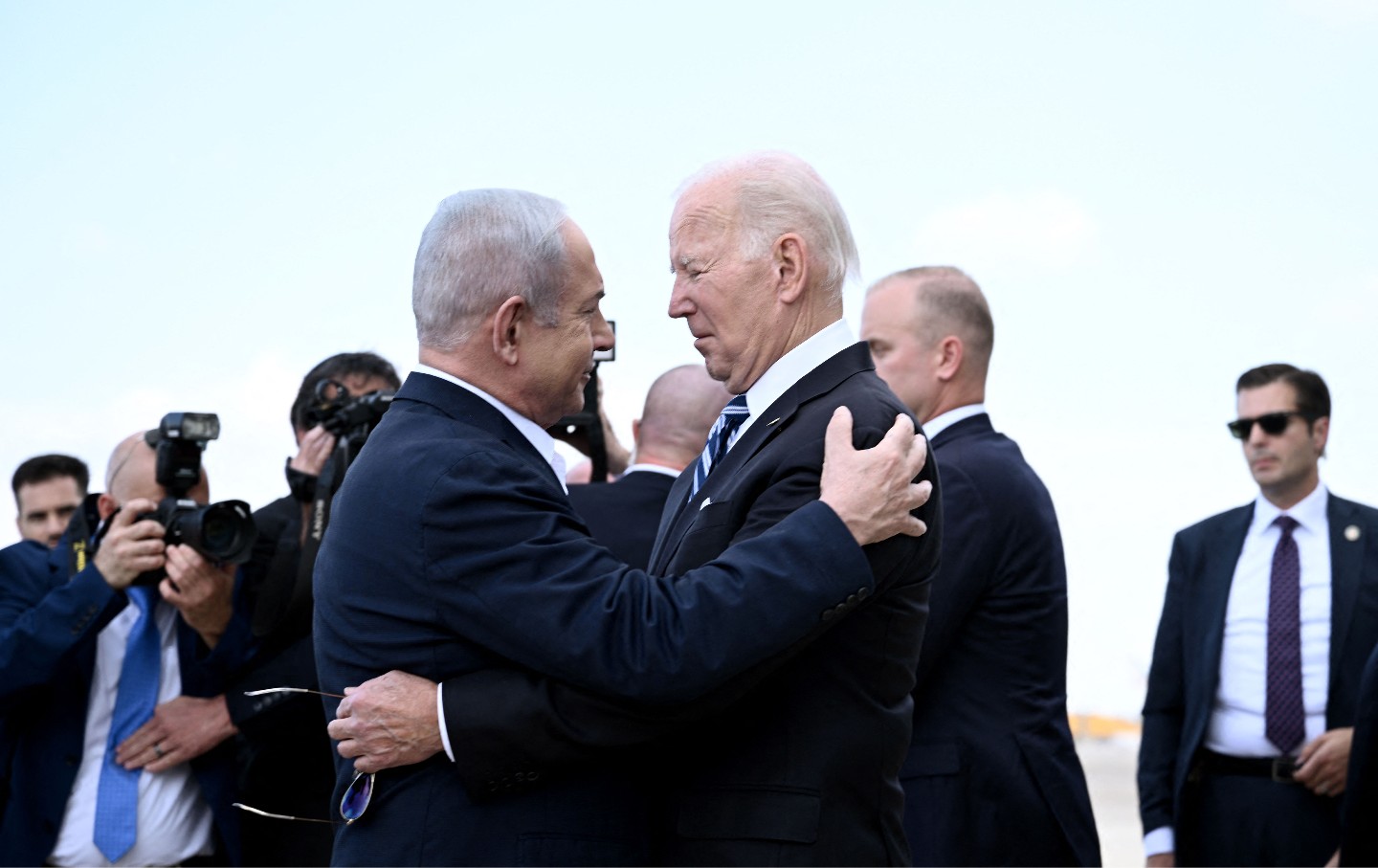
Israel Prime Minister Benjamin Netanyahu greets US President Joe Biden upon his arrival at Tel Aviv’s Ben Gurion airport on October 18, 2023.
(Brendan Smialowski / AFP via Getty Images)For the past two weeks, the Israeli government has been warning that the International Criminal Court (ICC) in The Hague is about to file war crimes charges against Benjamin Netanyahu and other senior Israeli officials for their actions in Gaza. Netanyahu has labelled the possibility of being hit with an arrest warrant an “antisemitic hate crime” and called on the “leaders of the free world to stand firmly against the ICC’s outrageous assault on Israel’s inherent right of self-defense,” adding “we expect them to use all the means at their disposal to stop this dangerous move.” The Israeli government also reportedly warned the Biden administration that if the ICC issues warrants against Israeli leaders, it will take retaliatory steps against the Palestinian Authority that could lead to its collapse.
American officials are rushing to Israel’s defense. Speaker of the House of Representatives Mike Johnson called for the Biden administration to “immediately and unequivocally demand that the ICC stand down.” Johnson went on to say that Congress would “use every available tool to prevent such an abomination.” Members of Congress from both parties said that warrants would be met with a strong response, and a letter from 12 Republican senators threatened Khan, promising that the US would “sanction your employees and associates, and bar you and your families from the United States.” “You have been warned,” the letter concluded ominously.
As the pressure mounted, the ICC prosecutor, British barrister Karim Khan, took to social media to issue his own warning. Threats of retaliation, he said, undermine the court’s “independence and impartiality.” And, he noted, those who issue them could be charged by the ICC with the crime of obstructing justice.
While the ICC has not confirmed the reports of impending charges—which would almost certainly be coupled with warrants against top Hamas officials—the furious diplomatic maneuverings are reflective of the unprecedented nature of any such event. The ICC has never, in over 21 years of existence, indicted a Western official. Indeed, no international tribunal since Nuremberg has done so. Up until now, the instruments of international justice have been used almost exclusively to address crimes by defeated adversaries, powerless outcasts, or opponents of the West such as Vladimir Putin or Slobodan Milošević.
For 15 years, since the Palestinian Authority submitted a declaration accepting the ICC’s jurisdiction in January 2009, following Israel’s Cast Lead operation, which killed more than 1,400 Gazans, Palestinian efforts to invoke the ICC have gotten the slow walk from three successive ICC prosecutors. Indeed, even after the indiscriminate and disproportionate Israeli response to the horrific Hamas attacks of October 7, many ICC-watchers believed that the savvy Khan was reluctant to cross a historic US red line with an indictment of Israeli officials, despite his increasingly strong warnings to both Hamas and Israel.
If that was in fact Khan’s concern, it may have yielded to the relentless Israeli assault and the growing international consensus around the criminal nature of Israel’s response, bolstered by the decision by the other court in The Hague, the International Court of Justice (ICJ), which in response to a complaint by South Africa found that Israeli actions created a “plausible” risk of genocide. In March, Khan named Britain’s former chief prosecutor, a Conservative Party member, to oversee his probe. Reporting by The New York Times suggests that an indictment would focus on Israel’s obstruction of humanitarian aid, which Khan has emphasized in his public warnings and which would be relatively easy to demonstrate even without the ability to conduct an in-depth on-the-ground investigation. This would also be in line with the ICJ’s emergency orders to Israel to facilitate such aid and an April statement by the UN’s human rights chief Volker Türk that Israel’s policies may “amount to the use of starvation as a method of war, which is a war crime.”
In response to the reports of possible warrants, the White House and State Department have insisted that the ICC has no jurisdiction over Israeli nationals because Israel is not state party to the ICC’s governing Rome Statute (Palestine is a party). That pretension was roundly rejected in the 1998 Rome negotiations, however, which determined that the ICC could investigate and prosecute crimes committed by nationals of states party to the statute or on the territory of states that gave their consent. The Clinton administration, thus deprived of an iron-clad guarantee that no American (or Israeli) could ever be charged by the court, cast one of only seven votes against the Rome Statute.
Under President Donald Trump, Washington imposed sanctions on previous prosecutor Fatou Bensouda for her timid investigations into Palestine and alleged US crimes in Afghanistan. Even in 2021, when the Biden administration lifted those sanctions, Secretary of State Antony Blinken said, “We maintain our longstanding objection to the Court’s efforts to assert jurisdiction over personnel of non-States Parties such as the United States and Israel.”
Then, however, came the Russian invasion of Ukraine, massive Russian war crimes, the largest ICC investigation in history, and an arrest warrant against Putin. All of a sudden, the US did not care that the ICC was investigating nationals of a state not party to the statute (Russia). President Biden said the charges were justified, and Blinken urged ICC members to arrest Putin and his co-indictee Maria Lvova-Belova, Russia’s commissioner for children’s rights, who is accused of abducting thousands of Ukrainian kids, and turn them over to The Hague. Bipartisan legislation permitted Washington to support the ICC’s Ukraine investigation. Now the United States may be hoist with its own petard—something the Pentagon feared when it objected to providing the ICC with evidence against Russia.
An ICC warrant would make Netanyahu a wanted man, in the same category as Putin and Sudan’s Omar al-Bashir. While it’s unlikely that Netanyahu and the other indicted officials would be in handcuffs anytime soon, these crimes have no statute of limitations, meaning that once indicted, their world would be much smaller. And following on the heels of the ruling by the International Court of Justice, and the ICJ’s decision in a later case brought by Nicaragua against Germany which reminded “all States of their international obligations relating to the transfer of arms to parties to an armed conflict,” to avoid such arms’ being used to violate the Geneva and genocide Conventions, indictments of Netanyahu or other Israeli officials would make it untenable for the United States to claim that arming the Israeli military does not render it complicit in atrocities.
Become a Sustaining Donor This September
Between the reemergence of right-wing red-baiting and Donald Trump’s use of the chilling National Security Presidential Memorandum–7 to criminalize left political organizing, we’re seeing McCarthyism reborn before our eyes.
This assault on democracy cannot be ignored or wished away. Resisting it requires bravery in the face of threats and repression, a steadfast commitment to the truth, and the unwavering belief that we can—and will—overcome this darkness.
We must have an independent media that sets the record straight, unearths corruption and abuses of power, and advances a politics of justice and dignity for all if we’re to win this fight.
That’s why I’m writing to you today. This September, The Nation needs to add 100 monthly donors to sustain our progressive journalism. Your contribution makes the next investigative report, the next truth-speaking column, and the next pathbreaking essay all possible.
I hope you’ll support our work with a recurring donation today. If you donate $10 or more a month, we’ll send you a brand new “Hands Off the Free Press!” sticker to recognise your commitment to our cause. Please, donate today.
Onward,
Katrina vanden Heuvel
Editor and Publisher, The Nation