
Why Aren’t We Talking About the War-Mongering Lies of Mike Rogers?
The media’s relentless focus on Hasan Piker allows the dishonest GOP hawk (and actual Michigan Senate candidate) to evade scrutiny.
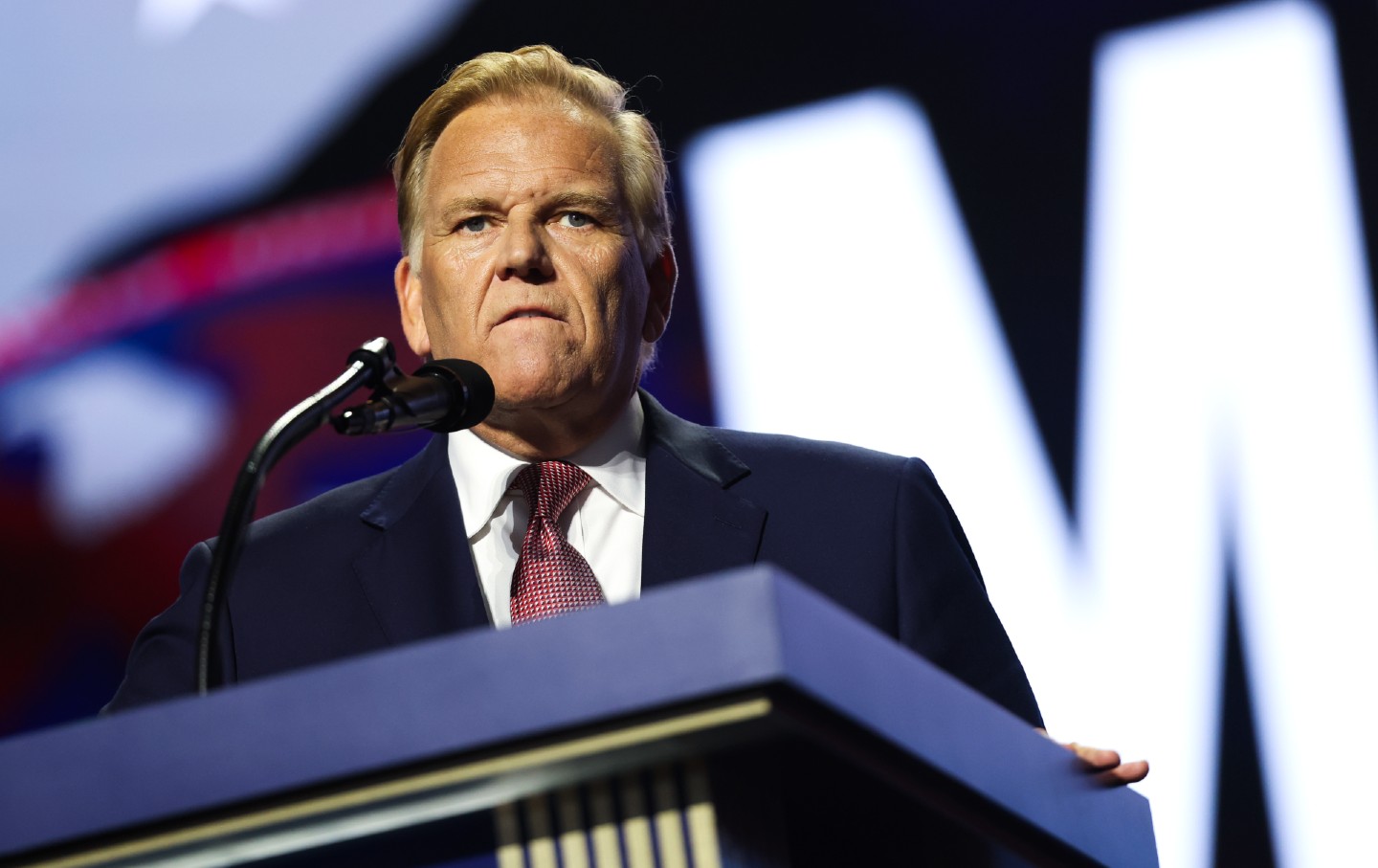
Michigan Republican Senate candidate Mike Rogers speaks at the 2026 Republican National Convention at the American Airlines Center on September 10, 2026, in Dallas, Texas.
(Kevin Dietsch / Getty Images)Voters can be forgiven if they think the 2026 midterms are a referendum on Hasan Piker. The Twitch streamer is not, in the grand scheme of things, a very well-known figure. According to an Echelon poll released in April, a super-majority of the public (60 per cent) either has no clue as to who Piker is or has no opinion about him (a further 19 percent).
This immense ocean of ignorance and indifference is a testament to the good sense of the American people. Pundits are not just a dime a dozen these days. In the age of torrential social media and the epidemic of influencers, ten cents could probably buy you a lifetime supply of YouTube pontificators. Not knowing or caring about Piker should be the natural condition of even the minority of citizens who regularly follow the news.
Piker, however, has become a favorite target of media scrutiny, not just from the right-wing press such as Fox News and The New York Post but also centrist outlets such as The Atlantic and The New York Times. The ever-spreading Piker discourse has even made it into The Nation.
The amount of attention Piker has received is truly staggering. In early September, Justin Baragona of Zeteo noted, “Fox News mentioned him in 566 segments across 267 programs since 8/4. And in the last week alone, they ran 107 segments totaling nearly 8 hours of airtime!” As Baragona observes, “If you’ve just casually tuned into cable news these past few weeks, chances are you were on the receiving end of a hyperbolic shoutfest aimed at convincing you that Hasan Piker, a leftist Twitch streamer who most Americans have never heard of, is the single biggest story in politics today.”
The motives behind this outsized attention are obvious and cynical. Over the last two years, a wave of progressive candidates have won Democratic primaries and sometimes general elections. Many of these candidates were championed by Piker, who would interview them for his show and offer his endorsement—notably Michigan Senatorial candidate Abdul El-Sayed and New York City mayor Zohran Mamdani.
Piker has many opinions that are perfectly reasonable but shocking to conventional wisdom, such as his recent assertion that the Middle East would be more stable if Iran had nukes (a position utterly compatible with the theories of mainstream international relations scholars such as the late Kenneth Waltz).
Unfortunately, unorthodox ideas are rarely examined on their merit in political contests. More commonly they are used as a cudgel. Piker has become a hot-button campaign issue because Republicans and centrist Democrats think that associating with him will discredit progressives. So far, this strategy has been a singular failure, but that has only led to it being adopted with ever greater stridency.
Amid the deafening din of Piker discourse, the actual stakes of the election are getting lost—particularly in the Michigan Senate race, which has become the epicenter of anti-Piker hysteria. Piker is not on the ballot in the race. The real contenders are El-Sayed and GOP challenger Mike Rogers. But while El-Sayed is endlessly badgered about his association with Piker, Rogers enjoys an enviable lack of investigation, let alone criticism.
When Rogers does get looked at, as in a recent New York Times profile, he’s described only in generic terms as a formerly mainstream Republican who has become more Trumpist, an all-too-familiar arc in the modern GOP. The Times generously portrayed Rogers as “One of his party’s leading voices on national security and foreign policy” and quoted a Democratic colleague who in 2014 said Rogers was “a voice for moderation and consensus-building.”
Jonathan Chait — an anti-Piker obsessive who has found a suitable home in the Piker-fixated pages of The Atlantic — took a similar tack in an article about how Trump’s extremism is hampering Republican candidates. In a long paragraph on Rogers, Chait mentioned the difficulties the candidate faces because of Trump’s general unpopularity and tariff wars with Canada, as well as Rogers discrediting himself by embracing Trump’s lies about the 2020 election.
What’s striking is what was missing from Chait’s column: any reference to the Iran war. (It’s hard not to speculate that Chait’s own hawkishness played a role in this glaring omission: although he opposes the Iran war, his general foreign policy stance, reflective of the worldview of The Atlantic, is interventionist).
It makes no sense to ignore the Iran War when it comes to Rogers, who is not just an ardent supporter of this particular war but is, more generally, a mega-hawk who has pushed for war with Iran for more than 20 years. In other words, Rogers is not caving to MAGA pressure by backing the conflict. Rather, Trump is giving Rogers something the candidate has long wanted.
Popular
“swipe left below to view more authors”Swipe →The war is immensely unpopular both on its own terms and because it is driving up prices. According to a Fox News poll, 60 per cent of the public thinks the decision to go to war was wrong, with 71 per cent believing that Trump has no plan to end the war. That’s a huge problem for Rogers. But you wouldn’t know it from reading Chait.
Writing in Jacobin, Branko Marcetic performed a singularly useful and rare service by documenting the depth of Rogers’s war-mongering, which includes repeatedly making demonstrably false claims that Iran was on the cusp of acquiring nuclear weapons. This sort of threat inflation is all too typical of Washington militarists and has been the basis of many illegal and misbegotten wars, notably George W. Bush’s invasion of Iraq in 2003.
As Marcetic notes:
A review of the public record shows that Rogers has been pushing for war with Iran for at least two decades, since all the way back when George W. Bush was mulling it. Rogers used his perch on the House Select Committee on Intelligence, which he chaired from 2011 to 2015, to make a host of dubious claims about Iran’s nuclear ambitions and capabilities, hype the threat it posed to the United States, and undermine efforts at diplomacy that could have prevented the current conflict.
Rogers has been tireless in pushing for war. Marcetic quotes him gleefully saying, “I was for all of this when it wasn’t very cool to be for all of this” after Trump first bombed Iran in 2025. Rogers often made false claims about an imminent Iranian nuclear program, sided with Israeli Prime Minister Benjamin Netanyahu in undermining the nuclear deal negotiated by Barack Obama, and even worked to legitimize the extremist Mojahedin-e-Khalq (MEK), which had once been designated a terrorist group by the State Department.
Aside from lying about Iran’s nuclear program, Rogers is also a fantasist on more personal matters. In a recent fundraising email, he claimed, “I saw the dead body of Osama bin Laden with my own eyes, knowing that together, we had delivered justice for America.” As The Guardian reports, the truth is that Rogers merely saw a photograph of bin Laden’s corpse.
In pushing his hawkish agenda, Rogers often found his views amplified by centrist journalists such as Jeffrey Goldberg, who now edits The Atlantic and who in 2012 was all too credulous in echoing the narrative of Rogers and Netanyahu.
There’s a striking disconnect between the media and the public in this midterm cycle. The public is angry at the Iran War and its many dire consequences. This anger rarely finds voice in a media staffed with erstwhile hawks such as Chait and Goldberg, who might dislike Trump’s blundering foreign policy but remain committed to the project of US global hegemony. For these figures, there’s nothing really scandalous about Rogers long record of militarism and lies. The true threat, to this worldview, is Hasan Piker.
The Michigan Senate race is close but El-Sayed can win if voters are reminded that of Rogers’ history of reckless militarism. One can also hope that voters continue to ignore the mainstream media drumbeat focused on Piker.
Become a Sustaining Donor This September
Between the reemergence of right-wing red-baiting and Donald Trump’s use of the chilling National Security Presidential Memorandum–7 to criminalize left political organizing, we’re seeing McCarthyism reborn before our eyes.
This assault on democracy cannot be ignored or wished away. Resisting it requires bravery in the face of threats and repression, a steadfast commitment to the truth, and the unwavering belief that we can—and will—overcome this darkness.
We must have an independent media that sets the record straight, unearths corruption and abuses of power, and advances a politics of justice and dignity for all if we’re to win this fight.
That’s why I’m writing to you today. This September, The Nation needs to add 100 monthly donors to sustain our progressive journalism. Your contribution makes the next investigative report, the next truth-speaking column, and the next pathbreaking essay all possible.
I hope you’ll support our work with a recurring donation today. If you donate $10 or more a month, we’ll send you a brand new “Hands Off the Free Press!” sticker to recognise your commitment to our cause. Please, donate today.
Onward,
Katrina vanden Heuvel
Editor and Publisher, The Nation
More from The Nation

Netanyahu Is Accused of Ignoring Warnings About October 7 Netanyahu Is Accused of Ignoring Warnings About October 7
Will justice be served?
AI Is a Kitchen-Table Issue AI Is a Kitchen-Table Issue
And with the Trump administration encouraging unregulated growth in the industry, Democrats need to start acting like it.
Trump Is a Runaway Train—and Nobody’s Pulling the Brakes Trump Is a Runaway Train—and Nobody’s Pulling the Brakes
Everywhere you look, the president is causing chaos and destruction.


Can These 4 Working-Class Populists Win In November? Can These 4 Working-Class Populists Win In November?
We’re keeping an eye on their races to find out. Here’s where things stand.

