
Pregnancy in Jails: A New Report Finds Flagrant Violations of Illinois Laws
Jails throughout Illinois continually deny, restrict, interfere with, or discriminate against pregnant people’s rights to reproductive care.
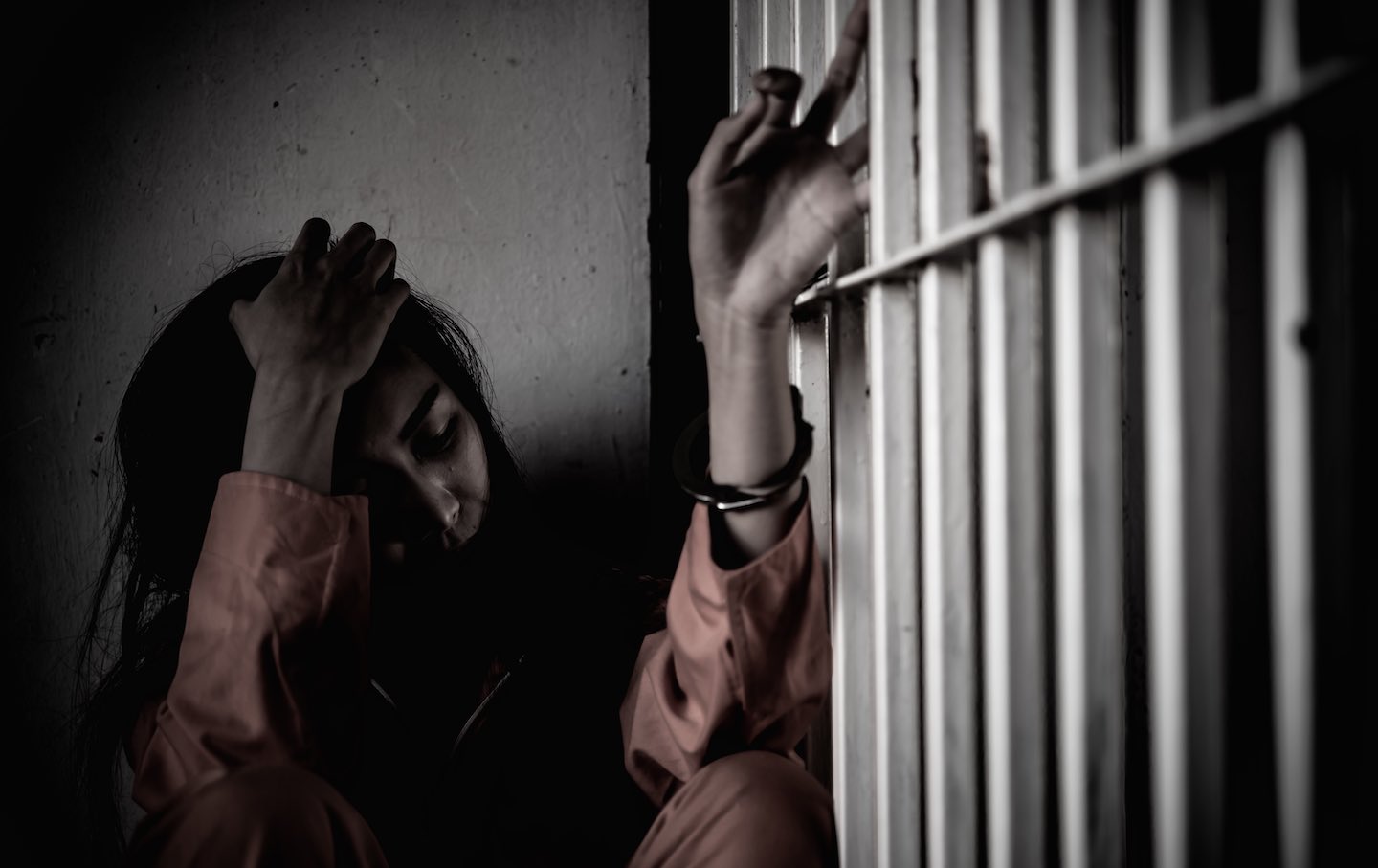
Paige learned she was pregnant two weeks after entering Illinois’s Winnebago County Jail in 2021. Through the jail’s electronic messaging system, she asked how to obtain an abortion. Illinois law states that every person has a right to reproductive care, including abortion. It also states that the “government cannot deny, restrict, interfere with, or discriminate against any person’s exercise of these fundamental rights.”
Despite the law, the jail’s response was an electronic message with a frowning emoji, Paige said.
“I was scared, sad, upset,” Paige recalled. Her previous pregnancies had been high-risk, requiring C-sections. Left to the tender mercies of the jail’s inadequate medical system, she was afraid of dying and leaving her four children motherless.
The jail medical staff did not follow up by scheduling her for prenatal care. Instead, Paige said, she had to request a visit with the jail’s doctor. She was also transported to an outside health center where she was able to see her physician and obtain prenatal care that the jail could not provide.
Each time, she was placed in handcuffs and accompanied by two guards.
During her first outside visit, her physician noticed that her placenta had attached itself to scar tissue from previous C-sections, a condition known as placenta accreta. He warned that her placenta might detach, which could be life-threatening, or it might grow so far into her uterus that she would need a partial hysterectomy. He needed to frequently monitor her condition.
But Paige had no control over whether jail staff scheduled or brought her to appointments. Jail policy prohibits incarcerated people from knowing when they have outside appointments to prevent the possibility of escape. This meant that guards occasionally pulled Paige out of the shower for her appointments. During the winter, where daytime temperatures often dipped below freezing, that sometimes meant going outside with wet hair, in shower shoes, and without a coat.
Other times, she would learn, the guards did not bring her to scheduled appointments. “You cannot keep missing appointments,” Paige recalled her doctor scolding her.
Eight months after her arrest, Paige agreed to a plea bargain. The plea agreement included a furlough, or temporary release from jail, once she was admitted to the hospital for labor.
The day after she took the plea deal, she began having contractions. Staff handcuffed her, she explained. When the ambulance technicians objected, jail staff removed one handcuff but cuffed her other hand to the gurney.
At the hospital, she wasn’t dilated enough to be admitted. She was handcuffed again, she said, and returned to jail where she was placed in the medical unit. She spent two days experiencing contractions in a loud, chaotic unit before being admitted to the hospital for a cesarean section. She spent three months at home with her baby girl and other children. Then, she had to turn herself in to serve the remainder of her sentence. She was released nearly two weeks after her daughter’s first birthday.
Paige’s story illustrates the many ways in which jails throughout Illinois continually deny, restrict, interfere with, or discriminate against pregnant people’s rights to reproductive care—from the initial denial of an abortion to missed medical appointments to being handcuffed while in labor.
But no one knows how often such violations occur. Local jails operate as their own individual fiefdoms with less scrutiny and oversight than state prison systems. At the same time, jails hold more women than state prisons. Across the United States, women’s jails confine greater numbers than state women’s prisons—84,000 (of whom over 51,000 have not been convicted) in jails compared with 77,000 in state prisons.
In Illinois, local jails held over twice the number of women as state prisons (3,433 women in jails versus 1,419 women in prisons).
A new report by the Women’s Justice Institute and ACLU Illinois sheds light on the reproductive health policies (or, in many instances, the lack of policies) in 98 Illinois county jails and the experiences of women imprisoned in a dozen of those counties. Expecting Justice: The Status of Pregnancy and Reproductive Health Care Policies in Illinois Jails describes flagrant violations of existing state law, such as Paige’s denial of abortion, placement in solitary confinement, or being handcuffed during labor. It is the first such report to examine policies beyond shackling in jails throughout the state.
Emily Werth, senior staff attorney at ACLU Illinois and a co-author of the report, said that this lack of information is partially due to the sheer number of jails. “Illinois has one state prison system versus 98 county jails, each of which are run independently,” she told The Nation. “It’s very challenging to keep the pulse on 98 jails.”
Even less is known about pregnancy in those jails. Nationwide, roughly 3 percent of women entering jails were pregnant in 2017. But, said Alexis Mansfield, senior adviser at the Women’s Justice Institute and a coauthor of the report, “we don’t know how many people are pregnant coming to [Illinois] jails, we don’t know how many are released.” And those in jails have no way to know their reproductive rights or how to notify someone if those rights are violated.
Illinois became the first state to pass legislation prohibiting restraining pregnant people who are in labor, delivery, and postpartum recovery in the hospital in 1999.
Nearly a quarter-century later, only two-thirds of jails have written policies explicitly prohibiting restraints during labor and delivery, according to the report. Only one-third have policies about pregnancy and postpartum care, and fewer than one-third have policies about abortion access. Only six jails had policies complying with the 2023 law prohibiting solitary confinement for pregnant and postpartum people.
Werth acknowledges that policies alone will not stop reproductive injustices. But, she notes, “You cannot expect folks who work within these systems to follow the law and to provide the best standards of care if there are no standards, or expectations, through written policies.”
Mansfield agrees. “If there isn’t even a written policy, staff have no way to know what to do and those detained have no idea of what their rights are.”
Popular
“swipe left below to view more authors”Swipe →Women in the report also detailed problematic pregnancy treatment that is not currently covered by law, including inadequate nutrition and lack of prenatal care. One woman recounted that, when she attempted to advocate for herself, jail staff punished her by placing her in a belly chain when taking her to court or to the doctor for the rest of her pregnancy. Another remembered that guards refused to remove her handcuffs during an ultrasound despite the doctor’s request. Others recalled staff threatening them with solitary confinement when they attempted to seek help for medical emergencies. Like Paige, none of the women knew whom to notify about these injustices.
Previous research has shown that incarceration increases the risks of pregnancy and childbirth complications, including miscarriages, preterm births, and infants who are small for their gestational age.
The Illinois Department of Corrections, which operates the state’s prison system, has a Jail and Detention Standards Unit to monitor jails’ compliance with the state’s county jail standards. Those standards include a prohibition on using restraints on pregnant people held in any county with 3 million or more inhabitants or when they are in labor. However, the unit lacks any enforcement power. Instead, it is limited to referring jails which it deems in serious noncompliance to the Illinois attorney general’s office, which can petition a court on behalf of the IDOC’s director for an order requiring the jail to comply. Furthermore, counties are not required to report and the standards unit does not collect information about compliance.
In February, Illionis lawmakers introduced HB 5431, which expands the prohibition on restraints throughout pregnancy and up to six weeks postpartum. It requires jails and prisons to provide pregnant people with at least 300 additional calories each day and that the facilities document the number of pregnant people in custody and their pregnancy outcomes each year. The law also requires that jails and prisons distribute and post this information, including policies on abortion access, in units that house pregnant women. On Friday, the House committee passed the bill, which is now on the floor awaiting a vote.
Such a law might have helped Paige, who hadn’t known what rights she still had while incarcerated. Had she known, she said, “I would have contacted a lawyer. I would have talked to someone while I was in the situation.” Remembering that frowning-face emoji, she reflected, “I should have had that choice and they took that from me.”
The Winnebago County sheriff’s office declined to respond to The Nation’s queries about Paige’s pregnancy experiences. When asked about her allegations that she had been handcuffed while transported to the hospital, its FOIA office stated that the jail followed protocol, which prohibits restraints while transporting a person to the hospital for delivery.
In advancing policies protecting the rights of pregnant people, “Illinois has taken a stand that it intends to be a leader in reproductive rights,” Werth told The Nation. But, she added, as the report shows, the state’s stance on reproductive rights has failed to cover those behind bars. “If Illinois is going to truly be a leader in this area, we cannot leave behind those who are incarcerated. Their reproductive autonomy has to be as important to us as anyone else’s.”
Become a Sustaining Donor This September
Between the reemergence of right-wing red-baiting and Donald Trump’s use of the chilling National Security Presidential Memorandum–7 to criminalize left political organizing, we’re seeing McCarthyism reborn before our eyes.
This assault on democracy cannot be ignored or wished away. Resisting it requires bravery in the face of threats and repression, a steadfast commitment to the truth, and the unwavering belief that we can—and will—overcome this darkness.
We must have an independent media that sets the record straight, unearths corruption and abuses of power, and advances a politics of justice and dignity for all if we’re to win this fight.
That’s why I’m writing to you today. This September, The Nation needs to add 100 monthly donors to sustain our progressive journalism. Your contribution makes the next investigative report, the next truth-speaking column, and the next pathbreaking essay all possible.
I hope you’ll support our work with a recurring donation today. If you donate $10 or more a month, we’ll send you a brand new “Hands Off the Free Press!” sticker to recognise your commitment to our cause. Please, donate today.
Onward,
Katrina vanden Heuvel
Editor and Publisher, The Nation
More from The Nation

Notes From Evictionland Notes From Evictionland
Eviction is practically baked into the way Britain manages its tenanted homes. Here’s how it played out—over and over again—for my parents.

How 9/11 Became a Joke How 9/11 Became a Joke
The 25-year journey from national tragedy to national punchline.

We Can’t Let the Kaepernick Era Be Erased From History We Can’t Let the Kaepernick Era Be Erased From History
Critics say the Black Lives Matter movement in sports went too far. In reality, it didn’t go far enough, and the backlash to it has been brutal.
The Bund and the Radical History of Jewish Anti-Zionism The Bund and the Radical History of Jewish Anti-Zionism
Molly Crabapple’s Here Where We Live Is Our Country revisits the past of the Jewish Labor Bund and considers what it might mean for our future.
The Making of the Millennial Working Class The Making of the Millennial Working Class
A new book follows a rising generation of labor organizers as they attempt to unionize their workplaces.

Can We Save Democracy? Can We Save Democracy?
Hélène Landemore’s case for an alternative system of popular government.

