
What Trump’s Cruel Policies Against Immigrants Say About Who’s Next
The plight of immigrants under this administration provides a lesson and a warning.
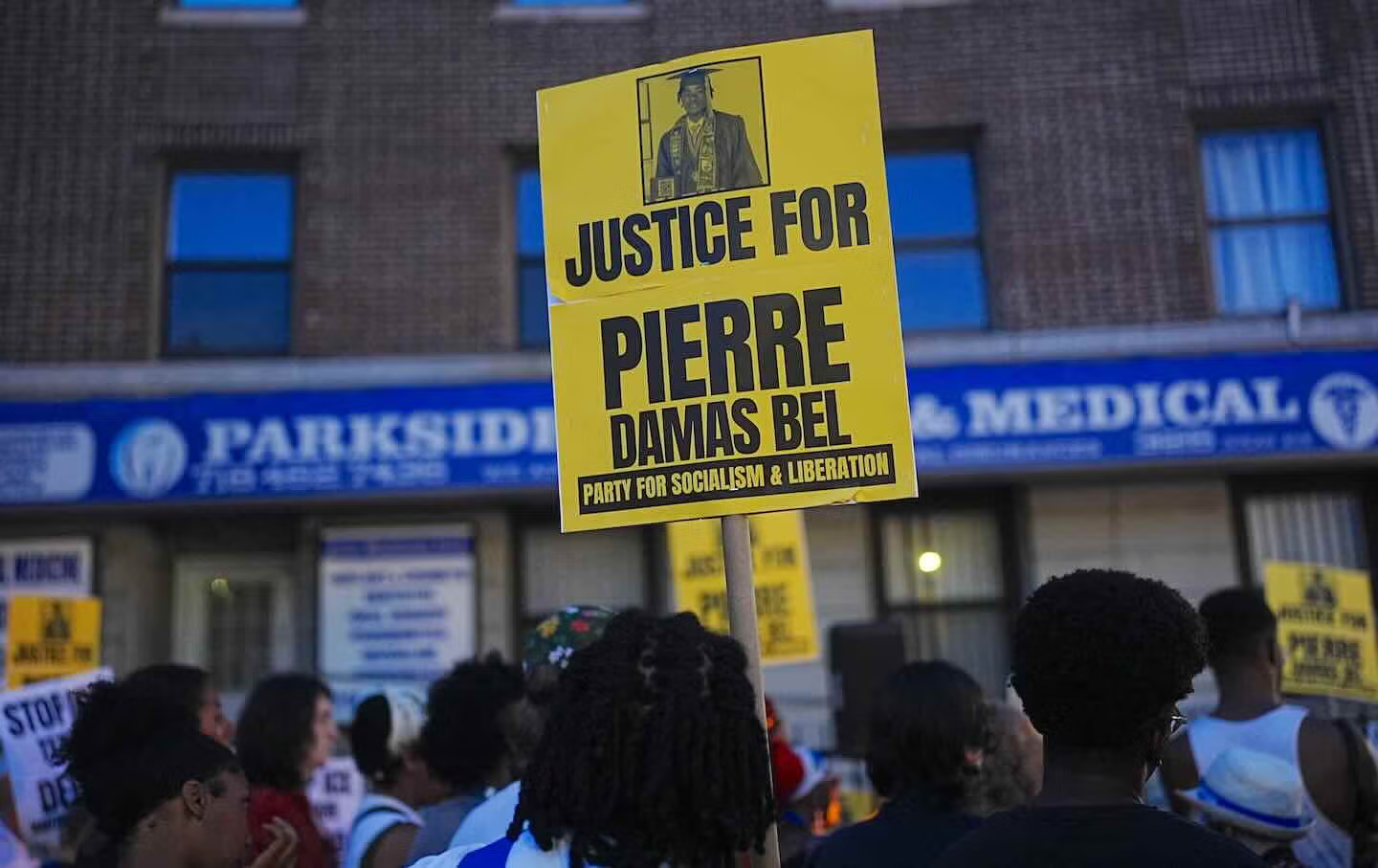
Friends, advocates, and community members hold a vigil in Brooklyn to honor 20-year-old Haitian immigrant Pierre Damas Bel, who died by apparent suicide after facing the termination of Temporary Protected Status protections for Haitians, on September 4, 2026, in New York City.
(Selcuk Acar / Anadolu via Getty Images)With the protracted war in Iran, a pending firing squad execution, the most expensive election cycle in US history, the unaffordability of everyday necessities, outbreaks of vaccine-preventable diseases, relentless ICE raids and arbitrary detainments (including of children), attacks against selective press outlets, the continued demand for justice for Epstein victims and survivors, and ongoing threats to civil liberties and civil rights, what’s happening to Haitians in the United States might not register for most Americans. But the plight of Haitians living here offers a lens into how America’s light and credibility as a beacon for human rights and civil liberties is quickly fading, shamefully growing dark at rapid speed.
A vital part of the sweeping Immigration Act of 1990, signed into law by President George H.W. Bush, was Temporary Protected Status (TPS). This congressionally created program provided protection from deportation and extended work permits for immigrants experiencing natural disaster, armed conflict, or other extraordinary and temporary conditions in their home countries. The law did not provide permanent protection, and was specifically meant to be temporary, but with an important caveat allowing for review and extension of status. This mattered because armed conflict itself might not be temporary, as evidenced by the US wars in Vietnam and Afghanistan.
Now, however, instead of protecting foreign nationals who cannot safely return to their home country, the country is vilifying them.
The contrasts between George H.W. Bush’s statement upon signing the Immigration Act and Donald Trump’s public statements cannot be more glaring—and that is shameful for the United States. Bush noted that the act’s objectives included “support for the family as the essential unit of society” because the law sought to balance family reunification and employment pathways. This falls in stark contrast to the utterly false and crass campaign slogan Donald Trump spread about Haitian immigrants in Springfield, Ohio: “They’re eating cats and dogs.”
After Trump and the right continued to amplify this untrue rumor about Haitians, the administration moved to revoke their TPS. The Supreme Court was forced to weigh in and decided, in a 6–3 ruling, to allow the revocation to proceed. Justice Elena Kagan’s dissent in the case, Mullin v. Doe, underscores our point. As she noted, President Trump’s targeted actions against Haitians must be understood for what they are—xenophobic and racist. She offered some of Trump’s statements to prove her point. “Haitians are ‘eating the dogs…they’re eating the cats. They’re eating—they’re eating the pets of the people that live [in Springfield, Ohio].’” His crudity suggests Haitians are infected with disease: “Haitians in the United States “probably have AIDS.” That their nation is a “‘shithole country,’ which is ‘filthy, dirty, [and] disgusting.’” In his more than apparent disgust toward Haitians—very likely because they are Black—he has stated that they are “poisoning the blood” of the United States. As Justice Kagan surmised, “The references–of filth, disease, and primitiveness—are shot through with racial stereotypes and tropes.” She concludes, “It is hard to imagine the statements being made today of any White community.”
Yet, the United States’ dismantling of human rights is not a matter of mere crude words. The effects are serious and proof of America’s backsliding on democracy and the rule of law. Consider the death of Pierre Damas Bel. Authorities labeled his death a suicide. On August 31, near Springfield, Ohio, Bel stopped his car on the shoulder of a highway, exited, stepped in front of an oncoming tanker truck, and was killed. It would be more accurate to say that the 20-year-old Haitian immigrant was the victim of the Trump administration’s cruel and erratic immigration policies. In this case, he was one of the innumerable immigrant victims caught in the horrific trap of an administration that views Black immigrants as both unworthy of legal protection and as a threat.
Bel had only been in the United States since 2024. He was a first-year college student. He had been an honors student in high school. Pierre was a lieutenant in the Marine Junior Reserve Officer Corps and volunteered at local charities. He dreamed of becoming a doctor.
Tragically, like so many other Haitians, he was driven to depression after the administration stripped TPS from some 330,000 Haitians Bel’s asylum claim was pending when he died. Like many of his neighbors in Springfield, he was summoned to a local ICE office and fitted with the ankle monitor. And like them, he was traumatized, shamed, and humiliated—treated like a criminal.
From a civil liberties point of view, forcing ankle monitoring on Haitians in the US is a serious problem for several reasons. First, it is a departure from standard law enforcement protocols, because he had not committed a crime and did not pose a risk of harm to anyone. According to the local government in Springfield, Ohio, Haitians are more likely to be victims of crime there than commit offenses. Contrary to Donald Trump’s statements, non-detained immigrants have a very high compliance rate with immigration appointments. Thus, this shift is not only unnecessarily invasive, but also procedurally unprecedented. Second, an ankle monitor is highly restrictive, limiting the distances one may travel, affecting employment, schooling, and caregiving. Third, ankle monitoring imposes stigmatization and can result in a severe emotional strain—as was the case for Bel, according to his family members. Fourth, for an administration that claims to be fiscally responsible, the program is a clear waste of resources: Many of the individuals being fitted with ankle monitoring devices have pending legal claims and were already cooperative.
Today, Haitians in the US are being stalked by ICE. As a headline in the French publication, Le Monde read in early October, “ICE agents are chasing Miami’s Haitians: ‘No one goes out anymore, the streets and churches are deserted, people are afraid of being arrested.’” It seems that cruelty is the point. And this is why Americans should be concerned.
The president has justified breaching constitutional norms and ignoring judicial rulings based on a theory of protecting national security. This served as the underlying justification of ICE raids and lawlessness in the Twin Cities, where Alex Pretti and Renée Nicole Goode were gunned down by government agents. That is also the community represented by Representative Ilhan Omar, whose home was raided by federal immigration agents on October 12, in an effort to “build [a] case for stripping her citizenship” according to The Wall Street Journal. It was the argument used with deploying National Guard troops in Los Angeles and Washington, DC. It has also been the justification for barring news organizations from briefings at the White House.
A healthy and functioning democracy does not pander to racial stereotypes to promote policy. Both constitutional precedent and civil rights laws make this clear. As Justice Kagan expressed, Donald Trump’s “statements fairly shout, in their racial undertones and overtones alike, that race entered into the President’s resolve to remove Haitians from this country.” Moreover, a well-functioning executive does not weaponize government against law-abiding immigrants and citizens. A nation committed to the rule of law does not brazenly kill its citizens and then blame them for their deaths.
While Americans may have moved on from the plight of immigrants among us, their experiences under this administration provide a lesson and a warning. Their case shows how the Trump administration ignores the rule of law, disregards precedent, is willing to impose psychological threats and harms against innocent individuals, and cares very little about disrupting the lives of law-abiding individuals. Americans should worry that immigrants are simply the canaries in the coal mines.
More from The Nation
William Gass’s Brilliant and Maddening Magnum Opus William Gass’s Brilliant and Maddening Magnum Opus
Long out of print, The Tunnel returns with a timely exploration of the fascism of the heart.

The Culture of Experts and the Rise of MAHA The Culture of Experts and the Rise of MAHA
The left won’t win over rural Americans by condescending to them.

What’s It Like Inside a Data Center? What’s It Like Inside a Data Center?
Northern Virginia is laden with structures that house data for Fortune 500 companies. I went inside just one of those monstrosities that bothers its neighbors.
What Trump and Tucker Carlson Have in Common What Trump and Tucker Carlson Have in Common
Carlson has broken with Trump largely over the war in Iran. But on Ukraine and immigration, the two speak very much the same language.

The Jewish Case Against AI The Jewish Case Against AI
Haredi rabbis and the secular left agree: This technology is a threat to the entire social fabric.
The Fight for Educational Equality Is Also a Fight for a Just Supreme Court The Fight for Educational Equality Is Also a Fight for a Just Supreme Court
The court has severely weakened our ability to make an education system that fulfills the promise of Brown.

