
The New Bard of the Right
When a video of his song “Rich Men North of Richmond” went viral, Oliver Anthony claimed he was politically “dead center.” His lyrics say otherwise.
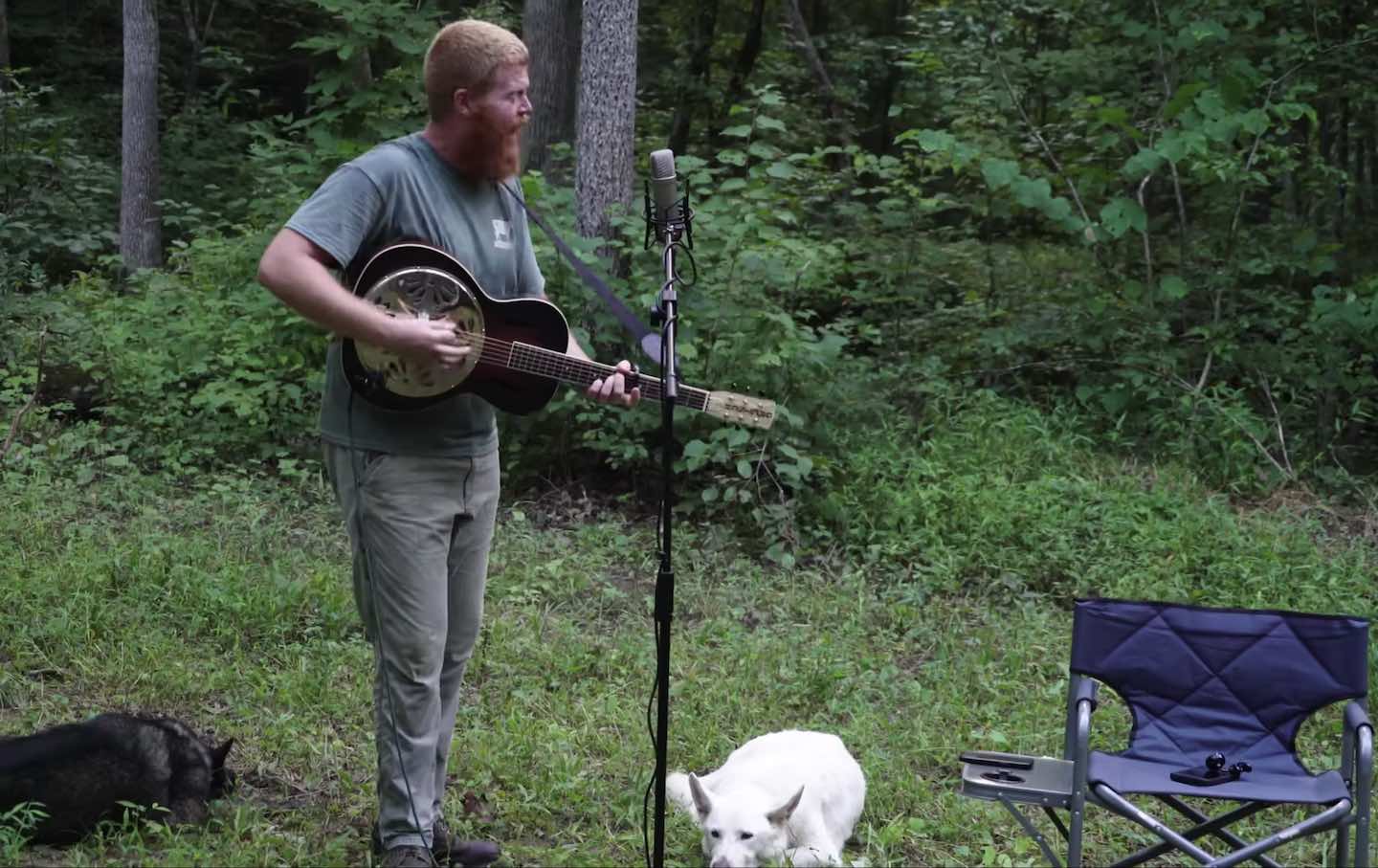
The American right is singing a new tune, and it’s the refrain from the breakout country song “Rich Men North of Richmond” by Oliver Anthony: “Livin’ in the new world, with an old soul / There’s rich men north of Richmond, Lord knows, they all just want to have total control.” This week, a video of Anthony performing the song clocked 12 million YouTube views in six days and landed, along with two of his other recordings, in the top 10 downloads on iTunes. Its lyrics chime in with the dominant social myth of Trumpian politics—rendering it as the voice of the forgotten white working class, seeking to reclaim its birthright against a soulless, power-mad, and redistribution-minded deep state. That abiding sense of persecution drives the balance of the song’s chorus: “They want to know what you think, and know what you do / And they don’t think they know, but I know that you do / Your dollar ain’t shit / And it’s taxed to no end / Because of the rich men north of Richmond.”
That sentiment has captured the imagination of the self-styled “populist” leaders of the right, from Q-pilled Representative Marjorie Taylor Greene of Georgia to former Arizona gubernatorial candidate and full-time election denier Kari Lake, both of whom have been jockeying for consideration as Trump’s 2024 running mate. In short order, a flotilla of commentary from the right has hailed Anthony and his breakout song as the voice of aggrieved real American virtue. All-purpose Rumble provocateur Matt Walsh embraces Anthony’ s performance as a moment of spellbinding realness in a culture of fakery. Theo-paleo-con Rod Dreher has proclaimed Anthony the J.D. Vance of the present political moment—namely, the author of “an articulation of white working-class pain and frustration that has startled the cultural guardians by going megaviral.” Not to be outdone, Real Clear Markets writer Rob Smith likens Anthony’s lyrics to the verses of Byron and Shelley.
Mainstream chroniclers of this hyperbolic chorus chalk it up to Anthony’s most overtly political verse in the song, which excoriates welfare recipients in the sort of rhetoric that has driven backlash politics for half a century. After a drive-by characterization of “the obese milkin’ welfare,” Anthony, evidently feeling the case hasn’t yet been clinched, tries to get specific: “Well, God, if you’re 5-foot-3 and you’re 300 pounds / Taxes ought not to pay for your bags of fudge rounds / Young men are puttin’ themselves six feet in the ground / ’Cause all this damn country does is keep on kickin’ them down.” (Note to Rob Smith: This isn’t exactly “Love’s Philosophy.”)
Regrettably, such downward-punching depictions claim an outsize legacy in modern country, from Merle Haggard’s “Working Man’s Blues” to Guy Drake’s “Welfare Cadillac”—though the main run of slantwise social commentary about income support in the genre mostly follows in the lovelorn footsteps of Buck Owens’s “Waiting in Your Welfare Line.” Against this backdrop, Anthony’s plaint about income redistribution doesn’t exactly mark “Rich Men North of Richmond” as any sort of breakout phenomenon, let alone the anthemic clarion call that right-wing political leaders and pundits are making it out to be.
Instead, the real Trump-branded message of Anthony’s song is conveyed in a single couplet: “I wish politicians would look out for miners / And not just minors on an island somewhere.” In mainstream discussions of the song, entertainment writers noncommittally note that this appears to be a reference to Jeffrey Epstein. But as Anthony himself makes clear in an introductory video timed to the song’s release, it’s much more than that.
Anthony explains that he began writing songs in earnest in 2021, during Covid, and that he was among a large contingent of Americans who felt at loose ends amid the pandemic’s upheavals. He explains that his search for release via drugs and alcohol during a punishing work schedule started to seem hollow, to the point where he felt he no longer could even summon any strong emotions over things he actually cared about. But he found a sense of purpose in both songwriting and renewed religious faith, after spending much of his life as “an angry little agnostic punk.”
His new song, then, addresses the upshot of that conversion. “It touches base on human traffic and the atrocities…,” Anthony starts to explain, with his voice trailing off. He then continues: “I’ll say this: I sit pretty dead center down the aisle on politics and always have…. It seems like both sides serve the same master, and that master is not someone of any good to the people of this country. But I think one of the worst things a human being can do is take advantage of a child. And I can’t begin to conceptualize what has to happen to someone in order for them to think that’s OK. And I think I drew the line on being quiet when I started to see that becoming normalized. And I’ll leave that at that.”
Amazingly, those mainstream commentators have only quoted Anthony’s claim that’s he’s in the “dead center” of the political spectrum as a sign that the core inspiration for “Rich Men North of Richmond” wasn’t especially political, implying that Anthony has been adopted by a corps of opportunistic on the right on the lookout for a more tuneful version of Vance. But the entire context of Anthony’s self-characterization shows that his song, like Sound of Freedom, the other major breakout entertainment hit from the right this summer, is squarely in the wheelhouse of the QAnon movement.
It wasn’t only Oliver, after all, who came to the conviction that child sex trafficking was being normalized during the Covid lockdown years—the Q movement experienced its greatest mass recruitment surge then, as a vast new corps of involuntarily housebound web users stumbled across the movement’s sensationalist claims about a worldwide liberal-led conspiracy to kidnap, abuse, and even cannibalize young children. (Nor are Anthony’s conspiratorial speculations evidently confined to QAnon; in a YouTube playlist of 48 videos he’s endorsed as a way to “make your noggin get bigger,” three are devoted to anti-Semitic conspiracies about the 9/11 terror attacks.)
Anthony’s crusading sense of mission was front and center in his recent concert debut, another awkward and incongruous moment for a guileless entertainment press that has thus far greeted him as a kinder, gentler version of Jason Aldean—who had his own viral right-wing backlash anthem, “Try That in a Small Town,” go viral this summer. As Variety reports, Anthony opened his performance “by reading a lengthy biblical passage from Psalm 37. His recitation ended with the words ‘But the wicked will perish. Though the Lord’s enemies are like the flowers of the field, they will be consumed, and they will go up in smoke.’” Yet here again, the media refuses to see, and name, a clear moment of movement proselytizing. Variety correspondent Chris Willman only notes wanly that “with that promise, he closed the good book, and the crowd erupted in enormous cheers—whether for the promise of the damnation of enemies, or just the promise of the music starting up, it was hard to tell.”
No, it’s not. Everything about the breakout appeal of “Rich Men North of Richmond” is steeped in an evangelical culture of bellicose ideological confrontation—and QAnon is but the most recent and most lurid iteration of that broader Kulturkampf mobilization. To put things in perspective here, is it really possible to imagine reporters filing a “hey, whatever” reaction should any of the wide array of liberal-sympathizing country performers, such as Jason Isbell, Tyler Childers or Margo Price, begin a show by calling down brutal Leninist vengeance on their political opponents?
The reason that such a turn of events isn’t thinkable, of course, is that for our cultural gatekeeping class, country music enjoys a near-monopoly on genuine and legitimate expressions of real-American grievance. If any howl of backlash-themed provocation issues from a Southern-branded bard like Anthony or Aldean, it’s automatically stamped as “authentic” as it moves down the culture-trust production line.
Popular
“swipe left below to view more authors”Swipe →This uncritical reflex not only strategically muffles and distorts the most unsettling sentiments of Anthony’s breakout song; it silences the many powerful voices of protest that have helped shape country music in America. For but one bracing example, see this 1991 interview on New Zealand television with the members of the Highwaymen supergroup—Johnny Cash, Waylon Jennings, Kris Kristofferson, and Willie Nelson—on the first American invasion of Iraq. (Sample Kristofferson quote: “The lap dog media cranks out propaganda that would make a Nazi blush.”) Better yet, listen to James McMurtry’s epic 2005 protest song, “We Can’t Make It Here,” which presciently discards the bad-faith class mythologies of Trumpism in a single verse:
Should I hate a people for the shade of their skin
Or the shape of their eyes or the shape I’m in
Should I hate ’em for having our jobs today
No, I hate the men sent the jobs away
I can see them all now, they haunt my dreams
All lily white and squeaky clean
They’ve never known want, they’ll never know need
Their shit don’t stink and their kids won’t bleed
Their kids won’t bleed in their damn little war
And we can’t make it here anymore.
No pundit chorus has ever been mustered to try to anatomize what such sentiments might mean for the forgotten workers, kids, and soldiers in the real America. No, the Oliver Anthonys and Jason Aldeans are tailor-made for that gig, no matter how wooly their beliefs or bigoted their public statements may be. Anthony’s vision of a remote and faceless governing caste pursuing “total control” while fattening welfare recipients and coddling pedophiles is mistaken on many fronts, God knows. But in one respect, he can claim true prophetic inspiration. “We are living in dark times,” he says near the outset of his introductory video. “This is really just the beginning of what’s to come.”
More from The Nation
The Genius of Charli XCX The Genius of Charli XCX
On her new album, Music, Fashion, Film, the musician embraces rock.

The Architectural Follies of Trump’s Washington, DC The Architectural Follies of Trump’s Washington, DC
The president plans to remake the capital in his own image, but is all he is doing destroying what’s already there?

The Carnival of Venice Biennale The Carnival of Venice Biennale
That so much of the art of “In Minor Keys” is muted in effect is ironic, because so much of it is overproduced, aspirationally eye-catching, and so big.

