
“We’re Not Calling Things What They Are”
Years after leading opposition to the US war in Iraq, France’s Dominique de Villepin speaks out against another illegal war in the Middle East and Europe’s timid response.
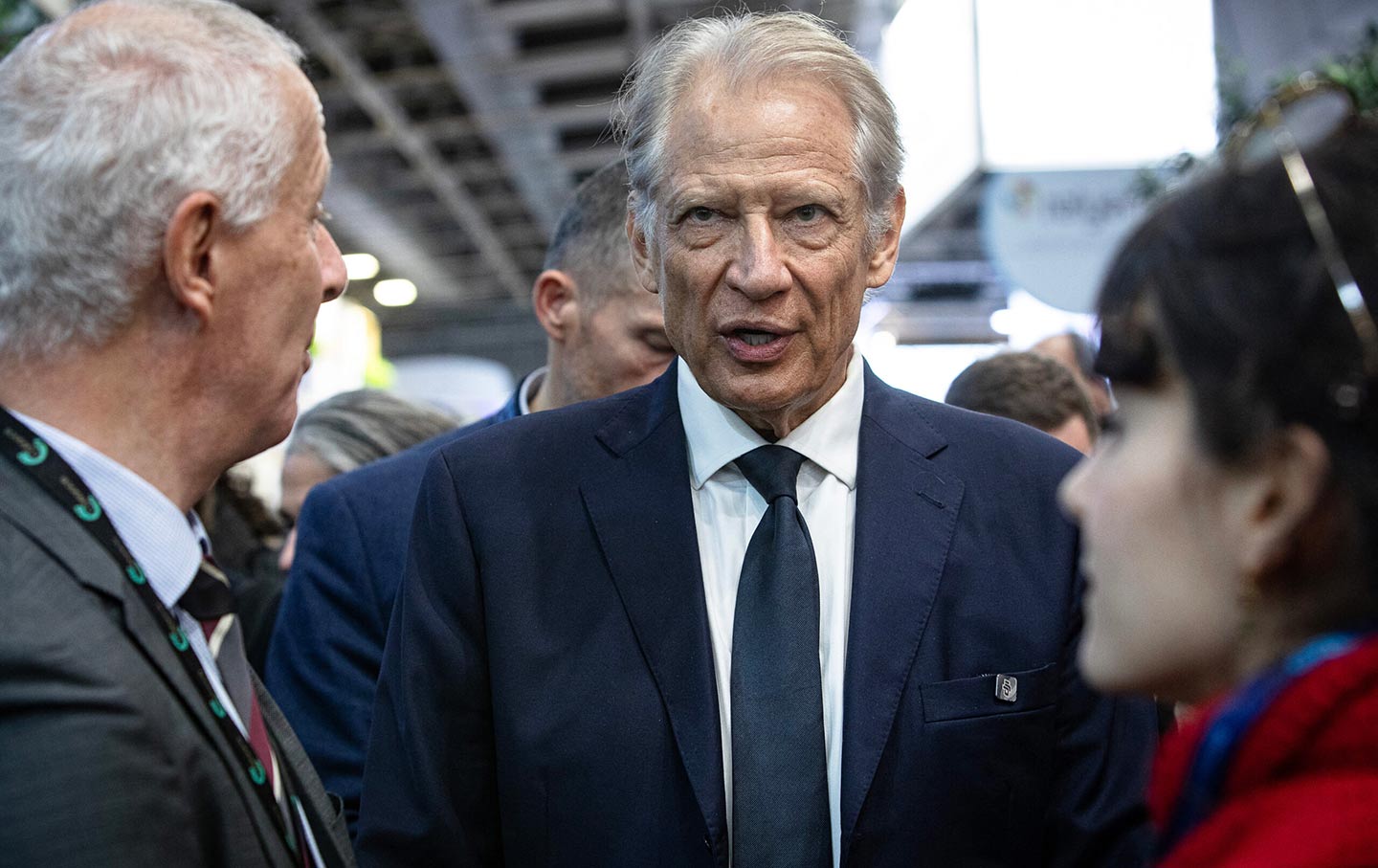
Marseille—One could forgive Dominique de Villepin for feeling a bit of déjà-vu.
As France’s foreign minister in 2003, he led the charge at the United Nations Security Council against US attempts to drum up support for the invasion of Iraq, culminating in a widely celebrated speech decrying the use of force and hailing the power of diplomacy. It was ignored by Washington at the time, but his warning that an intervention would trigger “incalculable consequences” across the Middle East proved sadly prophetic.
That’s why I began our interview by asking about the parallels between the conflicts, expecting him to quickly lean into the similarities with the current horrors unleashed by the United States and Israel.
Instead, the 72-year old statesman launched into a long analysis emphasizing the differences—a spoken essay as well-structured as any address he might have given during his stint at the Quai d’Orsay. Today’s war, he told me over video from his office in Paris, is even more dangerous and more reckless than the one that ravaged the region more than two decades ago. And the muted response from European leaders stands in stark contrast to the days he took on a vial-clutching Colin Powell in New York—yet another reason why Villepin, out of government since serving as prime minister from 2005 to 2007 under center-right President Jacques Chirac, is mulling a potential presidential run of his own next spring.
Deep disagreements between Paris and Washington aside, Villepin recalled that the US decision to invade Iraq followed its participation in a multilateral initiative at the United Nations that involved weapons inspections. And while the Bush administration never won UN support for the war, it still managed to pull together something of an international coalition. Even US objectives in 2003 were “relatively clear,” if terribly misguided—as Villepin put it, driven by a “neoconservative ideology idea that one could impose democracy though force and that this democracy would allow the Middle East to enter a virtous cycle that would serve the entirety of the region.”
Today’s conflict, by contrast, lacks even a semblance of grounding at the United Nations. It is led by only two countries. And the goals remain frighteningly unclear. “In the current case, there are no clear objectives,” Villepin told me, drawing out each of the final three words for emphasis. “There are no objectives with respect to democracy. There’s not even an objective with respect to the Iranian people, who are nevertheless dealing with oppression from an odious regime that oversaw horrors at the beginning of the year, likely involving the deaths of thousands of people.”
When it comes to the Washington/Tel Aviv axis, Villepin said the latter’s motivations are much more clear. Although he believes the United States has an addiction to the “cult of power”—the notion that “American power is unlimited” and can solve any geopolitical problem on the planet—he acknowledged the Trump administration’s actual aims remains hard to decipher. “The United States is leading a war by touch. It’s trying to find its way, in the night, in the darkness, it doesn’t know where it’s going—and from this point of view, the only partner who knows what he wants and where he’s going is Benjamin Netanyahu.”
In Villepin’s reading, Israel’s government has adopted a doctrine of “security at all costs” following the October 7 attacks. “Dissuasion was reestablished after October 7, but there’s the idea that dissuasion isn’t enough and that something else needed to be imagined, which is to say, a guarantee of absolute security,” he told The Nation. “And this guarantee of absolute security involves absolute insecurity for all the neighbors of Israel. That’s the situation in Lebanon and Southern Lebanon with Israel’s right to intervene. It’s the situation in Syria. It’s the same thing in Iraq, Yemen, and Iran.… all of this leads one to imagine a construction of the Middle East that gives control and hegemony to Israel, or what certain geopolitical experts in Europe call a pax hebraica, with the support of the United States.”
While a fragmented postwar Iran could serve the immediate interests of PM Benjamin Netanyahu, it would be disastrous for the 90 million people residing with Iranian borders. “It would be a catastrophe for the Iranian people,” Villepin said. “Nobody today would want to see the decomposition of Iran itself—of the regime of course, but not the country.”
To be sure, it’s not just American foreign policy that has evolved since House Republicans were rallying around “freedom fries” and late-night hosts making cringey jabs at their country’s oldest ally. In 2003, much of Europe stood up to the United States: France could count on Germany in opposing the war and the continent’s twin powers didn’t shy away from stressing disagreements over policies they considered disastrous and unlawful. This time around, the response in Europe has been far more subdued.
The day US bombs began falling on Tehran, EU foreign policy chief Kaja Kallas issued a terse statement describing “perilous” developments—and while she now calls for “de-escalation,” she has reserved the brunt of her criticism for Iran. For his part, German Chancellor Friedrich Merz has shown more support for Trump than even Democrats in Congress have, saying his country shares the war aims of the US and Israel. Even France has offered mixed messages: In a nationally televised address on March 3, President Emmanuel Macron acknowledged that the United States and Israel acted “outside the framework of international law,” but stressed that Iran bore “primary responsibility” for the war. Only Spanish PM Pedro Sanchez has condemned Washington and Tel Aviv in plain language.
For Villepin, Europe’s unwillingness to more pointedly condemn the US and Israel for an unlawful war of aggression marks an abdication of the continent’s role on the international stage.
“American power makes it hard to imagine directly and frontally opposing Donald Trump, but we could start with our words,” he told me. “And today, those words are not calling things what they are, starting with the illegality of this process and the lack of respect of international law. There’s a principle of legality that needs to be recalled. There’s a principle of responsibility that needs to remembered. And we need to place our weight on the international scene with the countries of the region who are fearfully watching the cycle of destruction intensify.”
These are hardly the words of a left-wing radical—indeed, Villepin spent the entirety of his political career in the party of the mainstream right. He belongs to an older guard of French diplomats who think of themselves as Gaullists: upholding a vision of France that retains autonomy on the international scene and draws inspiration from the founder of the Fifth Republic who famously refused to allow US bases on French soil and withdrew from NATO’s integrated command structure.
According to Villepin, it’s the aimless drift of France’s current political class that has motivated his slow return to public life—and in June 2025, the launching of a new movement dubbed “Humanist France” that could serve as a vehicle for a potential presidential campaign. On the domestic level, he is alarmed at the rise of Marine Le Pen’s far-right National Rally. But he also believes recent French foreign policy has fallen short of what today’s perilous moment in global affairs requires. While he says European leaders rightfully condemned Russia’s full-scale invasion of Ukraine in 2022, they failed to extend that same commitment to international law in Gaza. Against that backdrop, Villepin has emerged as one of Europe’s most prominent critics of Israel’s war (and genocide, as he declared in a June 2025 op-ed for Le Monde.) “I said, ‘Be careful about the risk of double standards,’” he told me of the West’s inability to condemn Israeli atrocities at the start of the war in 2023. “The entire world is going to see whether or not you’re hypocritical and if you’re acting as an ‘occidentalist,’ without really respecting international law for all. And it became clear that, in effect, there were double standards.”
Popular
“swipe left below to view more authors”Swipe →Imagining the construction of a global order undergirded by commitments to peace and international law may sound like a fanciful task in the age of Trump, Putin, and Netanyahu. But Villepin believes France and Europe could start by championing a proposal at the UN to force belligerent states to pay for the costs of war—an initiative that could be folded into a broader push to include Western reparations over colonization and climate change. “When you see the consequences of the American intervention in Iraq and when you see the consequences of the intervention taking place today, the question of responsibility is essential,” he said. “You can’t do whatever you want without paying the price.”
But he also believes states need to simply uphold their own laws: Although President Bush and British PM Tony Blair’s misdeeds in Iraq went unpunished, Villepin said it’s incumbent on liberal democracies to “hold accountable those who blindly hold the world accountable.” In a recent interview on French news channel BFM, Villepin suggested that US Defense Secretary Pete Hegseth’s boasting about no longer following “stupid rules of engagement” put him in that category, and he further developed his criticism of those remarks in his interview with The Nation. “What does that mean, that the Geneva conventions don’t exist?” Villepin asked. “That international humanitarian law has no reason to exist? That we can rejoice over sinking ships off the coast of Venezuela and letting people drown? That we hate our enemies so much that every single rule of humanity is set aside. This is return to a state of savagery. The United States risks returning to the 19th century, to the Far West where you shoot at everything that moves and it’s a colt pistol that makes order. No, that’s not how law and order work.”
It may take time, but Villepin believes a day of reckoning is inevitable. “We’re going to have to collectively pay the consequences of what’s been decided with this war in Iran,” he said. “And when this cycle ends, the next American president and future European presidents will have to sit around the table with leaders from around the world to decide how to turn this tragic page of world history and how we reinvent ourselves. I’d like for this to happen in a few months, but maybe it’ll happen in 10 years or maybe even 50 years. We may well be entering a period of 50 or 100 years of global disaster.”
Support independent journalism that does not fall in line
Even before February 28, the reasons for Donald Trump’s imploding approval rating were abundantly clear: untrammeled corruption and personal enrichment to the tune of billions of dollars during an affordability crisis, a foreign policy guided only by his own derelict sense of morality, and the deployment of a murderous campaign of occupation, detention, and deportation on American streets.
Now an undeclared, unauthorized, unpopular, and unconstitutional war of aggression against Iran has spread like wildfire through the region and into Europe. A new “forever war”—with an ever-increasing likelihood of American troops on the ground—may very well be upon us.
As we’ve seen over and over, this administration uses lies, misdirection, and attempts to flood the zone to justify its abuses of power at home and abroad. Just as Trump, Marco Rubio, and Pete Hegseth offer erratic and contradictory rationales for the attacks on Iran, the administration is also spreading the lie that the upcoming midterm elections are under threat from noncitizens on voter rolls. When these lies go unchecked, they become the basis for further authoritarian encroachment and war.
In these dark times, independent journalism is uniquely able to uncover the falsehoods that threaten our republic—and civilians around the world—and shine a bright light on the truth.
The Nation’s experienced team of writers, editors, and fact-checkers understands the scale of what we’re up against and the urgency with which we have to act. That’s why we’re publishing critical reporting and analysis of the war on Iran, ICE violence at home, new forms of voter suppression emerging in the courts, and much more.
But this journalism is possible only with your support.
This March, The Nation needs to raise $50,000 to ensure that we have the resources for reporting and analysis that sets the record straight and empowers people of conscience to organize. Will you donate today?
More from The Nation
Welcome to the Era of the AI-Powered War Machine Welcome to the Era of the AI-Powered War Machine
How a clique of unhinged techno-optimists is putting humanity at risk.
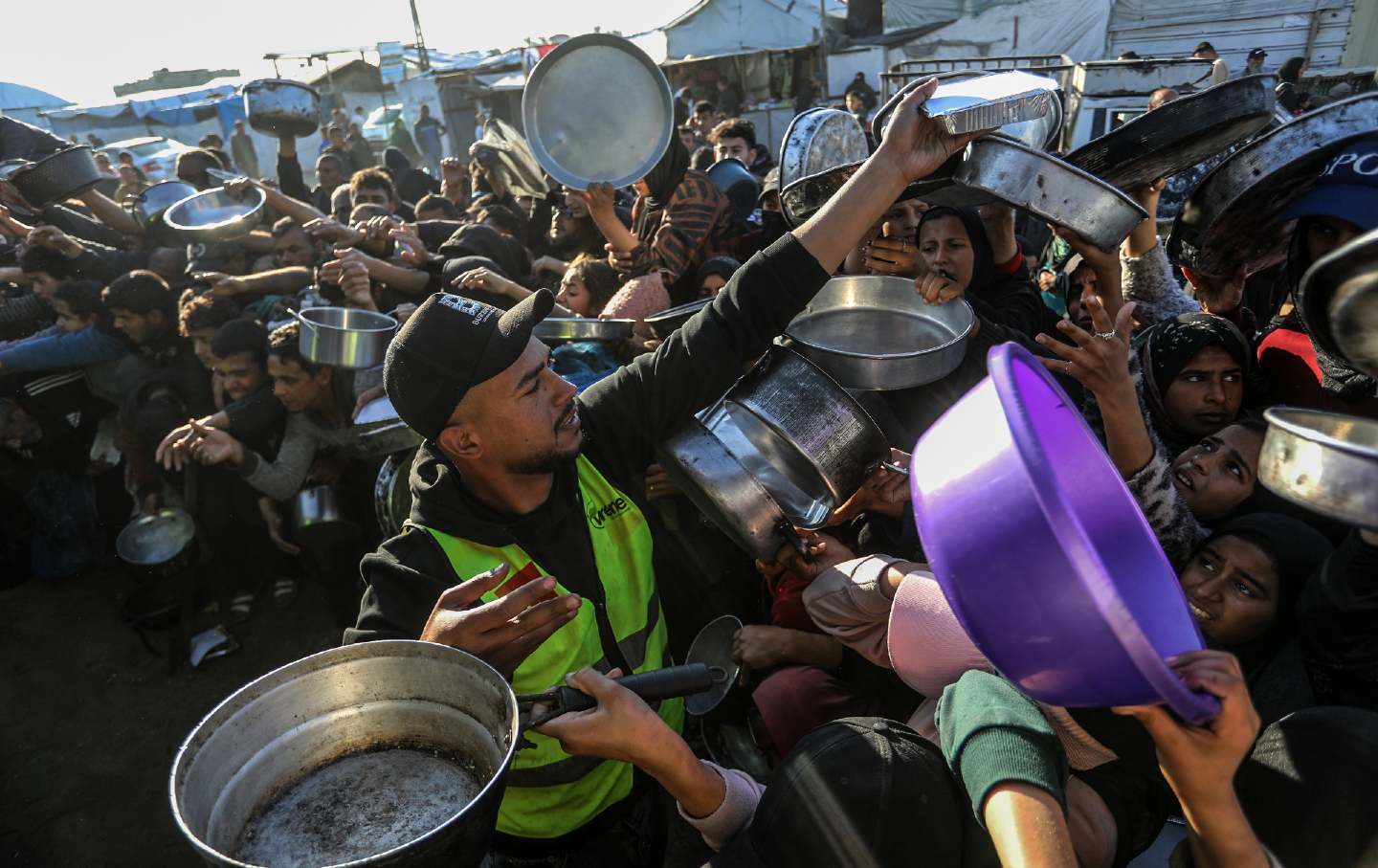
How a Rocket in Iran Reverberates in Gaza How a Rocket in Iran Reverberates in Gaza
As Israel bombards Iran with rockets, it is sealing off borders across Gaza and the West Bank, halting the flow of food, aid, and bodies.
How the Israeli Tail Wags the American Dog How the Israeli Tail Wags the American Dog
The US attack on Iran may be less about American security than about the priorities of Israel’s government.

What to Expect From a Mammoth Disruption of Global Oil and Gas Supplies What to Expect From a Mammoth Disruption of Global Oil and Gas Supplies
And why was the Trump team so unprepared for shock waves?
The Man Who Would Be the Face of the Anti-Trump West The Man Who Would Be the Face of the Anti-Trump West
Mark Carney has put himself forward as one of the sharpest Western critics of Trump’s neo-imperial order. What’s less clear is what he’s offering in its stead.
The “Rules-Based Order” Is Gone. Let’s Not Bring It Back. The “Rules-Based Order” Is Gone. Let’s Not Bring It Back.
Trump has destroyed a global system that mostly benefited the rich and powerful. We need to create something completely different in its wake.

