
Ukraine and the End of Magical Thinking
Time for reassessment and a change of course.
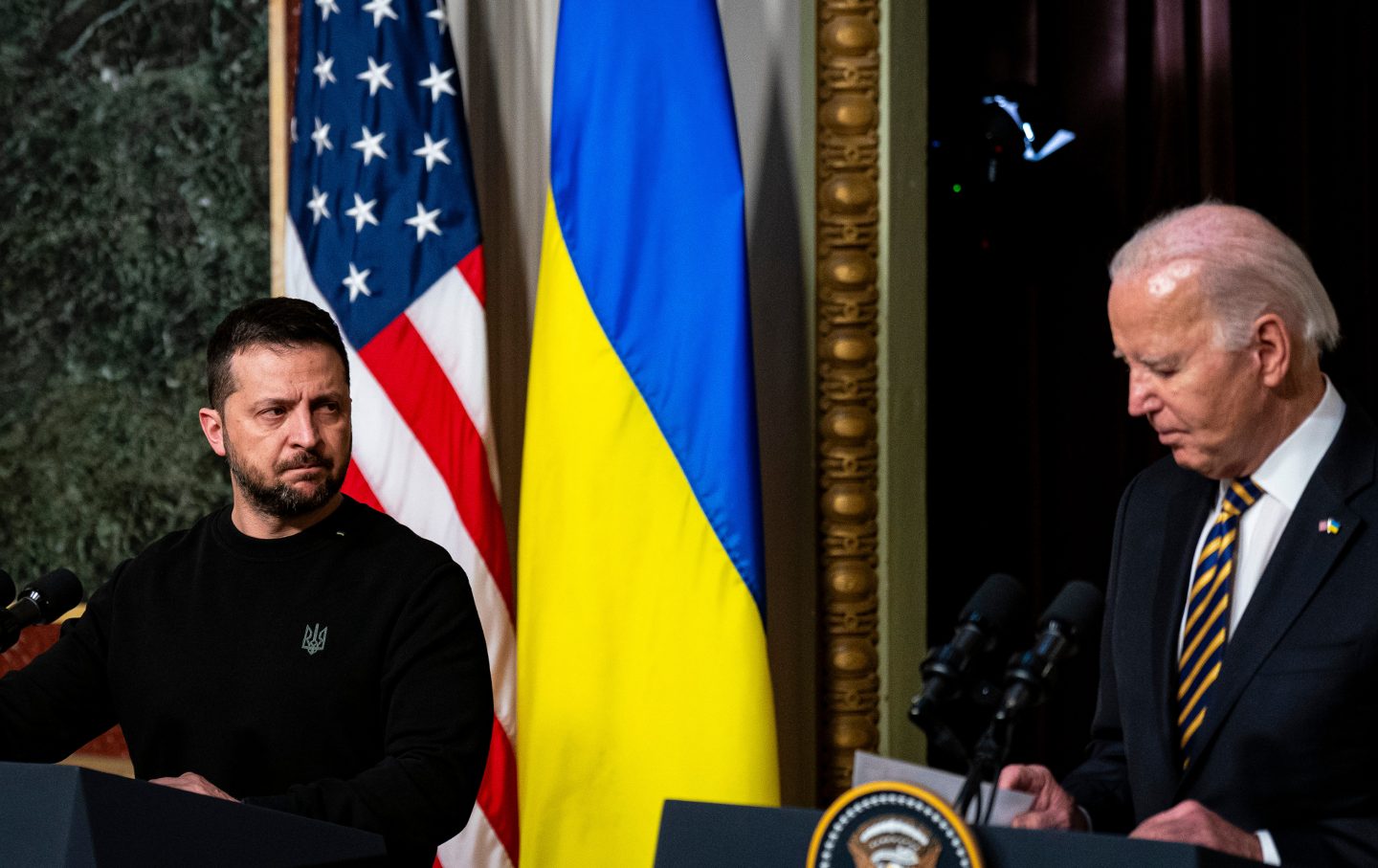
US President Joe Biden, right, and Ukrainian President Volodymyr Zelensky during a news conference in the Indian Treaty Room on the White House complex, in Washington, D.C., on Tuesday, December 12, 2023. Zelenskiy came to Congress today to appeal for more aid to resist Russia’s invasion, and Republican leaders told him to first wait for an elusive US deal on immigration.
(Al Drago / Bloomberg / Getty Images)In early November, Ukraine’s top general, Valerii Zaluzhnyi admitted that the war with Russia was at a stalemate. In December, Republicans in the US House of Representatives torpedoed the Biden administration’s request for billions in new military assistance to Ukraine. At the European Union, Hungary vetoed desperately needed monetary assistance. President Biden’s mantra that the allies would support Ukraine “as long as it takes” became a pledge to support the country “as long as we can.” From Europe, a stalwart Ukraine supporter, Lithuania’s Foreign Minister Gabrielius Landsbergis reported that “apparently as long as it takes means as long as we can agree.” Clearly, the time of magical thinking is over.
Ukraine’s startling early success in repelling the Russian attempt to take Kiev produced widespread euphoria. Russia’s military was exposed as incompetent and bumbling. The US mobilized its allies to provide arms and support and impose harsh sanctions on Putin. NATO was galvanized and expanded. Putin would be handed a defeat without NATO troop involvement. As the noxious Lindsay Graham put it, “Russians are dying” as Ukrainians fight “to the last person,” so aid to Ukraine is “the best money we’ve ever spent.” Sanctions would isolate and bankrupt Russia. China, Iran, North Korea and other adversaries would learn that aggression doesn’t pay. Putin might even be deposed and hauled before the International Criminal Court. In little more than a year, the US alone rushed $75 billion in largely military aid to Ukraine, a sum nearly as great as the entire annual Russian military budget.
That was then. Now as another harsh winter descends, the much-ballyhooed Ukrainian “offensive” has failed. With China, India and much of the Global South stepping in, Russia’s economy has rebounded from the sanctions. Putin has geared up for a long war. Ukraine, the second-largest country in Europe, is locked in a war of attrition with a country that is bigger, with more people, more troops, more artillery, and control of the air. The Pentagon, we’re told, has plans to increase production of 155 million artillery shells from 30,000 per month to 90,000 or 100,000 in 2025. Russia is headed toward generating 2 million a year.
Russia, according to a US intelligence estimate, lost a stunning 87 percent of its active-duty military in the first months of the war. But Ukraine’s losses have been nearly as great and not as sustainable. It is running out of men, guns, and ammunition. Its economy is battered. Over 20 percent of its people have been displaced, including 6.3 million refugees. It is estimated that it will take 757 years to rid the country of the mines now strewn across the countryside. The price tag for rebuilding is estimated to be north of $400 billion.
With NATO at its side, Ukraine can possibly hold out. But the problem with a proxy war is that war fever is hard to sustain without lives at risk. The administration’s sales pitch has grown more and more shrill—from “Russia will collapse quickly,” to “using Ukraine to weaken Russia is a cheap investment,” to “if Russia wins, US men and women will end up fighting them in Europe to aid to Ukraine is a job program at home,” to (as former Trump national security adviser Fiona Hill puts it), Putin is fighting to “remove the United States from the world stage.”
Enough. It is time for a sober reassessment. In the end, Barack Obama got it right nearly a decade ago. When the Russians entered Crimea after the 2014 coup against an elected Ukrainian leader who was sympathetic to Russia, Obama rejected plans to get involved militarily, arguing that “the fact is that Ukraine, which is a non-NATO country, is going to be vulnerable to military domination by Russia no matter what we do.” The Mexicans have a saying—“Poor Mexico, so far from God and so close to the United States.” Ukraine shares that same fate with neighboring Russia. Rather than providing the West with a proxy force to weaken Russia, it had to find a way to coexist with its bigger, more powerful neighbor.
A Way Out
After the casualties and destruction, no settlement will be easy. Both sides have good reasons not to trust the other. Putin’s speeches decrying the breakup of the Russian empire stoke fears that he will use any settlement to reload for the next target. Former German chancellor Angela Merkel’s admission that the West used the Maidan accords to buy time to build up the Ukrainian military gives Putin good reason to question any new agreement.
Putin clearly intends to consolidate Russia’s hold on Crimea and the Donbas region, if not more. No Ukrainian government would survive if it acceded to Russia’s land-grab. Ukraine needs massive aid in rebuilding its country. Putin has little appetite to bear the cost of the destruction that his invasion has created.
Yet both sides have reason to explore a cease-fire. The damage and casualties inflicted on Ukraine can’t be sustained. Outgunned and outmanned, with its allies distracted and faltering, it can only lose more ground and suffer more destruction in a war of attrition. Putin has announced plans to wage the war through 2026, expanding the territory that he claimed, leaving Ukraine a much diminished rump state. He won’t give up Crimea, with its warm water ports. He’ll demand that Ukraine become a neutral state and stay out of NATO. He’ll certainly want to incorporate much if not all of the Donbas into Russia.
Yet Putin has a real stake in a settlement, one that doesn’t stoke furies that lead to constant terrorist attacks. He’ll want an end to sanctions and an agreement on the damage claims around Ukraine’s ruin. The stability he would desire couldn’t be had without a settlement that sticks.
What’s clear is that any continued support for Ukraine must be tied to a serious exploration of a negotiated settlement with the Russians. That requires a reassessment and a change in course and moving toward negotiations, a cease-fire, and reconstruction—not the continued war of bloody attrition, the senseless killing and fighting to the last Ukrainian in the hope that Putin will collapse.
More from The Nation

Progressives Are Backing Puerto Rican Independence. It’s About Time. Progressives Are Backing Puerto Rican Independence. It’s About Time.
More and more leftists are concluding that statehood for the island is not enough.
The Saudi Phase of the Iran War Signals More Chaos to Come The Saudi Phase of the Iran War Signals More Chaos to Come
The conflict that Donald Trump has repeatedly proclaimed an unequivocal American victory keeps spiraling out of control.
Why Navi Pillay’s Receiving the Nobel Peace Prize Is So Important Why Navi Pillay’s Receiving the Nobel Peace Prize Is So Important
She believes that human rights and international law are universal principles that must be enforced regardless of violator’s ideology, ethnicity, or geostrategic alignment.
Andy Burnham’s Speech to the Labour Party Conference Could Be the Start of a Positive Social-Democratic Politics Andy Burnham’s Speech to the Labour Party Conference Could Be the Start of a Positive Social-Democratic Politics
But the autumn budget to be released at the end of October will offer needed details.
Writing About War as Bombs Fall Writing About War as Bombs Fall
While the Israeli government launched a well-orchestrated offensive of disinformation and hyperbole that would make the illegal permissible in the war on Gaza.

