Trump and Netanyahu’s 20-Point Gaza Ultimatum
The plan for Gaza does not promise an end to Israel‘s genocide—but does promise indefinite occupation.
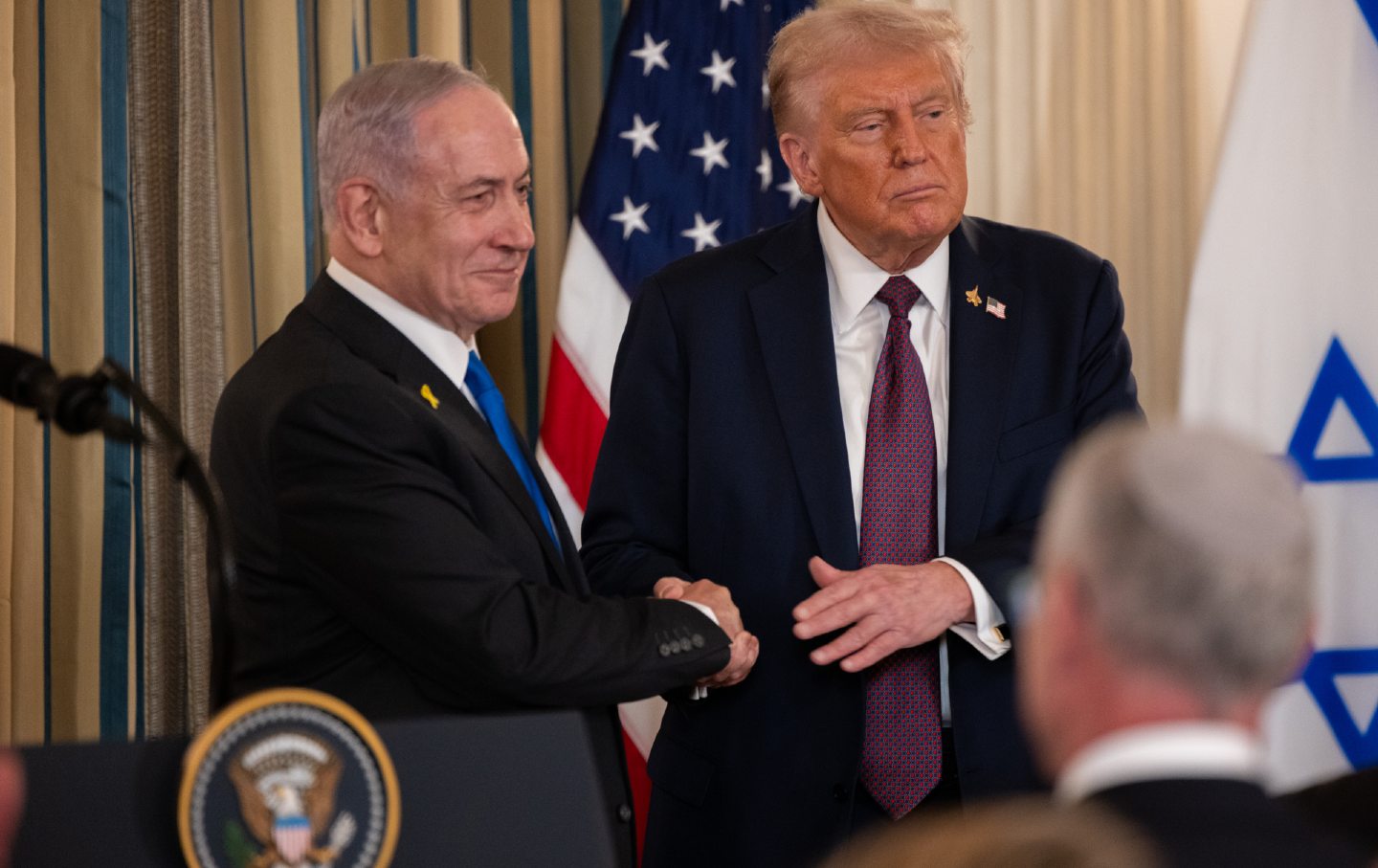
In a long and rambling speech, President Trump called his proposed Gaza peace plan “the whole deal, everything getting solved…. peace in the Middle East.” Standing next to a grinning Israeli prime minister, he said it was a “historic day for peace.” In fact, he said, it would be “one of the great days ever in civilization.” Lots of smiles, lots of commercials for Trump’s incessant “I deserve the Nobel Peace Prize” campaign.
Lots of everything—except enforcement of any of Israel’s obligations. Except accountability. Except international law. Except justice. Not even any guarantee of an actual end to the genocide, or to the suffering of Palestinians in Gaza. Instead, as even one New York Times headline acknowledged, the 20-point plan “offers Netanyahu [a] victory lap.”
If you scan the text quickly enough, there are some potentially encouraging words. “The war will immediately end.” “Israeli forces will withdraw.” “Military operations will be suspended.” “All hostages, alive and deceased, will be returned.” And “Israel will release 250 life sentence prisoners plus 1700 Gazans who were detained after October 7, 2023, including all women and children detained.” Also: “Israel will not occupy or annex Gaza.” “Distribution and aid in the Gaza Strip will proceed without interference.”
That all sounds like an enormous relief for Palestinian suffering under the bombing, starvation, dislocation, and annihilation of Israel’s almost two-year-long genocide. But: An even slightly more careful read shows the limits. Israeli forces are supposed to withdraw, but only to a line inside Gaza, agreed to by the United States and Israel, where they will remain indefinitely. The release of all hostages is set for 72 hours after the agreement is signed—but Israel isn’t required to release any Palestinian prisoners until after all its hostages have been returned. Who will enforce that if Israel reneges?
Israel may not officially annex Gaza, but the Israeli military forces will remain an occupying force into an undetermined future and only begin to conditionally and partially withdraw as an “international stability force”—foreign troops who would arrive to take over occupying the territory—“establishes control.” And that international force should not be confused with a protection force mandated to safeguard Gaza’s 2 million people from the ravages of Israeli genocide, occupation, and apartheid; its officially stated purpose is to make sure Gaza “no longer poses a threat” to Israel or Egypt.
And, oh yeah, that crucial claim that “the war will immediately end” and “all military operations, including aerial and artillery bombardment, will be suspended”? Who’s going to enforce that if Israel decides, after all the hostages are released, to ignore the rest of the agreement and go back to full-scale genocide, as Netanyahu has made clear is his intention?
Indeed, in the complicated agreement of 20 separate and sometimes contradictory points, only six have anything to do with ending the genocide—and they’re not very solid. The rest are all about how “New Gaza,” as the agreement names it, will be governed (by various Israeli, US, British, and other outside international forces under the joint control of Trump and Tony Blair) and how its economy will be rebuilt (by international financiers and real estate barons). “New Gaza’s” role in the region and the world will be defined by “posing no threat to its neighbors or its people.” That will be guaranteed by regional partners, meaning Arab governments, and the future International Stability Force, whose job will be “to ensure that Hamas, and the factions, comply with their obligations” to be nice in the neighborhood.
If one were actually looking at threats to, or destabilization of Gaza’s neighbors, it might be useful to list the seven countries across the region that Israel has bombed in the past few months—Qatar, Iran, Lebanon, Syria, Yemen, Iraq, and Palestine—and ask who is going to guarantee that Israel “complies with its obligations” not to pose a threat to its neighbors. But the agreement makes no reference to that.
Ultimately, Palestinians will have no say in the governance of their land. With Hamas disarmed (how and by whom and over what time frame that will be defined, carried out, confirmed remains unclear), Gaza would be governed first by a “temporary transitional…technocratic, apolitical Palestinian committee” of “qualified Palestinians and international experts.”
In a move painfully reminiscent of the 2001 Afghan and 2003 Iraqi “democratic governance” experiments of US-chosen, US-vetted, and US-installed individuals who provided indigenous cover to Washington’s occupation forces, that “transitional” committee will be overseen by a newly created US-UK team chaired by no other than Trump himself and featuring Tony Blair as the pro-consul. In an Orwellian “New Gaza” version of Iraq’s US-controlled Coalition Provisional Authority, that team will be called the “Board of Peace.” Its role will be to “rebuild and energize Gaza” by relying on a “Trump economic development plan.”
There is a vague and rather confusing reference to a small potential future role for the Palestinian Authority, but only after it has “completed its reform program, as outlined in various proposals including President Trump’s peace plan in 2020 and the Saudi-French proposal…” Effectively, it means the United States and its allies will determine when, if, and to what (limited) degree the PA will have any role to play—and Netanyahu seems determined to block even that small concession.
When he took his victory lap home, he reassured his far-right cabinet that the reference to a Palestinian state was “ambiguous” and that they had no need to worry about the Palestinian Authority playing a role. “The Palestinian Authority (PA) is out,” he said. “Even on the ‘Board of Peace,’ no PA representatives will be appointed. Israel and the US are the ones who decide if it will meet the conditions, and there’s an entire wall of conditions.” Palestinian civil society, of course, is never mentioned. Nor are ending occupation, apartheid, or colonial settlement.
Crucially, the plan also does not promise a permanent end to Israel’s war. To the contrary, Netanyahu’s effusively positive but substantively vague responses to Trump during their joint September 29 press conference (without questions from the press) left plenty of room for entirely different positions once he returned home to his extremist right-wing base.
It should not be surprising that Trump’s much-touted peace proposal represented a powerful victory for Israeli power—even putting aside the decades of US financial and military support enabling Israeli genocide. According to the The Times of Israel, by the time Netanyahu left the White House after his meeting with Trump, he was triumphant. In a Hebrew-language video, he gloated: “Now the whole world, including the Arab and Muslim world, is pressuring Hamas to accept the terms that we created together with Trump, to bring back all the hostages—the living and the dead—while the IDF stays in the majority of the Strip,” he said.“Who would have believed it?!”
An earlier draft of the proposal had been provided to mediators Qatar and Egypt and to other Arab and Muslim states, about a week before the public announcement, and they had agreed to support that deal. But later, Netanyahu demanded and won significant new concessions in talks with Trump’s son-in-law Jared Kushner and his real estate buddy-cum-envoy Steve Witkoff.
Kushner played a central role in orchestrating the 2020 Abraham Accords that led to several Arab governments agreeing to normalize relations with Israel in return for major US arms, trade deals, and diplomatic trade-offs—while abandoning long-standing Arab insistence that Israel must end the occupation before normalization could occur. And that role appears to have been matched by his part in redrafting Trump’s 20-point proposal to include Netanyahu’s additional demands for concessions.
There are reports that at least some of the eight Arab and Muslim governments that initially welcomed Trump’s proposal were angry at the last-minute changes made after they had agreed. According to Drop Site News, Egyptian Foreign Minister Badr Abdel Aaty said Trump’s plan “contains many positive elements,” but added, “there are also elements that require extensive discussion and, as the saying goes, the devil is in the details. Therefore, these issues must be discussed in depth in order to reach a consensus on them, especially with regard to implementation on the ground.”
Popular
“swipe left below to view more authors”Swipe →Given their dependence on the United States and eagerness to maintain the Abraham Accords trajectory, it remains unlikely, but not impossible, that some or all of them may withdraw their earlier embrace of the Trump proposal. Whether they do or not, it is likely that this deal, like the Abraham Accords, has more to do with Trump’s eagerness to reshape the Middle East around the US/Israel/Arab Gulf states axis than with anything remotely resembling peace or even an end to genocide for Palestinians.
We don’t know yet how Hamas will respond to the proposal. The limitations in it are clear—both in the uncertainty over whether it will actually end the immediate Israeli military assault and the genocidal famine across Gaza, and in the likely future of indefinite foreign occupation of Gaza while de facto annexation of the West Bank continues. What is also clear is the denial of Palestinian agency. Moreover, the legacy of Israeli violations of ceasefires—in Lebanon for decades, just months ago in Gaza—means there’s little reason to accept Tel Aviv’s claimed agreement at face value.
And yet. The genocidal assaults and death by famine-induced hunger continue. Children, elders, and so many others continue to die, averaging more than 100 every day. We cannot know how anyone—Hamas, long-standing components of the Palestinian national movement, or the hundreds of thousands of people simply struggling to survive and to feed their children—will respond, even to an “offer” that is not only difficult to accept in its substance but is put forward on the basis of “you will agree to this or else.”
What we do know, all we can know, is what it means for those of us committed to Palestinian freedom, justice, and dignity. We know we need to continue to fight to end this genocide, regardless of what decision Hamas or other Palestinian negotiators may make on the latest proposal. That means mobilizing at every level. Engaging in community and city-based protests. Maintaining pressure on Congress—whenever members come back to Washington, and in their districts till they do—to cut all military support to Israel. Supporting global mobilizations from civil society flotillas to the International Court of Justice in the struggle for accountability and an end to US complicity in genocide.
Public opinion is shifting dramatically. But conditions on the ground mean we have no time to wait for politicians to catch up. What we do know is we need to continue to act now.