
Donald Trump Is Losing the Iran War
Despite his constant declarations of victory, the truth about this conflict is clear.
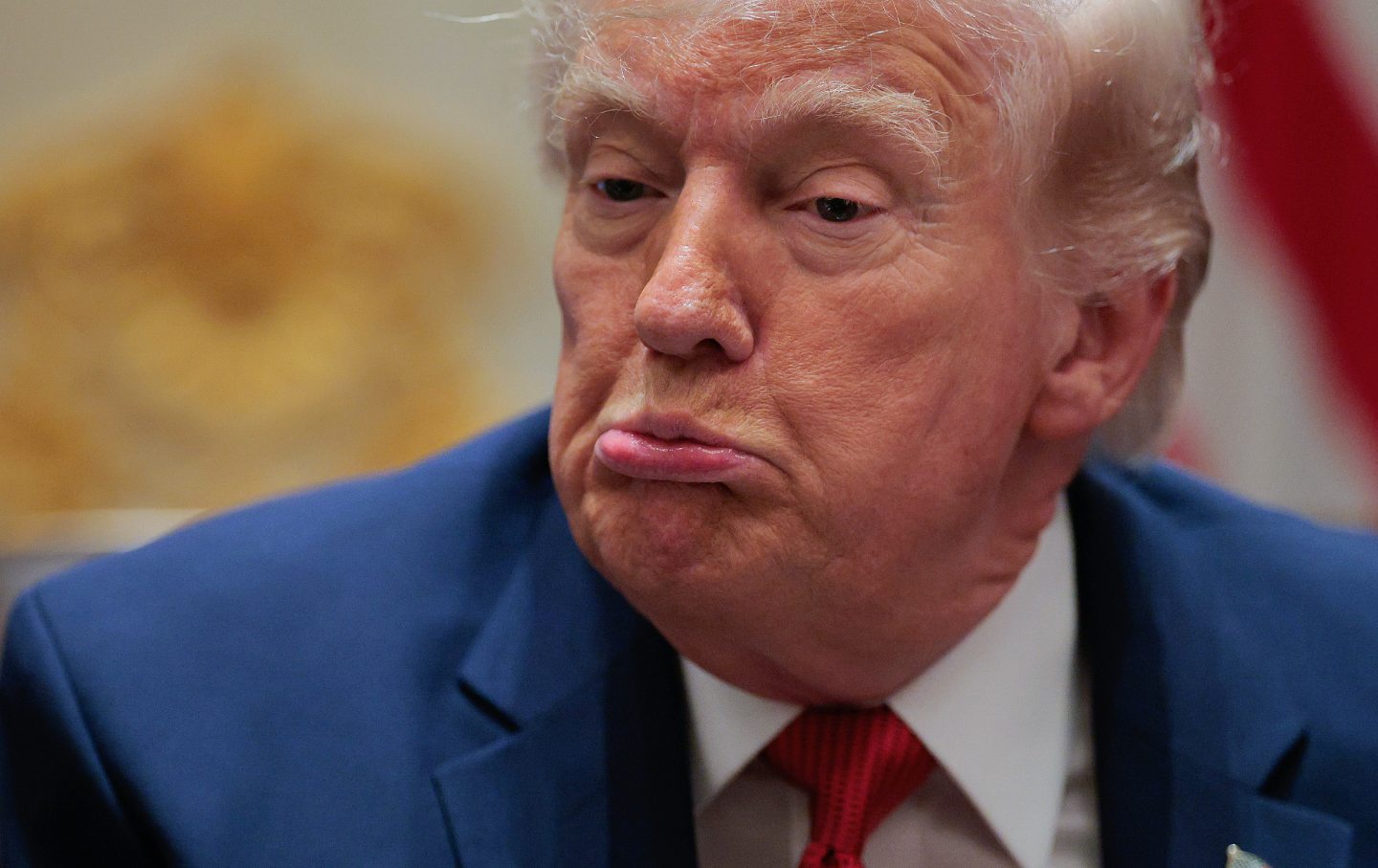
Donald Trump during a meeting in the Cabinet Room at the White House on March 26, 2026.
(Chip Somodevilla / Getty Images)After weeks of bombing Iranian military installations, naval vessels, and cities, President Trump declared the war against Iran “won” on March 24. Such a momentous achievement could have been announced in a grandiose speech—perhaps on an aircraft carrier with a banner describing the mission as having been accomplished—but Trump’s assertion passed without much fanfare.
Perhaps the reaction was so muted because Trump had already proclaimed that the war was won several times before—such as three weeks ago, when he said he thought the “war was complete, pretty much,” or two weeks ago, when he told a rally in Kentucky that America had won “in the first hour” of the war.
Perhaps there was a collective national shrug because, at the same time that Trump has declared victory, he has also claimed, against all Iranian denials, to have recently held “constructive talks” with unnamed leaders in Tehran who are “desperate for a deal,” but simply fear saying so because they will be killed, either by the government or by the US itself.
Or perhaps Trump’s words were ignored because everyone can plainly see that it is a lie. Despite such victories, despite such completeness, the war has somehow gone on still, as the Iranians will, unbelievably, not “accept they have been defeated militarily,” in the words of White House press secretary Karoline Leavitt. The idea that the United States is in fact losing this war is completely out of the question. But there is no avoiding the truth: The United States is, in fact, losing this war.
Endless press conferences, statements to gathered reporters, and social media posts from the commander-in-chief tell of thousands upon thousands of strikes, the decimation of the Iranian Air Force, and the destruction of literally “100%” of Iran’s military capabilities. But, as anyone with eyes can plainly see, the Iranian military continues to fight, not just in a flailing and minuscule way as the president implies, but with consistent levels of ballistic missile fire towards both Israel and American bases in the Gulf. This has forced the White House into increasingly baffling turns of phrase to describe what is happening.
At the same time that the president claimed that in Iran “we have nobody even shooting at us,” an F-35, a stealth fighter jet thought to be the height of cutting-edge military power, was struck and disabled by Iranian anti-aircraft fire for the first time in the plane’s history (Five days later, Trump would claim Iran had “no anti-aircraft equipment). In the 12 days since Trump posted that Iran was now only sending “a drone or two” and “a close-range missile somewhere,” the Islamic Revolutionary Guard Corps has launched more than 30 additional waves of attacks and shows no sign of stopping or even dropping the number of missiles and drones it fires. Despite claims of the destruction of the Iranian Navy, the Strait of Hormuz remains closed to all shipping from nations the Iranian state deems to be hostile.
Seemingly all other objectives of the war, be they degrading the Iranian military’s capabilities or overthrowing the Islamic Republic, have fallen by the wayside as the American government desperately attempts to control the price of oil, and reopen the Strait that was previously completely open before the war. The Trump administration has resorted to a routine cycle of market manipulation, claiming US Navy escorts of tankers that never existed, the absence of naval mines that news outlets said had very much already been laid, and the forced opening of the Strait being a “simple military maneuver” that European nations must involve their own militaries in, unless they don’t want to, which is no matter, because the US didn’t need their help anyway.
The frenzy to control the rapidly rising price of gas has become so acute that the Treasury Department, in an unprecedented move, lifted sanctions on Iranian oil already on the water, with Secretary Scott Bessent attempting to claim that the US was, through this move, “jiu-jitsuing” the Iranians.
Despite the presence of American aircraft carriers just outside its territorial waters and regular US-Israeli bombing raids on Iranian ports and missile launchers, Iran is exporting considerably more oil now than before the war, has imposed a toll regime on all ships passing through the critical strait, and has forced Israeli and Gulf interceptor missiles to run low in a way that has led to far more direct hits than at the beginning of the conflict.
Desperate for symbols of American victory, CENTCOM has regularly published videos of costly airstrikes on individual drones—for instance, throwing $100,000 Hellfire missiles at $7,000 Shahed drones, of which Iran had 80,000 before the war, and which, under ideal conditions, the Iranian military can produce 10,000 a month. Rather than receiving actual information about the war’s progress, President Trump has, according to NBC, instead been getting a daily montage of “the biggest, most successful strikes on Iranian targets over the previous 48 hours” by military officials, more simply described as “a series of clips of ‘stuff blowing up.’”
There is an apt historical comparison for this over-emphasis on sorties flown, strikes conducted, and commanders killed, over all other obvious, abundantly clear indicators of victory: Vietnam. General William Westmoreland, the American military chief of staff whom Iranian Foreign Minister Abbas Araghchi has compared to Trump officials, regularly boasted of weapon loss statistics and kill ratios as evidence that the tide was turning against Ho Chi Minh. Defense Secretary Robert McNamara told the Senate in 1965 that the US was flying 13,000 sorties a month against the North Vietnamese, that 1,900 “fixed targets” had been hit, and that the US had been “hurting North Vietnam’s war-making capability.” Westmoreland would declare in 1967 that “we have reached an important point when the end begins to come into view.” The war would rage on for another 8 years, ending with the fall of Saigon to the communists.
The key difference, one would argue, was that Vietnam included an immense investment of ground troops, whereas there are no American troops on the ground in Iran. That may change soon.
As with virtually every other aspect of this conflict, this would be a complete reversal of the promises the White House made when it first attacked Iran. Back then, War Secretary Pete Hegseth bragged that there was no need for “boots on the ground” because America had “taken control of Iran’s airspace and waterways” from the air. Now, there is a growing consensus among the Trump administration that ground troops are, in fact, needed to impose the control that the US has supposedly already taken. As of this writing, thousands of US troops are heading to the Persian Gulf region, as reports swirl about a potential landing on Kharg Island, or perhaps any number of other Iranian islands in the Gulf and in the Strait, where thousands, if not tens of thousands of Iranians, could soon come under direct American military occupation. The Iranian military, for its part, has been increasing its previously bombarded defenses on Kharg, anticipating the kind of invasion its military strategists have been anticipating for most of the Islamic Republic’s history.
Whatever happens next, this is not what a won war looks like. Instead, the mission creep of the war against Iran continues to lurch forward. The question of a potential new forever war that will cost many more thousands of Iranian lives, to say nothing of the American soldiers who would be in the line of direct Iranian fire, has been treated with a completely cavalier attitude. Every American administration prior to Trump has avoided war with Iran for a reason: the fear of being bogged down in a conflict on hostile terrain that would have no end in sight. This administration, believing wars are lost not by being outmaneuvered or being unprepared, but by being politically correct, has made a different choice.
American officials, from Stephen Miller to Hegseth to Trump himself, have gloated about the complete asymmetrical nature of this war, the overwhelming firepower the United States is displaying, and that the Iranians have no option other than to accept America’s demands whole cloth. The fundamental hole in America’s strategic thinking is the same now as it was in 1967: the inability to understand the basic truth that, in war, the enemy also gets a vote.
Become a Sustaining Donor This September
Between the reemergence of right-wing red-baiting and Donald Trump’s use of the chilling National Security Presidential Memorandum–7 to criminalize left political organizing, we’re seeing McCarthyism reborn before our eyes.
This assault on democracy cannot be ignored or wished away. Resisting it requires bravery in the face of threats and repression, a steadfast commitment to the truth, and the unwavering belief that we can—and will—overcome this darkness.
We must have an independent media that sets the record straight, unearths corruption and abuses of power, and advances a politics of justice and dignity for all if we’re to win this fight.
That’s why I’m writing to you today. This September, The Nation needs to add 100 monthly donors to sustain our progressive journalism. Your contribution makes the next investigative report, the next truth-speaking column, and the next pathbreaking essay all possible.
I hope you’ll support our work with a recurring donation today. If you donate $10 or more a month, we’ll send you a brand new “Hands Off the Free Press!” sticker to recognise your commitment to our cause. Please, donate today.
Onward,
Katrina vanden Heuvel
Editor and Publisher, The Nation
More from The Nation
The Decades-Old Roots of Trump’s War on Iran The Decades-Old Roots of Trump’s War on Iran
An interview with historian Behrooz Ghamari-Tabrizi about the generations of US presidents who have tried to destroy the Iranian regime.
Emmanuel Macron’s Turbulent Exit Emmanuel Macron’s Turbulent Exit
Between a budget crisis and a cost-of-living squeeze, Macron is leaving a country feeling more insecure than ever—and ready to take to the streets.
Israel’s Election Can’t Fix What Netanyahu Broke Israel’s Election Can’t Fix What Netanyahu Broke
The fundamental problem is not the name of the prime minister, but rather the actions of the Israeli government and the urgent issues that need to be addressed.

The AfD’s Rise Isn’t Just About East Germany The AfD’s Rise Isn’t Just About East Germany
The Alternative für Deutschland has a stable national poll lead, including in the former West Germany. Its rise owes to much more than Eastern grievances.
Chinese Development Is the Betrayal Washington Cannot Forgive Chinese Development Is the Betrayal Washington Cannot Forgive
The prospects for Xi Jinping’s visit are dim because American leaders are blaming China for the failures of globalization.

Pinochet: The Verdict of History in the Letelier-Moffitt Case Pinochet: The Verdict of History in the Letelier-Moffitt Case
An act of international terrorism on the streets of Washington, DC, still reverberates 50 years later.

