
The Missing News About Gaza
To understand Palestine and Israel, we need more coverage of the everyday structural violence of occupation.
The violence unfolding across Palestine and Israel over the past four months has been accompanied by a near-real-time deluge of information. Some of this information has been false, and fact-checkers have had their hands full. But beyond the issue of disinformation (trafficking falsehoods),
I worry as a media researcher and a longtime scholar of the Palestinian struggle that decontextualization (selectively presenting truths) is the more ubiquitous and elusive threat to our collective understanding.
Disinformation involves lying by commission. Decontextualization, on the other hand, is about lying by omission. While much has been made of the differential coverage of Palestinian versus Israeli suffering over the past several months, by far the greater asymmetry is to be found when comparing coverage of the weeks of kinetic violence after October 7 with that of the decades of structural violence before. The reason for this asymmetry runs far deeper than political agendas.
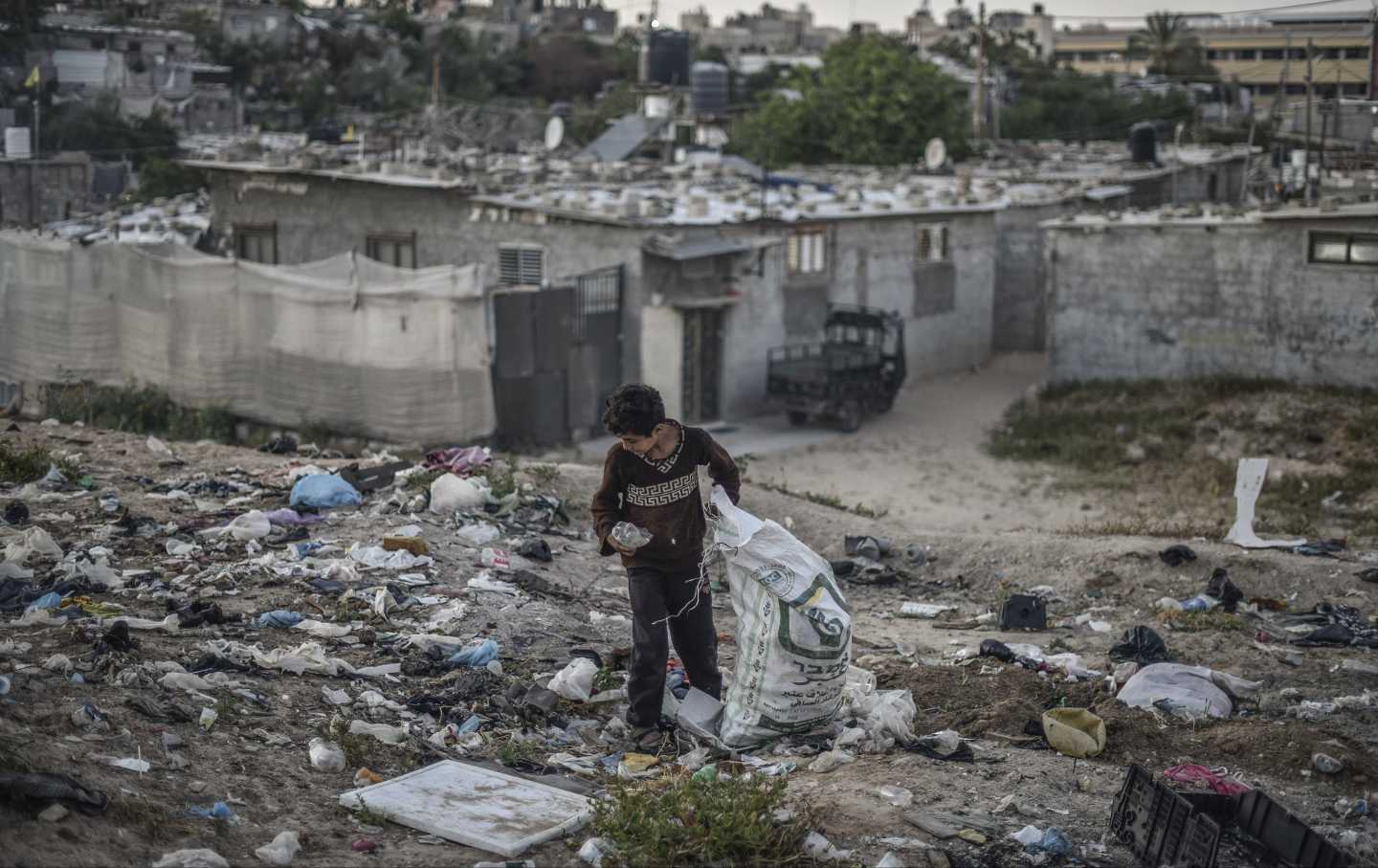
News networks cover bombings, shootings, and other forms of kinetic violence because they are loud, finite events that seize our attention. By contrast, the everyday structural violence of Israel’s occupation and apartheid is comparatively uneventful. Instead of loss, it inflicts absence. Instead of killing, it simply aborts. Its first casualties are dreams and destinies. Even its victims cannot offer a full accounting, because how can you miss that of which you were always deprived? Yet the two are inextricably linked. Decades of structural violence give rise to weeks and months of kinetic violence. To cover the latter while neglecting the former is, in a word, to decontextualize: to show audiences the symptoms while depriving them of the underlying causes.
All of the narratives spun by the Israeli government to justify its murderous bombardment of the Gaza Strip draw centrally on the facts of October 7. And while there have been some embellishments that have rightly drawn scrutiny, those core facts are not in dispute, and they are awful enough in their own right as to offer prima facie credibility to Israel’s war narratives.
The deficiency is not so much to be found in the information they present, but rather in the information that is left absent. Using Media Cloud, a database that has tracked news worldwide for around a decade, I found all the news articles published by American, Canadian, or British news outlets during 2023 that mentioned either “Gaza” or the “West Bank,” and generated this chart:
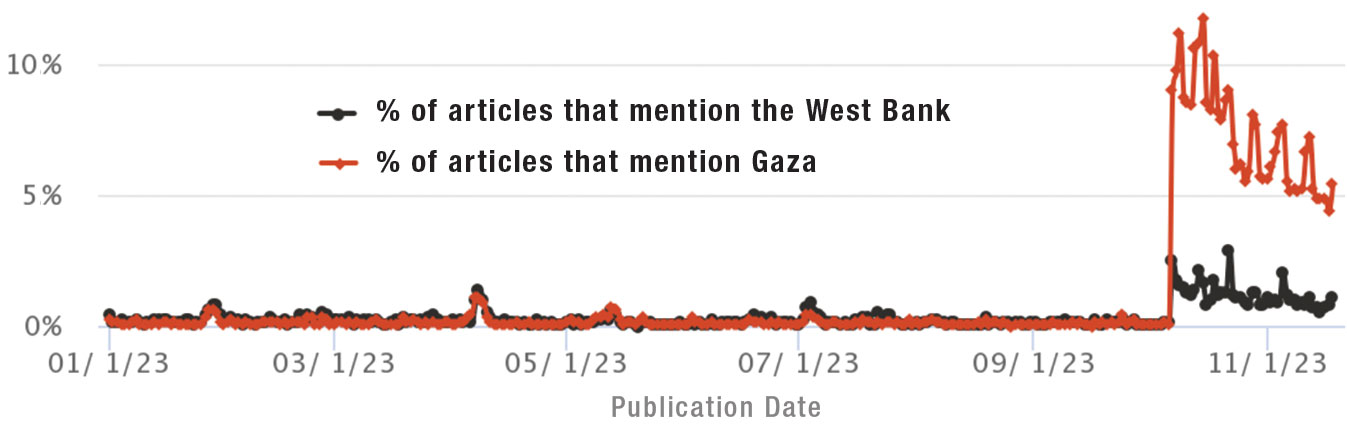
The coverage of both Gaza and the West Bank after October 7 dwarfs everything published in the comparatively stable nine months preceding it. The coverage of Gaza after October 7, meanwhile, consistently exceeds that of the West Bank, where kinetic violence was also happening but at orders of magnitude below its sister territory.
I say “kinetic violence” for the sake of distinguishing it from its complementary concept of structural violence. Whereas bombings or shootings are examples of kinetic violence, structural violence is exemplified by walls, barbed-wire fences, or systems of discriminatory laws. When a bomb goes off, it is a discrete event that can be reported or remarked upon. Structures of violence, by contrast, are continuous features that rend reality in two.
To get a glimpse of what it means for Palestinians to be the victims of structural violence, we can turn to the great Palestinian writer Ghassan Kanafani, who once wrote that “our lives are as a straight line that marches in shame and silence beside the line of our destiny; but the two lie parallel, and shall never meet.” In Kanafani’s telling, the life that Palestinians were meant to live haunts their every footstep. It runs parallel to their actual life, and in full view of their imagination, a daily reminder and humiliation next to which they trudge in silence and shame. As the Palestinian national poet Mahmoud Darwish alternatively phrased it, to live in the shadow of a wall, or on the wrong side of a fence, or on the receiving end of a discriminatory system, is to live “in the presence of absence,” to be haunted by the ghost of one’s potential self—the person you would have become were it not for this wall, this fence, this law, this structure.
This is the agony of the structural violence with which Palestinians were living throughout 2023, and for the long years and decades before that. Blockades and military occupations lead to declines in GDP or employment, which seem boring and statistical and simply lack the visceral horror of a suicide bomb or an airstrike. But behind those percentages are real people whose dreams have been crushed and who may succumb to depression, substance abuse, and death many years before their natural time. But all of that is deemed so indirect, obscured, and probabilistic that it just does not resonate with audiences as strongly.
The asymmetry with which kinetic violence is covered relative to structural violence has implications for how international audiences perceive Palestine-Israel and other civil conflicts. Eventually, after many years of daily indignities and frustration, a breaking point is reached and a rebellion forms. The rebels are much weaker than the state, however, and cannot wield structural violence. Instead, their primary tool is kinetic violence. And because kinetic violence is newsworthy, the first time many outside observers really pay attention to the conflict is when they see masked rebel gunmen killing and terrorizing people. Indeed, if you analyze the coverage of rocket fire and airstrikes over the Gaza Strip in the late 2000s and early 2010s, you will find over and over again that it is usually Palestinian militants who appear to have broken the “calm.” And yet, if you look closer, you will find that nearly every rocket attack was preceded by Israeli provocations—bulldozed orchards and structures, restrictions on freedom of movement, and so on—that blended into the day-to-day humdrum of structural violence.
The kinetic violence of October 7 cannot be understood without the structural violence of October 6 and all the days before. If you recklessly burn fossil fuels for decades, you risk hurricanes and wildfires. And if you indefinitely postpone the political process of relieving structural violence, you risk outbreaks of kinetic violence. For all of these reasons, decontextualization is an enormous challenge to our understanding. To undo it will require more than fact-checking. We will need compassion and patience, and to reflect upon our own biases and blind spots. We will need all of these instruments to see absence.
Support independent journalism that does not fall in line
Even before February 28, the reasons for Donald Trump’s imploding approval rating were abundantly clear: untrammeled corruption and personal enrichment to the tune of billions of dollars during an affordability crisis, a foreign policy guided only by his own derelict sense of morality, and the deployment of a murderous campaign of occupation, detention, and deportation on American streets.
Now an undeclared, unauthorized, unpopular, and unconstitutional war of aggression against Iran has spread like wildfire through the region and into Europe. A new “forever war”—with an ever-increasing likelihood of American troops on the ground—may very well be upon us.
As we’ve seen over and over, this administration uses lies, misdirection, and attempts to flood the zone to justify its abuses of power at home and abroad. Just as Trump, Marco Rubio, and Pete Hegseth offer erratic and contradictory rationales for the attacks on Iran, the administration is also spreading the lie that the upcoming midterm elections are under threat from noncitizens on voter rolls. When these lies go unchecked, they become the basis for further authoritarian encroachment and war.
In these dark times, independent journalism is uniquely able to uncover the falsehoods that threaten our republic—and civilians around the world—and shine a bright light on the truth.
The Nation’s experienced team of writers, editors, and fact-checkers understands the scale of what we’re up against and the urgency with which we have to act. That’s why we’re publishing critical reporting and analysis of the war on Iran, ICE violence at home, new forms of voter suppression emerging in the courts, and much more.
But this journalism is possible only with your support.
This March, The Nation needs to raise $50,000 to ensure that we have the resources for reporting and analysis that sets the record straight and empowers people of conscience to organize. Will you donate today?
More from The Nation
“I Refused to Let the Genocide Steal My Dreams” “I Refused to Let the Genocide Steal My Dreams”
For these medical students in Gaza, completing their studies was an act of defiance.
Donald Trump Is Losing the Iran War Donald Trump Is Losing the Iran War
Despite his constant declarations of victory, the truth about this conflict is clear.
Israel Is Also Committing Genocide In the West Bank Israel Is Also Committing Genocide In the West Bank
It’s not just Gaza—Israel wants to exterminate all Palestinians, everywhere. We are one people being destroyed as one people.
How the War Has Led to the Largest Disruption of Energy Supplies in Decades How the War Has Led to the Largest Disruption of Energy Supplies in Decades
Unless a resolution is found, the impact is likely to grow.
“Erasing the Lines”: How Settlers Are Seizing New Regions of the West Bank “Erasing the Lines”: How Settlers Are Seizing New Regions of the West Bank
After decades consolidating their control over Area C, Israeli settlers are expanding into Areas B and A—nominally under Palestinian Authority jurisdiction—and displacing communit...
Feature / Oren Ziv with Ariel Caine
In Gaza, Eid Is an Act of Resistance In Gaza, Eid Is an Act of Resistance
This year, Eid was a declaration: We are here. We pray. We dress in our best. We love, even when the world tries to convince us that we have nothing to love or to live for.

