Rodrigo Duterte Is at The Hague. What’s Next for the Philippines?
His arrest by the ICC was a monumental step in prosecuting his bloody drug war. But it’s also the latest episode in a battle between the Philippines’ two political dynasties.
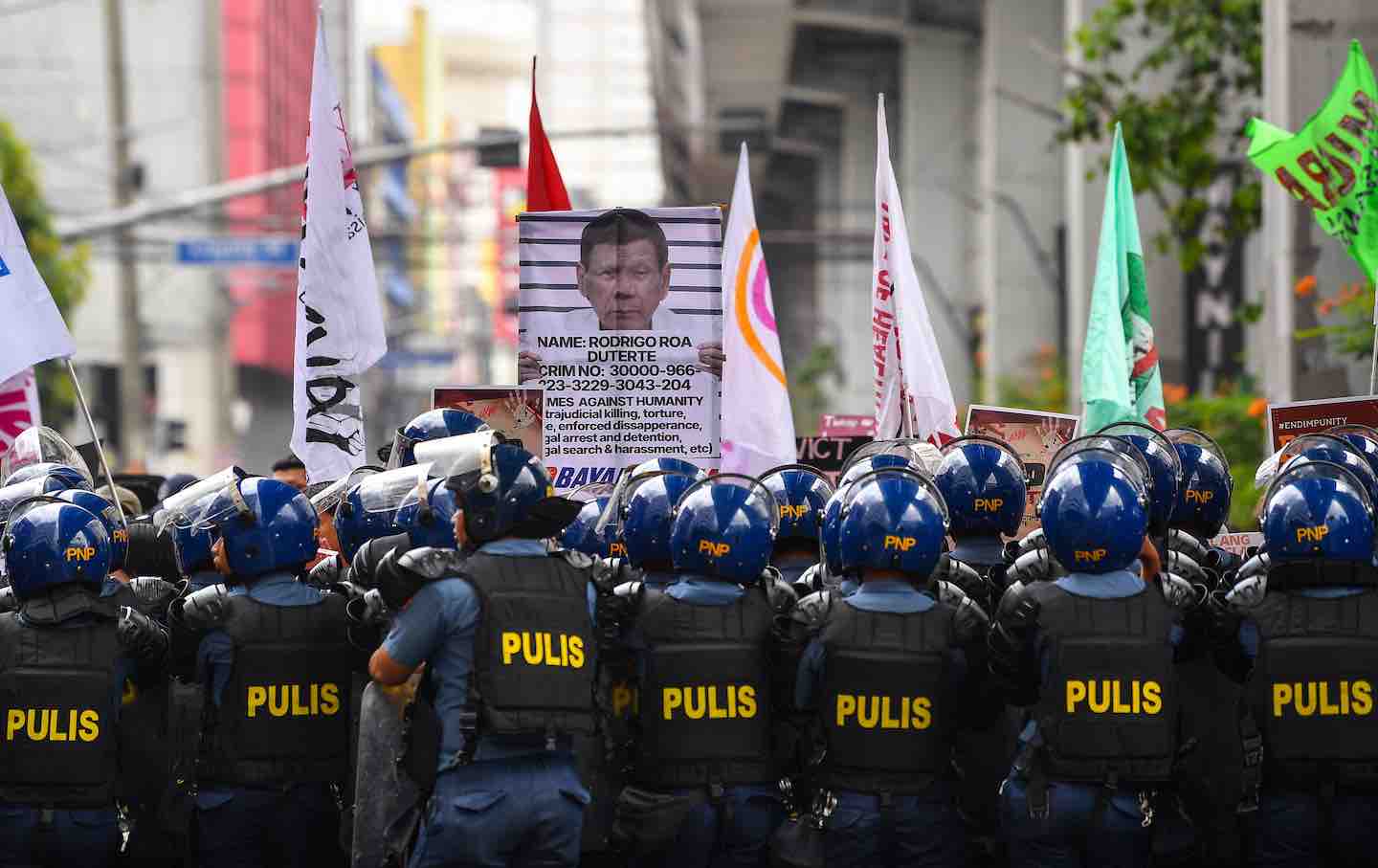
Protesters carrying a placard showing former president Rodrigo Duterte are blocked by anti-riot policemen near Malacanang palace in Manila, 2025.
(Photo by Ted Aljibe / AFP)
While he was president of the Philippines from 2016 to 2022, Rodrigo Duterte evoked tremendous controversy both at home and internationally owing to his bloody “war on drugs.” As many as 30,000 Filipinos, according to human rights groups, were victims of his presidency’s most publicized and cruelest policy—a war he waged on his own citizens. Last week, he was again the center of international attention, with his dramatic arrest on the tarmac of Manila’s Ninoy Aquino International Airport. It is a move that has divided the country: embraced as a long-overdue action or condemned as an illegal encroachment. It reflects the 16th president’s continuing ability to set Filipinos against one another.
Like so many of my compatriots, I took to social media, where I declared that I was among those who fully support Duterte’s extradition to face trial at the International Criminal Court in the Hague,
so that he can be tried for the extra-judicial execution of some [tens of thousands of] Filipinos, most of them committed before the Philippines withdrew from the ICC in 2019 and for which crimes, therefore, Duterte is legally liable. The procedures for his arrest were observed, with meticulous respect for the due process that he never granted his thousands of victims.… Duterte’s being brought to justice was an obligation incurred by the Philippine state that transcended the temporary holders of its permanent powers and duties.… [The] the sooner he is extradited to the Hague so he can be accorded the just process he deserves, the better.
At a press conference after Duterte’s arrest, President Ferdinand Marcos Jr. asserted that the government had no choice but to honor a warrant of arrest delivered by Interpol, which is authorized to serve warrants issued by the ICC, owing to its “responsibilities” as a member of the “community of nations.” To most Filipinos, pro- or anti-Duterte, Marcos Jr. was being disingenuous—he handed Duterte over to the ICC not only to fulfill his government’s international obligations but also, if not mainly, to eliminate a powerful rival. Had it not been for an ongoing struggle for power between the Dutertes and the Marcoses, the ICC’s most momentous action yet since it was established in 2002 would not have been possible.
Duterte apparently underestimated the Marcos family’s willingness to get rid of him; he also let his contempt for the ICC get the better of him. His confidence that the court is a toothless body was reflected in a statement he made in 2023: “I would like to reiterate my statement, you sons of bitches in the ICC, I don’t care. You know why? Early on in my presidency, if you were listening, I said I would stake my name, my honor, and the presidency.”
In an expletive-filled testimony at a hearing in the Philippine Senate in October last year, Duterte was confident enough that he was untouchable that he confessed proudly to running a death squad in Davao City, while he was mayor there, before he became president: “I can make the confession now if you want,” he said. “I had a death squad of seven, but they were not policemen, they were also gangsters.” “I’ll ask a gangster to kill somebody,” he added. “If you will not kill [that person], I will kill you now.”
More on the Philippines
In retrospect, Duterte’s failure to appreciate the danger posed by his brazen disregard for international law and his mistaken sense of invulnerability were of a piece with a string of mistakes that began in 2021, when Sara Duterte-Carpio, the former president’s daughter, agreed to run on the same ticket as Marcos Jr. for the vice presidency of the country. The political wedding had not been the elder Duterte’s idea; he had little respect for Marcos Jr. and had denounced him as a cocaine user prior to the elections. Duterte was convinced that if Sara were to run for president, she would win, and in late 2021, preelection polls showed her winning 20 percent of the vote, with Marcos Jr. trailing at 15 percent. But his daughter took the advice of her friend Senator Imee Marcos, Marcos Jr.’s sister, who had promoted the projected union with the Marcos dynasty as a “marriage made in heaven” and eventually convinced Sara to take the subordinate role in the partnership.
The former president’s primary concern was that, once in office, his daughter would be outmaneuvered by the Marcos family. And indeed his fears seemed to be confirmed by a series of developments after the elections. First, Marcos Jr. decided to sideline the vice president, giving her a portfolio that handled the country’s education policy (naming her secretary of education) instead of a more substantial role she desired in directing military policy as secretary of defense. Then the House of Representatives—which has been run as a fiefdom by a cousin of Marcos Jr., Speaker Martin Romualdez—denied Sara a “confidential intelligence fund” for 2024 after her office could not account for how it spent an earlier slush fund of 125 million pesos ($2.2 million) in just 11 days.
The final provocation, as far as Duterte was concerned, was when Marcos Jr. and Romualdez endorsed amending the Constitution, which Duterte interpreted as a way to make Romualdez prime minister and derail Sara’s plan to succeed Marcos Jr. via the presidential election in 2028. The constitutional changes would make the Philippines a parliamentary system, abolishing the presidency or turning it into a ceremonial position, and making the head of the ruling party in the lower house of parliament the head of state. Such a move would favor Romualdez, who is not popular enough to win a presidential election but has the loyalty of the majority of members of the House.
The former president could no longer hold back. In late January of last year, at a rally in Davao City, he called Marcos Jr. a “drug addict,” and denounced his plan to change the Constitution, warning that, like his father, Ferdinand Sr., he could be ousted. Rodrigo Duterte’s younger son, Sebastian, the mayor of Davao, duly called on Marcos Jr. to resign.
A few months later, Sara gave up her position as secretary of education to protest what she saw as a concerted effort to oust her and discredit her family. Sara then escalated the war of words, making public statements about her daydreams of decapitating Marcos Jr. and announcing to the world that she had already hired a killer to take out the president, his wife, and Romualdez if she were harmed. She added for emphasis, “No joke, no joke.” That threat was what Romualdez was waiting for to get his allies in the House of Representatives to successfully impeach Sara last month. Perhaps the most prominent of the articles of impeachment was this threat of assassination, which Sara later claimed was not at all serious and made at the heat of the moment.
Political analysts are divided over the domestic impact of Duterte’s arrest and upcoming trial, where preliminary proceedings took place at the ICC last week. Some are of the opinion that his supporters will eventually become demoralized as the trial drags on and the initial outbursts of anger are likely to subside. For others, Duterte will be turned into a martyr who will return triumphant from his Elba. To them, the sight of Filipinos protesting at the prison complex at Scheveningen in the Hague, where Duterte is being detained and will be held while on trial, and the outpouring of support for the former president on the Internet, are indications of the anger that is just beginning to build up. A prominent Japanese scholar of Philippine politics, Wataru Kusaka, of the Tokyo University of Foreign Studies, has warned precisely of such a development: “Duterte is ready to be a martyr, a real hero dying for Filipinos, which is likely to boost votes for the Duterte allies [in the May 2025 elections]. Those who are laughing at and beating him must be careful with the scenario. He and his allies intentionally exploit the popular martyrdom narrative.… Accumulated humiliations against underdogs have always sparked backlash. This may not be the end of the story.”
If punishment for massive violations of basic human rights and due process is what unites Duterte’s critics, it is the ardent belief that Duterte saved the country from criminals and the drug cartels that brings together his supporters. Also important is the cleavage between the northern Philippines or “imperial Manila,” the regions the Marcoses and their key allies hail from, and the poorer provinces of the south, where people feel that themselves and their grievances are represented by the Dutertes.
Duterte’s allies have been calling for another “People Power,” the show of force that toppled Marcos Sr. in February 1986. It is likely, though, that the most significant short-term consequence will be Sara’s conviction in the Senate, with her family’s disheartened allies likely to fold before the Marcos juggernaut. Should she be convicted, Sara will be banned from holding public office, meaning she won’t be able to run for the presidency in the coming presidential elections in 2028. (Marcos Jr. has proposed holding a referendum on changing the Constitution around the same time as the midterms.)
Popular
“swipe left below to view more authors”Swipe →International reaction from quarters expected to be pro-Duterte has so far been surprisingly muted. Donald Trump, as of this writing, has not made any public statements about the arrest even though his ire for the ICC is well-known: In February, he issued an executive order prohibiting the ICC from investigating and prosecuting US officials and American allies, notably Israeli Prime Minister Benjamin Netanyahu and former defense minister Yoav Gallant. China, meanwhile, has taken the former president’s side, warning the ICC to “avoid” politicizing the issue and refrain from exercising “double standards,” but this carries little weight with the court since, like Washington, it still not a signatory to the Rome Treaty that established the ICC in 2002.
The response from liberal and progressive quarters, on the other hand, has been jubilant, though some have claimed that while the arrest of Duterte is to be welcomed, “he’s low-hanging fruit,” as one American friend put it to me. For the ICC to validate itself as an international court, this friend said to me, it should more seriously pursue the likes of “Netanyahu and his co-genocidal generals, Biden, Blinken, Harris.” The ICC’s record in its nearly quarter century of existence may justify the skepticism: It has convicted only six men of crimes against humanity, all of them from the Global South and none of the stature of Duterte.
Duterte, I don’t think, is low-hanging fruit. If the former Philippine president is tried and found guilty of crimes against humanity, this will be a win not only for his thousands of victims and their families but also for global justice and international law, the sort of victory that can only strengthen the ICC and give it the determination and stamina to go after the so-called bigger fish.
Nearly a week after Duterte’s arrest, tensions continue to rattle the Philippines. But with Duterte in prison and Sara in the Hague to provide moral support, there is no figure on the ground around which the so-called DDS (Die-hard Duterte Supporters) can rally around for big mass actions in Metro-Manila. Not surprisingly, energies are being channeled back to campaigning for the midterm elections in May. Everyone knows that the result of the polls will be a gauge of the relative strength of the two dynasties that are at war.
Become a Sustaining Donor This September
Between the reemergence of right-wing red-baiting and Donald Trump’s use of the chilling National Security Presidential Memorandum–7 to criminalize left political organizing, we’re seeing McCarthyism reborn before our eyes.
This assault on democracy cannot be ignored or wished away. Resisting it requires bravery in the face of threats and repression, a steadfast commitment to the truth, and the unwavering belief that we can—and will—overcome this darkness.
We must have an independent media that sets the record straight, unearths corruption and abuses of power, and advances a politics of justice and dignity for all if we’re to win this fight.
That’s why I’m writing to you today. This September, The Nation needs to add 100 monthly donors to sustain our progressive journalism. Your contribution makes the next investigative report, the next truth-speaking column, and the next pathbreaking essay all possible.
I hope you’ll support our work with a recurring donation today. If you donate $10 or more a month, we’ll send you a brand new “Hands Off the Free Press!” sticker to recognise your commitment to our cause. Please, donate today.
Onward,
Katrina vanden Heuvel
Editor and Publisher, The Nation