Our Back Pages / April 4, 2024

NATO and The Nation

Unhappy Birthday: NATO Is 75 Years Old Today

The Cold War alliance long ago outlived its usefulness. But then Nation contributors have been skeptical since the beginning.
Richard Kreitner

The 75th anniversary of the North Atlantic Treaty Organization (NATO) offers a chance to reflect on the pact’s Cold War origins, checkered history, and uncertain future. Created in 1949 to formalize American security guarantees in Western Europe, NATO immediately signaled its intention to expand beyond the North Atlantic region designated in its name. Almost as quickly, The Nation expressed skepticism about this plan. In 1951, we objected to the idea of adding Turkey and Greece to the alliance. Bringing those countries in would “effectually end the concept of a democratic union in defense of the ‘free world,’” the magazine argued. “What we are constructing instead, with breathtaking speed, is an old-fashioned military alliance equipped with ‘fantastic’ new-fashioned weapons.”

A year later, one of The Nation’s regular correspondents on foreign affairs, the Spanish writer and socialist politician Julio Àlvarez del Vayo, voiced more concerns. Support for the internationalist vision behind the United Nations was being supplanted by NATO’s more militaristic approach, Àlvarez del Vayo wrote. “The attempt should be exposed for the sake of the millions of people here and abroad who still take seriously the democratic slogans enunciated during the war.”

NATO was founded to address a specific historical moment, but its strategic purpose since that moment passed has never been entirely clear. On the group’s 10th anniversary, in 1959, the English historian Geoffrey Barraclough wrote in these pages that NATO’s future was in doubt. “Even its warmest upholders are conscious of its shortcomings,” Barraclough observed. “World conditions have changed in fundamental ways since NATO was formed in 1949”—notably, with Joseph Stalin’s death—“but the organization has not changed with them.”

In 1995, when Washington’s foreign-policy “Blob” seized on the end of the Cold War as an opportunity to expand rather than wind down the pact, Nation writers warned—loudly and often—that such a step would only make everyone less secure. “A revival of East-West conflict along the lines of the Cold War is hardly inevitable,” Matthew Evangelista wrote. “But few geopolitical decisions would encourage it more than expansion of NATO into Eastern Europe. If the Clinton administration insists on enlarging NATO, it runs a serious risk of rupturing relations with Moscow, a break that could be disastrous at a time when democratic reformers in Russia already face the distinct possibility of being overwhelmed by the forces of the past.”

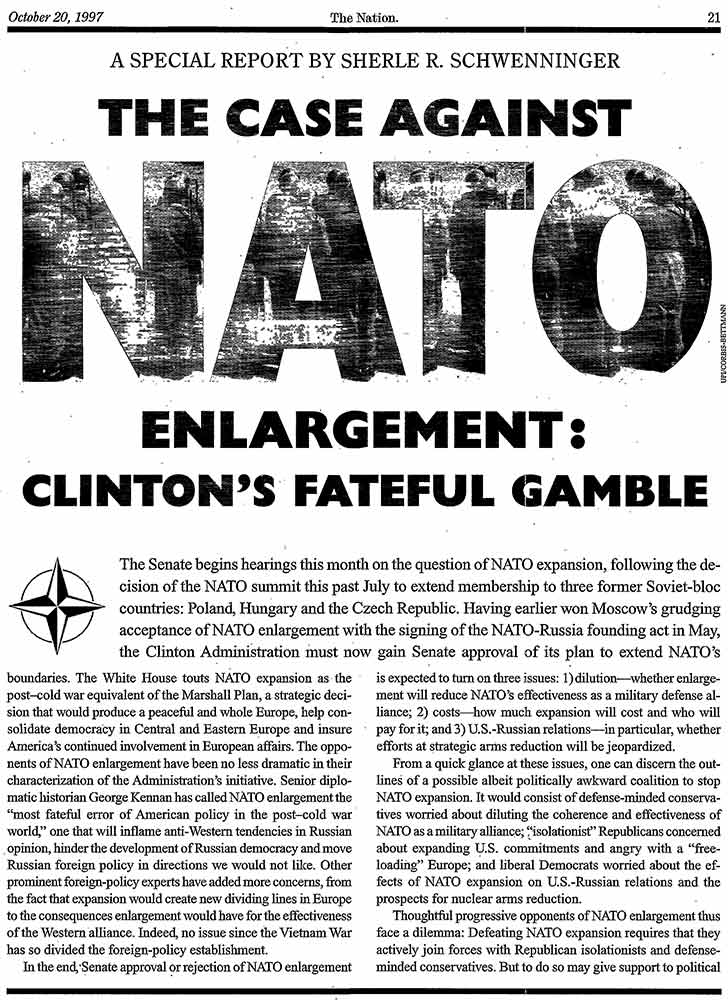
Two years later, Sherle Schwenninger laid out “The Case Against NATO Enlargement.” Expanding NATO, he warned, would set back nuclear disarmament efforts and hinder reconciliation. Given that Russia was not consulted in the decision to swell NATO right up to its borders, Schwenninger noted in one haunting passage, “Russian nationalists could reasonably ask…why should Moscow allow the United States to have a say in areas bordering Russia and in its sphere of influence?”
Time is running out to have your gift matched 

In this time of unrelenting, often unprecedented cruelty and lawlessness, I’m grateful for Nation readers like you. 

So many of you have taken to the streets, organized in your neighborhood and with your union, and showed up at the ballot box to vote for progressive candidates. You’re proving that it is possible—to paraphrase the legendary Patti Smith—to redeem the work of the fools running our government.

And as we head into 2026, I promise that The Nation will fight like never before for justice, humanity, and dignity in these United States. 

At a time when most news organizations are either cutting budgets or cozying up to Trump by bringing in right-wing propagandists, The Nation’s writers, editors, copy editors, fact-checkers, and illustrators confront head-on the administration’s deadly abuses of power, blatant corruption, and deconstruction of both government and civil society. 

We couldn’t do this crucial work without you.

Through the end of the year, a generous donor is matching all donations to The Nation’s independent journalism up to $75,000. But the end of the year is now only days away. 

Time is running out to have your gift doubled. Don’t wait—donate now to ensure that our newsroom has the full $150,000 to start the new year. 

Another world really is possible. Together, we can and will win it!

Love and Solidarity,

John Nichols 

Executive Editor, The Nation

Richard Kreitner

Richard Kreitner is a contributing writer and the author of Break It Up: Secession, Division, and the Secret History of America's Imperfect Union. His writings are at richardkreitner.com.

More from The Nation

A close-up of Donald Trump against a dark background looking skeptical.

Brace Yourselves for Trump’s New Monroe Doctrine Brace Yourselves for Trump’s New Monroe Doctrine

Trump's latest exploits in Latin America are just the latest expression of a bloody ideological project to entrench US power and protect the profits of Western multinationals.

Eric Ross

Jose Antonio Kast delivers a speech in front of his supporters after being elected.

Chile at the Crossroads Chile at the Crossroads

A dramatic shift to the extreme right threatens the future—and past—for human rights and accountability.

Peter Kornbluh

Trump speaks at a NATO Summit

The New Europeans, Trump-Style The New Europeans, Trump-Style

Donald Trump is sowing division in the European Union, even as he calls on it to spend more on defense.

David Broder

Two US Marine Corps MV-22 Ospreys depart at Mercedita International Airport on December 16, 2025, in Ponce, Puerto Rico. The Trump administration is conducting a military campaign in the Caribbean and eastern Pacific, deploying naval and air forces for what it calls an anti-drugs offensive.

The United States’ Hidden History of Regime Change—Revisited The United States’ Hidden History of Regime Change—Revisited

The truculent trio—Trump, Hegseth, and Rubio—do Venezuela.

Barbara Koeppel

Idi Amin in Kampala, 1975.

Mahmood Mamdani’s Uganda Mahmood Mamdani’s Uganda

In his new book Slow Poison, the accomplished anthropologist revisits the Idi Amin and Yoweri Museveni years.

Books & the Arts / Howard W. French

Trump and Putin walk side-by-side silhouetted

The US Is Looking More Like Putin’s Russia Every Day The US Is Looking More Like Putin’s Russia Every Day

We may already be on a superhighway to the sort of class- and race-stratified autocracy that it took Russia so many years to become after the Soviet Union collapsed.

Andrea Mazzarino