
Reeling From the UK Election and the Collapse of Labour
Labour leadership’s free fall is also tied to its lack of respect for the base it relies on to function.
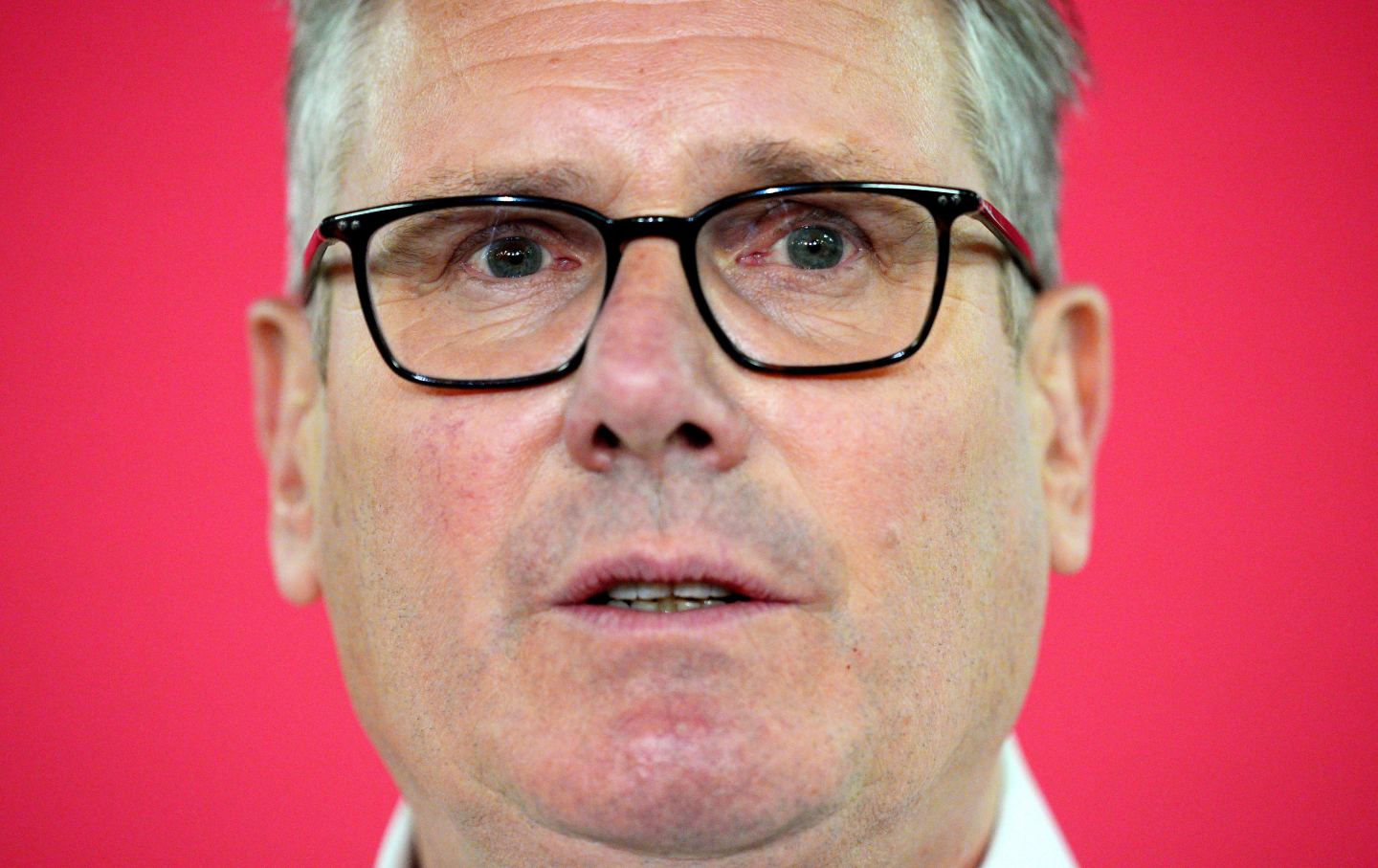
“Aspeech that should have begun with ‘sorry’” was how veteran Labour politician Emma Lewell summarized Prime Minister Keir Starmer’s speech today. The intervention was briefed by the prime minister’s spin doctors as the moment to draw a line under Thursday’s excruciating election results and to “show Labour values.”
But for Lewell, whose northeast seat of South Shields saw Labour lose in every single council seat they stood for, it was “written in the same internal echo chamber that got us into this mess.” Lewell, who has joined more than 50 Labour MPs calling for Starmer’s resignation, is not the only one reeling from the scale of Labour’s collapse. Across its heartlands, the tremors were felt. In Wigan, a northern English former mining town represented by senior Labour minister Lisa Nandy, 24 of 25 seats went to Reform UK.
It was the party of Nigel Farage, the stockbroker and fawning Trump supporter, that stole the headlines, sweeping up practically all contested seats in solidly Labour northern English areas such as Tameside, Redditch, and Halton.
They became the largest party in Kirklees, an historic socialist stronghold, and in Hartlepool—the former seat of Peter Mandelson, the repeatedly disgraced Labour grandee whose closeness with Jeffrey Epstein was ignored by Starmer loyalists to gift him the ambassador’s role in Washington, DC, and whose name was often mentioned alongside threats of physical violence from voters against door-knocking Labour campaigners.
In Scotland and Wales, where votes for national assemblies were being held, the collapse was generalized. A lackluster campaign from Welsh Labour couldn’t escape the anger over Vaughan Gething, the former Starmerite first minister, who resigned after it was revealed that he lobbied environmental regulators to ease restrictions on the company of a businessman convicted of dumping waste into Welsh waters—but from whom Gething accepted £200,000.
Such sleaze saw Wales, a country whose working class provided a bedrock of Britain’s labor movement for centuries, finally abandoning Labour. Gething’s successor, Eluned Morgan, made an historic first in losing her seat while in office. In Merthyr, where the red flag was first flown in 1831, Labour was left with a single seat, with three for social-democratic nationalists Plaid Cymru and two for Reform. The same was true in Scotland; in areas recently so safe for Labour that its major rivals were communist upstarts, leader Anas Sarwar oversaw the party’s worst result since the start of devolution in 1999, as the Scottish National Party enjoyed a landslide.
For the Greens, who have often beaten Labour in opinion polls and skyrocketed in membership under the self-styled “ecopopulist” Zack Polanski, the results were modest compared to Reform’s, but just as psychologically damaging to Labour. In Manchester, effectively a one-party Labour state for decades, the Greens took 18 of 32 seats. In London, the Greens won five councils, including Lambeth, the south London borough long considered to be a breeding ground for Blairite cadre, and where Starmer’s top aide Morgan McSweeney cut his political teeth.
Starmer’s political indecision can be significantly blamed for Labour’s free fall. After gaining a historic parliamentary majority of 165 less than two years ago, Starmer is one of the most unpopular prime ministers in history. Immensely popular policies such as wealth taxes and rent controls have been considered and shelved, while the government has consistently watered down long-anticipated legislation such as the Employment Rights Act so as to radically weaken its transformative edge.
In a country plainly in decline, people are desperate for a government willing to tackle declining living standards, soaring energy bills, the housing crisis, a collapsing health system, and the longest period of wage stagnation since the Napoleonic era. But Starmer’s managerialism is instinctively hostile to the sort of decisive break needed to even address these problems, choosing instead to offer tepid halfway solutions and Union Jack–waving.
Behind the collapse is a deeper story about the complete lack of respect the Labour leadership has for the base it relies on to function. In 1999, addressing a colleague about his “preoccupation” with maintaining support in industrial areas decimated by Thatcherism, Peter Mandelson said that “working-class voters…have nowhere else to go.”
Since the election of Mandelson’s New Labour project in 1997, those discarded voters have taken their revenge in voting against Labour consistently in national elections, with last week’s results showing that the trend is only deepening.
In February 2023, in a message directed at progressive voters, Starmer said that “if you don’t like the changes” he’s made to Labour, “the door is open, and you can leave.” In October that year, responding to a question about Israel’s withholding of water from Gaza, he responded that “I think that Israel does have that right”—a comment he never apologized for, but which cost him hundreds of thousands of votes in Muslim communities.
From working-class communities in northern England, Scotland, and Wales who developed and built Labour, to the graduates, liberally minded professionals, and ethnic-minority communities in large cities who have loyally backed Labour for decades, millions of people have left. The party’s coalition is flaking away in every direction, and nothing in Starmer’s speech—which was largely a self-justification of his failed governance—can address the fact that millions of people have found political homes elsewhere because of him.
Popular
“swipe left below to view more authors”Swipe →The problem with Blairism, to paraphrase Margaret Thatcher, is that you eventually run out of people to betray. And as right-wing Labour politicians whom Starmer’s factional machine helped “parachute” into safe seats begin turning on him, Starmer must know that his time is up. The only real debate on his future is whether he continues for weeks or months.
Inside Starmer’s camp, his allies are still frustrating attempts to return to Parliament Andy Burnham, the popular regional mayor who would represent a leftward turn should he win a Labour leadership contest and become prime minister. But his route to 10 Downing Street is far from guaranteed. Earlier this year, the party’s governing national executive committee blocked Burnham’s attempt to become Labour’s candidate for the Gorton and Denton by-election, with an unknown corporate lobbyist becoming the candidate. The Greens stood local plumber Hannah Spencer and won the ultra-red Manchester seat by a landslide.
These factional plotters seem to have learnt little from this, and have broadly decided they hate Andy Burnham more than they love the Labour Party, whose collapse can only be stabilized—never mind reversed—by a Burnham leadership. Should they succeed in keeping him out, it could well be terminal for a party that, for millions, seems to serve little purpose beyond creating jobs for second-rate politicians and first-rate fixers. As the former party chair and Wansbeck MP Ian Lavery said last week, “Keir Hardie founded the Labour Party, and another Keir may end it forever.”
Become a Sustaining Donor This September
Between the reemergence of right-wing red-baiting and Donald Trump’s use of the chilling National Security Presidential Memorandum–7 to criminalize left political organizing, we’re seeing McCarthyism reborn before our eyes.
This assault on democracy cannot be ignored or wished away. Resisting it requires bravery in the face of threats and repression, a steadfast commitment to the truth, and the unwavering belief that we can—and will—overcome this darkness.
We must have an independent media that sets the record straight, unearths corruption and abuses of power, and advances a politics of justice and dignity for all if we’re to win this fight.
That’s why I’m writing to you today. This September, The Nation needs to add 100 monthly donors to sustain our progressive journalism. Your contribution makes the next investigative report, the next truth-speaking column, and the next pathbreaking essay all possible.
I hope you’ll support our work with a recurring donation today. If you donate $10 or more a month, we’ll send you a brand new “Hands Off the Free Press!” sticker to recognise your commitment to our cause. Please, donate today.
Onward,
Katrina vanden Heuvel
Editor and Publisher, The Nation
More from The Nation
This AI Panic Is Nothing New This AI Panic Is Nothing New
In the 1940s, The Nation asked questions about the atomic bomb we’re asking of artificial intelligence today.

The Decades-Old Roots of Trump’s War on Iran The Decades-Old Roots of Trump’s War on Iran
An interview with historian Behrooz Ghamari-Tabrizi about the generations of US presidents who have tried to destroy the Iranian regime.
Emmanuel Macron’s Turbulent Exit Emmanuel Macron’s Turbulent Exit
Between a budget crisis and a cost-of-living squeeze, Macron is leaving a country feeling more insecure than ever—and ready to take to the streets.

Israel’s Election Can’t Fix What Netanyahu Broke Israel’s Election Can’t Fix What Netanyahu Broke
The fundamental problem is not the name of the prime minister, but rather the actions of the Israeli government and the urgent issues that need to be addressed.
The AfD’s Rise Isn’t Just About East Germany The AfD’s Rise Isn’t Just About East Germany
The Alternative für Deutschland has a stable national poll lead, including in the former West Germany. Its rise owes to much more than Eastern grievances.

Chinese Development Is the Betrayal Washington Cannot Forgive Chinese Development Is the Betrayal Washington Cannot Forgive
The prospects for Xi Jinping’s visit are dim because American leaders are blaming China for the failures of globalization.

