International Law Strikes Back
The World Court’s ruling that Israel’s occupation of Palestinian territory is illegal rewards growing judicial activism by states of the Global South.
My Columbia Law School professor, the legendary Louis Henkin, famously wrote decades ago that “almost all nations observe almost all principles of international law and almost all of their obligations almost all the time.” As the US invasion of Iraq, the Russian invasion of Ukraine and Israel’s indiscriminate and disproportionate onslaught on Gaza demonstrate, however, it is also often the most powerful nations that violate the most important principles of international law.
The past two years have seen the institutions of international law attempt to rise to the challenge. Following the full-scale Russian invasion of Ukraine, the International Court of Justice (ICJ), the United Nations’ top judicial organ, ordered Russia (by 13-2 with the Russian and Chinese judges dissenting) to “immediately suspend [its] military operations.” (Russia, of course, has not complied with that ruling.) In March 2023, the International Criminal Court (ICC), located across The Hague from the ICJ, issued an arrest warrant for Russian president Vladimir Putin, the first ever against the sitting leader of a permanent member of the UN Security Council (though Putin, of course, remains at large and defiant). At the time, it seemed that these bold and welcome judicial actions nevertheless perpetuated a double-standard which let western states and their allies off the hook.
In December 2023, however, following Israel’s assault on Gaza, South Africa charged Israel with genocide before the ICJ which, in a series of increasingly strong and specific rulings, ordered Israel to curtail its military actions in Gaza (though Israel has not done so in any discernable way). In May of this year, ICC prosecutor Karim A.A. Khan announced that he was seeking arrest warrants for Israeli and Hamas leaders for war crimes and crimes against humanity (though the ICC’s judges have yet to rule on the request).
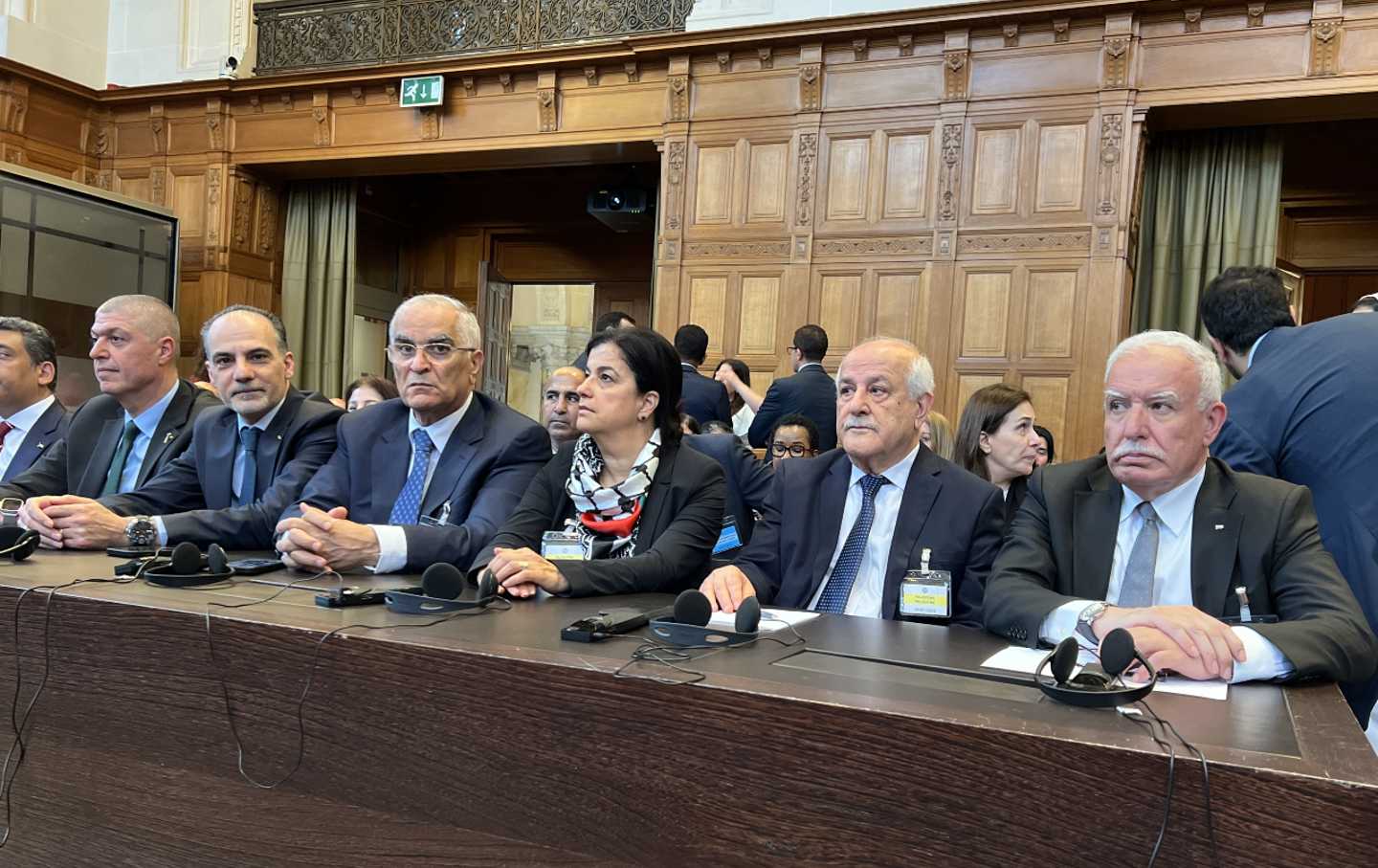
Now, in one of its most important and far-reaching rulings ever, the ICJ has found in an advisory opinion that that Israel’s continued occupation of the Gaza strip and the West Bank, including East Jerusalem, violates international law, held that Israeli settlements amounted to war crimes, and ordered Israel to end its occupation “as rapidly as possible,” to dismantle the settlements, to make reparations to Palestinian victims for its breaches and to facilitate the return of displaced people. The July 19 opinion came in response to a (pre-Gaza) 2022 request from the UN general assembly on the initiative of Palestine, and whose 87-vote plurality came almost exclusively from the global south. A record 52 states participated in the ensuing public hearings The decision was joined by a large majority of the ICJ judges, including the US’s Sarah Cleveland.
The ICJ’s ruling that Israeli settlements are illegal (it is a war crime for an occupying power to transfer its population to occupied territory) also reads like an invitation to ICC chief prosecutor Khan finally to seek warrants against the Israeli officials overseeing the settlements. These charges, like those of apartheid, collective punishments and war crimes from Israel’s 2008 “Cast Lead” operation which killed more than 1,400 Gazans, had been gathering dust in the prosecutor’s office for 15 years in the face of US lobbying and a covert Israeli “war” on the ICC that included spying, hacking and intimidation.
The ICJ crucially ruled that other states and international bodies are under an obligation not to recognize the occupation as lawful nor to “render aid or assistance in maintaining the situation created by Israel’s illegal presence in the Occupied Palestinian Territory.”
In the short run, of course, Israel will certainly ignore this ruling just as it has all the others, including a 2004 advisory opinion that held the separation wall to be illegal because it incorporated Palestinian lands. But the ICJ’s decision will be recognized as an authoritative statement of the law that the UN itself and its many specialized agencies will be bound to follow. Additionally, in the weeks and months ahead, Israel’s western allies will be forced to reconsider the nature of their commercial, military, economic and diplomatic relations if they do not want to run afoul of the prohibition on aiding the occupation. Israeli human rights lawyer Michael Sfard has thus called the ruling an “earthquake in slow motion.” Around the world, he said, lawyers “will now begin to advise and guide the governments, international agencies and other entities they serve based on international law, translating the ICJ’s determinations about the Israeli occupation into prohibitions of certain actions and obligations to carry out others in relation to Israel.”
British barrister Philippe Sands, who acted for Palestine in the ICJ case, has said that the decision “precludes sales of military material which could be used directly or indirectly to assist Israel in maintaining its unlawful occupation of the occupied Palestinian territories.” In an April ruling in a case brought by Nicaragua against Germany, the ICJ had already reminded “all States of their international obligations relating to the transfer of arms to parties to an armed conflict,” to avoid such arms’ being used to violate the Geneva and genocide Conventions. Judges in the Netherlands have blocked arms exports to Israel on the basis of evidence of war crimes, and the ICJ ruling will certainly provide fodder for similar rulings elsewhere.
The US government, of course, is by far Israel’s largest supplier of arms and military assistance, and Amnesty International and The New York Times, among others, have identified US weapons used in unlawful Israeli attacks, though most legal avenues to hold the United States accountable have been cut off. Back in 1985, the US withdrew from the ICJ’s compulsory jurisdiction as the ICJ was getting set to rule that it had violated international law by supporting the Contra rebellion against the Sandinistas and by mining Nicaragua’s harbors. And US federal courts have invoked the “political question” doctrine to throw out a lawsuit brought by the Center for Constitutional Rights against President Biden and others for their complicity in the Israeli government’s crimes. But individual Americans could, in theory at least, be held criminally liable by international courts for aiding and abetting Israel’s war crimes. And US officials should be called on to use the ICJ’s findings in their legal determination of whether US arms will be used in international law violations. If the rules-based order is to mean anything, international law must apply to all equally, including Israel.
Support independent journalism that does not fall in line
Even before February 28, the reasons for Donald Trump’s imploding approval rating were abundantly clear: untrammeled corruption and personal enrichment to the tune of billions of dollars during an affordability crisis, a foreign policy guided only by his own derelict sense of morality, and the deployment of a murderous campaign of occupation, detention, and deportation on American streets.
Now an undeclared, unauthorized, unpopular, and unconstitutional war of aggression against Iran has spread like wildfire through the region and into Europe. A new “forever war”—with an ever-increasing likelihood of American troops on the ground—may very well be upon us.
As we’ve seen over and over, this administration uses lies, misdirection, and attempts to flood the zone to justify its abuses of power at home and abroad. Just as Trump, Marco Rubio, and Pete Hegseth offer erratic and contradictory rationales for the attacks on Iran, the administration is also spreading the lie that the upcoming midterm elections are under threat from noncitizens on voter rolls. When these lies go unchecked, they become the basis for further authoritarian encroachment and war.
In these dark times, independent journalism is uniquely able to uncover the falsehoods that threaten our republic—and civilians around the world—and shine a bright light on the truth.
The Nation’s experienced team of writers, editors, and fact-checkers understands the scale of what we’re up against and the urgency with which we have to act. That’s why we’re publishing critical reporting and analysis of the war on Iran, ICE violence at home, new forms of voter suppression emerging in the courts, and much more.
But this journalism is possible only with your support.
This March, The Nation needs to raise $50,000 to ensure that we have the resources for reporting and analysis that sets the record straight and empowers people of conscience to organize. Will you donate today?