The Israeli Injustice Complex
How the military courts serve as one of Israel’s most effective and secretive weapons.
In April 2024, I went to the West Bank so I could go into the courts and prisons holding Palestinians. I brought with me proof of my admission as a witness before the United States Supreme Court, a letter from an Israeli lawyer vouching for me, and a letter from a human rights group concerned with the application of laws to Palestinians. I previously went to Israel’s jails, and South Africa’s under apartheid, Czechoslovakia’s before the Velvet Revolution, and those of Indira Gandhi’s India during the Emergency. I was always able to get into courts and sometimes prisons. On this trip to Israel, I could get into neither.
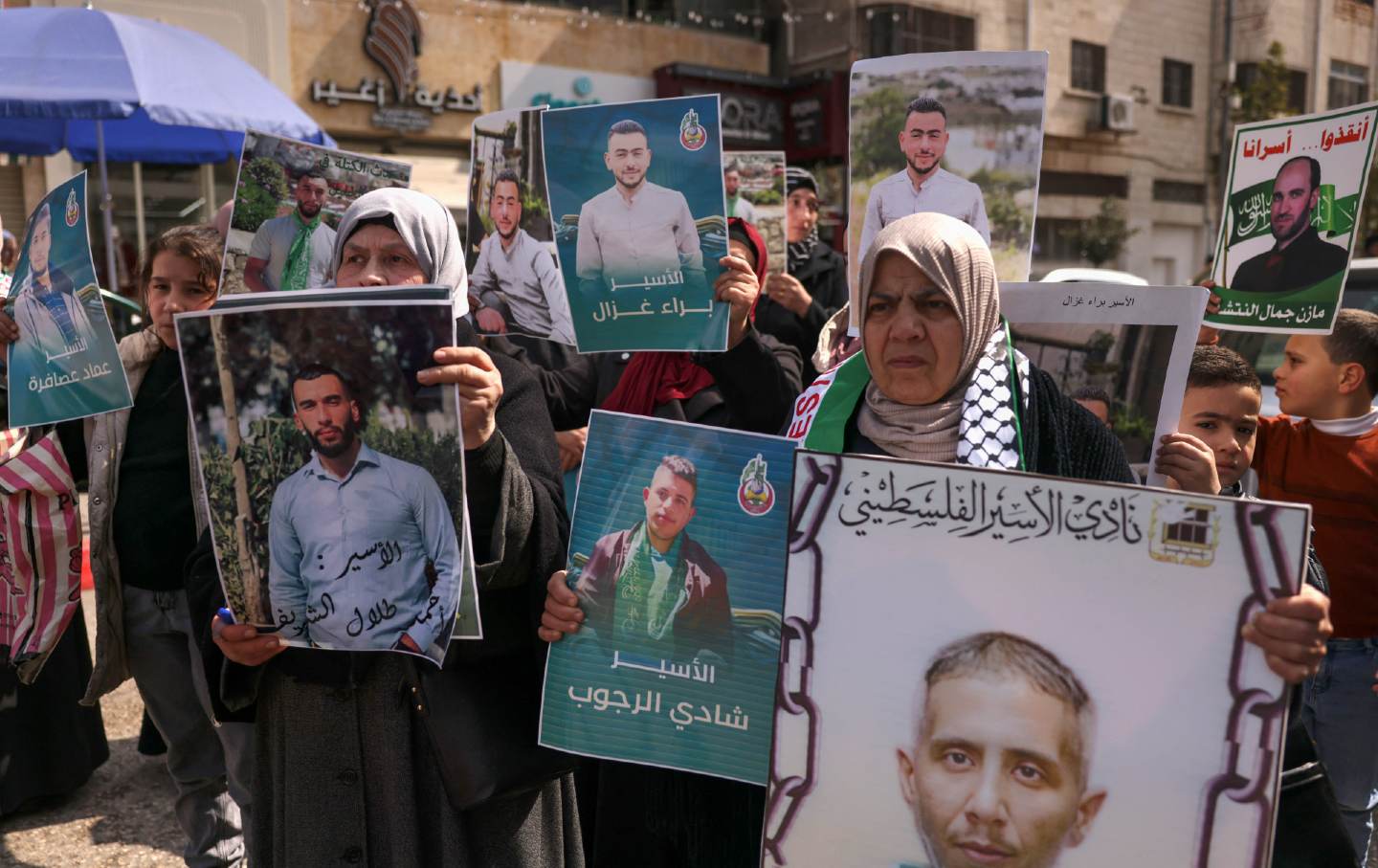
Israel’s military court system was created when Israel captured and occupied the West Bank and Gaza during the 1967 war with Jordan, Egypt and Syria. It is the longest use of occupation law, and it is the way that Israel controls “foreign civilians” residing in areas under its authority. The military courts totally overrule the occupied population’s right to self-determination—Palestinians did not establish the rules that govern the courts that decide their fate, and they have no mechanism by which to reform them. These courts disregard the fundamental legal and human rights of the Palestinians who end up in them. In this, the longest legal occupation in modern history, and in a region with the highest incarceration rate per capita in the world, military courts serve as one of Israel’s most effective and most secretive weapons.
In a visit to Israel prior to October 7, 2023, I had gotten into a military court in Hebron. When I drove to the Hebron court, I passed through a gate and a guardhouse, in a building on a hilltop surrounded by some 20 soldiers, each armed with a machine gun. There is no attempt to create even the appearance of justice in these courtrooms. The judges’ and lawyers’ anger boiled over as they tried to rush through the cases. The sentences we heard were harsh. Young Palestinian men facing up to 10 years for throwing rocks at armored vehicles are routinely denied pretrial release, while Jewish settlers accused of seriously injuring Palestinians may not be even charged with crimes. When they are, they are routinely given bail.
Nearly all the judges are part of the military. Some have little understanding of the law. Military prosecutors arbitrarily decide which individuals to charge with crimes. The judges decide what the charges should be. The lawyers who defend Palestinian suspects rightly see the courts as an extension of the occupation rather than an institution with any interest in justice, and they’re frequently denied access to their clients, no matter how seemingly minor the offense. Consequently, many of the handful of lawyers attempting to defend the detained Palestinians are boycotting the military courts rather than filing useless motions.
Sometimes, because of the incompetence and indifference of the prison and court administration, these lawyers don’t even know where their clients are being kept. Lawyers complain that they cannot prepare their cases because they cannot find witnesses and because they do not have the funds to mount a defense. Even if they could find their clients, there are inadequate facilities in the jails to talk with them confidentially.
Occupation laws are not unusual, historically speaking. However, these laws have been in effect for decades, which is quite unusual. The laws imposed by a more democratic occupier would be designed to keep order, to set an example of what the law ought to be, and to smooth out the rough edges of occupation. Israel’s laws do the opposite. Their prime purpose is to support the jailers, leading inevitably to the violence and bone-breaking reprisals we have witnessed, to even more resentment from Palestinians, and to the chaos that inevitably results from the lawless exercise of power. The Geneva Convention requires that courts in occupied territories be nonpolitical. It sets forth the rights of defendants and the obligations of the government. Israel’s court system totally ignores these requirements.
It is not possible to have a long-term occupation where the courts are seen as just another tool of the military. They must be reformed, and presently that reform can come only from within the Israeli military and government. The important first step would be to get rid of the Occupation Law and apply to the Palestinians in Gaza and the West Bank the same criminal procedures and protections that Israel applies to its own Jewish and Arab citizens. Trials should be held before independent tribunals with civilian judges. Administrative detention should end. Torture and intimidation should stop. There should be no interrogations without counsel, and defendants should have the right to a lawyer immediately and be provided with adequate facilities to confer with them in privacy. The court should stop forcing defendants to plead guilty by meting out greatly increased punishments for those who wish to stand trial because they claim innocence. Israel’s government should release reports to the Red Cross concerning the prisoners held under the authority of military courts, and the Red Cross should be given immediate access to interrogation centers and the prisons.
Sadly, like much else in Israel, change will not come immediately or dramatically. Israel’s military court system creates only victims and opponents, undermining its ostensible purpose: maintaining the country’s security. But no purpose is served by this malevolent court and jail system, and if it continues to operate as it does presently, Israel will only lend credibility to Palestinians’ accusations of illegitimacy and its increasing disrepute throughout the world.
Support independent journalism that does not fall in line
Even before February 28, the reasons for Donald Trump’s imploding approval rating were abundantly clear: untrammeled corruption and personal enrichment to the tune of billions of dollars during an affordability crisis, a foreign policy guided only by his own derelict sense of morality, and the deployment of a murderous campaign of occupation, detention, and deportation on American streets.
Now an undeclared, unauthorized, unpopular, and unconstitutional war of aggression against Iran has spread like wildfire through the region and into Europe. A new “forever war”—with an ever-increasing likelihood of American troops on the ground—may very well be upon us.
As we’ve seen over and over, this administration uses lies, misdirection, and attempts to flood the zone to justify its abuses of power at home and abroad. Just as Trump, Marco Rubio, and Pete Hegseth offer erratic and contradictory rationales for the attacks on Iran, the administration is also spreading the lie that the upcoming midterm elections are under threat from noncitizens on voter rolls. When these lies go unchecked, they become the basis for further authoritarian encroachment and war.
In these dark times, independent journalism is uniquely able to uncover the falsehoods that threaten our republic—and civilians around the world—and shine a bright light on the truth.
The Nation’s experienced team of writers, editors, and fact-checkers understands the scale of what we’re up against and the urgency with which we have to act. That’s why we’re publishing critical reporting and analysis of the war on Iran, ICE violence at home, new forms of voter suppression emerging in the courts, and much more.
But this journalism is possible only with your support.
This March, The Nation needs to raise $50,000 to ensure that we have the resources for reporting and analysis that sets the record straight and empowers people of conscience to organize. Will you donate today?