
To Stop the Slaughter in Gaza, We Need the Broadest Coalition Possible
People with very different visions of what a just peace looks like must work together to stop this war.
Editor’s note: This text has been updated to reflect the news of the cease-fire announced after we went to press.
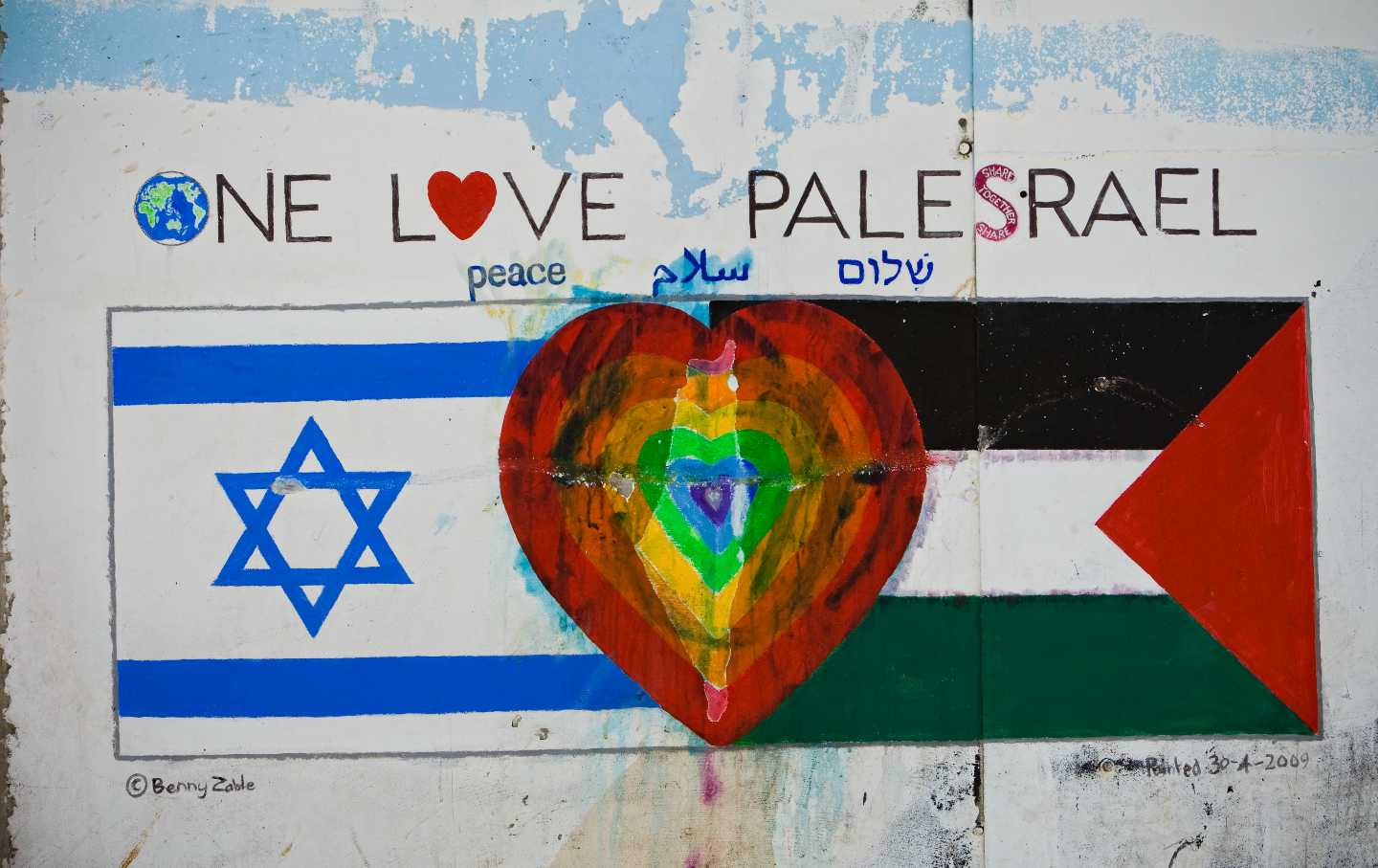
All war is hell for the civilians caught up in the fighting. But what makes the decades-long war between Israel and the Palestinians so soul-destroying is that while the only plausible peaceful solution to this bloody conflict has long been obvious, the route to getting there recedes with every new round of killing. (The cease-fire announced just after this issue went to press offers some grounds for hope. Clearly both Israel and Hamas are capable of negotiating with one another—through whatever intermediaries. But the four-day initial “pause” is a long way from a durable cease-fire, let alone genuine peace. The pressure and protests that got us to this point will need to be maintained, and the movement to end this war broadened as far as possible.)
The goal, surely, must be—as I wrote in these pages more than 20 years ago—“a day when the Palestinians themselves can also be heard, and when the lives of Palestinian children count as much as those of Israeli children, or Americans.” Despite the best efforts of AIPAC, the ADL, and the local, state, and national officials who do their bidding, the voices of Palestinians are no longer absent. But progress toward a just peace remains maddeningly remote.
You may well ask: Does a “just peace” mean one secular binational state? Two nation-states living side by side? Or some other vision of shared sovereignty? Those are all excellent questions for the future—and each has its partisans. But first, we need to stop the atrocities—murder on the ground as well as murder from the air—and secure the release of all civilian hostages. To do that, we need to assemble the broadest, most effective coalition possible. Which, for a start, requires us all to engage in the delicate, challenging task of learning to speak a shared language—or, at least, a language as many of us as possible can live with and stand behind.
As the more powerful party, and the occupying power, the greater share of the responsibility rests with Israel. But to label the situation “uncomplicated” is to betray an ignorance of history. Former president Barack Obama’s recent reminder that holding the space to act constructively “require[s] an admission of complexity and maintaining what on the surface may seem contradictory ideas” was a salutary corrective. So let us begin by allowing for that complexity—and the possibility that people with very different visions of what a just peace ultimately looks like can still work together to stop this war.
When Edward Said observed that “the conflict appears intractable because it is a contest over the same land by two peoples who always believed they had valid title to it and who hoped that the other side would in time give up or go away,” he was stating what seemed in 1999 to be an obvious truth. Yet Benjamin Netanyahu—then serving his first term as prime minister—clearly remains as attached as ever to the genocidal fantasy of “a land without people” (i.e., Palestinians) in which Jews exercise sovereignty “between the Sea and the Jordan,” as stated clearly in the 1977 Likud Party platform.
And as we have seen in recent weeks, the leadership of Hamas remains as committed as ever to its genocidal fantasy that the road to a free Palestine must be paved with the bodies of dead Jews. The inability on some parts of the left to utter clear condemnation for the slaughter of civilians on October 7—or even to offer condolences to the survivors without immediate recourse to a sanctimonious clause blaming the victims for their own murder (as if infants and children were legitimate targets)—is a stain on our movement.
Yet it should be equally obvious that adding to the Palestinian body count will not bring safety or security to a single Israeli. An immediate cease-fire remains the essential first step, ideally linked to a release of all of the Israeli civilian hostages—and the more than 1,000 Palestinian “administrative detainees” held without charge or trial, in some cases for years.
Then comes the hard part. Mythology to the contrary, this has always been an asymmetrical conflict—as Israel’s “new historians” began documenting in the 1980s. Fascism, which succeeded in murdering two-thirds of the Jews of Europe, posed an existential threat to the survival of the Jewish people; Palestinian resistance to colonization, occupation, and exile, however violent, is of a different order. But then so, too, is Israeli oppression—however brutal or unbearable for those on the receiving end. Describing the current state of affairs as “genocide” may feel righteous. But when, as the historian Omer Bartov reminds us, the priority is to stop an impending or potential genocide from occurring, why use language that distracts us from the need to act right now—and to act together?
A similar observation could be made about the chant “From the river to the sea”: However venerable as an affirmation of the Palestinian national ideal, it would be wiser, and more comradely, to respect Jewish discomfort than to argue with it. Likewise, affixing the label “settler colonialism” to Israel or analyzing the oppression of the Palestinians in terms of “white privilege” might feel satisfying—but the first negates the yearning to return to Zion that has been part of Jewish identity for millennia, while the second erases the existence of the 35 to 40 percent of Israelis who are Mizrahi (refugees from the Muslim world or their descendants).
To have any hope of being effective politically, we need to ask ourselves whether we are trying to achieve change—or catharsis. Getting a dictator to change course is simple: Only one mind needs to be changed. In a democracy, however, forcing a change requires assembling a coalition powerful enough to make our leaders pay heed.
Arguing over slogans wastes the time we need to spend stopping the slaughter—and working toward a just peace. This is a dispute about land, not language—and ultimately, the land will have to be shared. That may require new leadership in both Israel and Palestine. Certainly, it will require a change in tactics, both by Hamas (who, having demonstrated that the Israeli strategy of “mowing the grass” in Gaza is not sustainable, now have to decide whether they want martyrdom or something more mundane) and Israelis (who must eventually realize that sowing destruction in Gaza merely guarantees a fresh crop of hatred). The governmental structure can be determined later—as can the specific mechanisms for a “right of return” for both peoples. Right now, it would help if the United States stopped issuing blank checks to Netanyahu and pressed Israel to agree to a cease-fire—by whatever name. But if progressives can’t find enough common ground to stop this terrible war, what does that say about our prospects for building a durable peace?
Support independent journalism that does not fall in line
Even before February 28, the reasons for Donald Trump’s imploding approval rating were abundantly clear: untrammeled corruption and personal enrichment to the tune of billions of dollars during an affordability crisis, a foreign policy guided only by his own derelict sense of morality, and the deployment of a murderous campaign of occupation, detention, and deportation on American streets.
Now an undeclared, unauthorized, unpopular, and unconstitutional war of aggression against Iran has spread like wildfire through the region and into Europe. A new “forever war”—with an ever-increasing likelihood of American troops on the ground—may very well be upon us.
As we’ve seen over and over, this administration uses lies, misdirection, and attempts to flood the zone to justify its abuses of power at home and abroad. Just as Trump, Marco Rubio, and Pete Hegseth offer erratic and contradictory rationales for the attacks on Iran, the administration is also spreading the lie that the upcoming midterm elections are under threat from noncitizens on voter rolls. When these lies go unchecked, they become the basis for further authoritarian encroachment and war.
In these dark times, independent journalism is uniquely able to uncover the falsehoods that threaten our republic—and civilians around the world—and shine a bright light on the truth.
The Nation’s experienced team of writers, editors, and fact-checkers understands the scale of what we’re up against and the urgency with which we have to act. That’s why we’re publishing critical reporting and analysis of the war on Iran, ICE violence at home, new forms of voter suppression emerging in the courts, and much more.
But this journalism is possible only with your support.
This March, The Nation needs to raise $50,000 to ensure that we have the resources for reporting and analysis that sets the record straight and empowers people of conscience to organize. Will you donate today?
More from The Nation

Trump and His Soulless Cronies Have Managed to Suck the Joy Out of the World Cup Trump and His Soulless Cronies Have Managed to Suck the Joy Out of the World Cup
Not even soccer is immune from Trump’s reverse Midas touch.
Garbage In, Carnage Out Garbage In, Carnage Out
The harrowing lessons of the Pentagon’s recently dissolved partnership with Anthropic.
The Iran War Could Be Catastrophic for the US-Israel Alliance. Good. The Iran War Could Be Catastrophic for the US-Israel Alliance. Good.
As Israel’s role in pushing the war with Iran comes into ever sharper focus, it’s up to us to turn outrage into change.

An Unlawful War An Unlawful War
The precedent being set by the US in launching this war of aggression against Iran will long live in infamy.
Trump and Netanyahu Want to Turn Iran Into a Failed State Trump and Netanyahu Want to Turn Iran Into a Failed State
This war looks designed to cause maximum chaos and instability. The world will pay a high price.

The War on Terror Paved the Way for Trump’s Rise—Now He’s Making It His Own The War on Terror Paved the Way for Trump’s Rise—Now He’s Making It His Own
Only the total abolition of the DHS can restore freedom.

