
A Pakistani Human Rights Lawyer Is in Jail for Giving a Speech
My lawyer, Imaan Mazari, was arrested for speaking out against the Pakistani military.
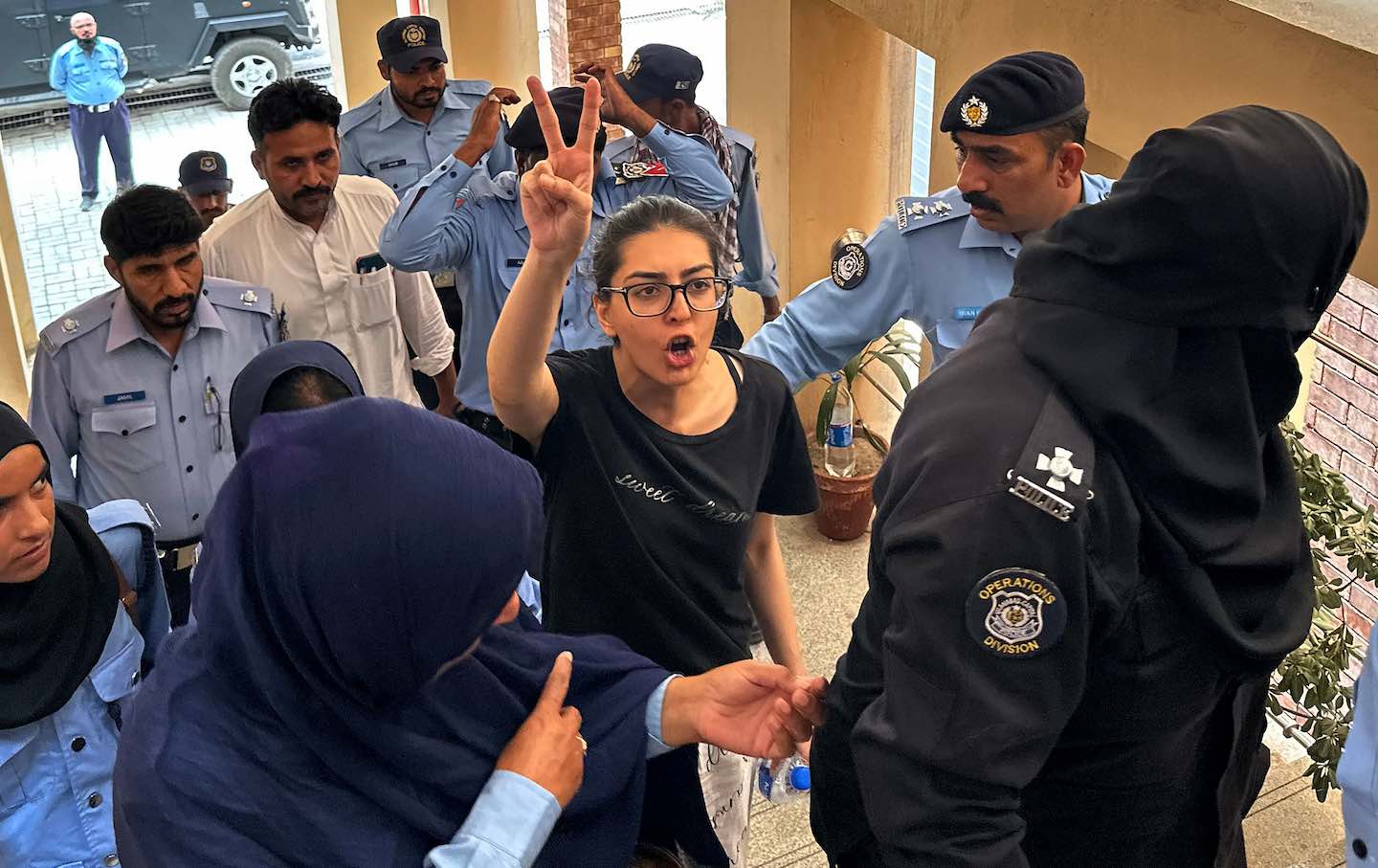
Police officials present arrested lawyer and human rights activist Imaan Mazari-Hazir before a court in Islamabad on August 20, 2023.
(Ghulam Rasool / AFP / Getty)At around 3:30 on the morning of August 19, dozens of police officers and plainclothes operatives stormed the Islamabad residence of the Pakistani lawyer and human rights activist Imaan Mazari. They dismantled the CCTV system, broke down the front door, took custody of Imaan in front of her recently widowed mother, a former human rights minister, and dragged her into the back of a car. She was not even given the opportunity to change out of her night clothes.
Two days earlier, Imaan had addressed a rally in Islamabad organized by the Pashtun Tahafuz Movement (PTM), which advocates for the rights of ethnic Pashtuns, who make up around 20 percent of Pakistan’s population. She openly accused Pakistan’s powerful military establishment of sponsoring terrorism. “The real terrorists are the ones sitting in GHQ,” she told the crowd, referring to the Pakistan Army’s command center in downtown Rawalpindi. “All of these generals and colonels who have betrayed the nation…should be court-martialed.” In her speech, Imaan demanded an end to what she called the “dollar wars,” funded by the United States, imposed on the Pashtun people, as well as the release of all missing persons allegedly abducted by the state.
On Monday afternoon, hours after the courts granted Imaan bail, the police rearrested her in a new case related to terrorism financing. Today, she is in jail on charges ranging from armed robbery to domestic terrorism. But her only crime, as far as anyone can tell, is that she had the courage to speak her mind in public. Her lawyers say that she is being kept under surveillance in a high-security prison and that they are being prevented from seeing her. This, sadly, is what life in Pakistan has been reduced to. The events of May 9, 2023—when violent demonstrations against the armed forces swept the country in the aftermath of former prime minister Imran Khan’s arrest—have given the state a pretext to viciously clamp down on any form of dissent and have eviscerated any semblance of democratic freedoms.
I know Imaan Mazari and consider her a friend. On the morning of my release from police custody after being arrested while reporting on the May 9 protests, she came to my house and offered me legal representation. In the two years or so that I’ve known her, I have never heard her utter so much as a word that could be considered seditious. It is true that she is an outspoken critic of the military’s involvement in politics and of the manner in which Pakistan has been transformed into a security state. But she has taken these positions out of the sincerely held belief that the policies of the military establishment, if left unchallenged, will eventually lead to the Balkanization of the republic.
The PTM—whose rally Imaan was addressing—is a social movement that rose to prominence after the extrajudicial killing of Naqeebullah Mehsud, a Pashtun laborer and aspiring model who was falsely accused of terrorism and shot dead in a staged encounter with police. Though Mehsud was posthumously exonerated by the courts, the police officers accused of his death were all eventually acquitted in a decision Mehsud’s lawyer, Jibran Nasir, termed “a travesty of justice.”
For years, human rights activists have accused the state of targeting ethnic Pashtuns under the guise of counterterrorism. Leaders of the PTM have accused the Pakistan army of killing civilians in its operations against the Pakistani Taliban along the border with Afghanistan, and have demanded the constitution of a truth and reconciliation committee to investigate human rights abuses and enforced disappearances. The leader of the PTM, Manzoor Pashteen, has frequently criticized the Pakistan army’s involvement in the US-led War on Terror and has blamed the army for secretly resettling Taliban fighters in the tribal areas of northwest Pakistan.
Popular
“swipe left below to view more authors”Swipe →Though the PTM has succeeded in mobilizing mass support—particularly among working-class Pashtuns and left-wing activists—and though its rallies are often attended by tens of thousands of people, the mainstream media in Pakistan has typically been prevented from covering its activities. The Pakistan army, which wields considerable influence over the mainstream media, has accused the movement of taking money from the Research and Analysis Wing of Indian intelligence and of fomenting discord among the general population. Ali Wazir, the cofounder of the movement, and a former member of Parliament from South Waziristan, spent 26 months in prison on various sedition charges from December 2020 to February 2023. He was rearrested on the same day as Imaan Mazari and booked for sedition and terrorism.
Zainab Janjua, one of Imaan’s lawyers, told me that the state is using terrorism laws to suppress dissent. “No matter how harsh the criticism may be, it cannot be categorized as terrorism,” she said.
Imaan’s mother, Dr. Shireen Mazari, became a victim of the same repression a couple of months ago. Having served in the cabinet of Imran Khan as minister for human rights, she too was arrested in the early hours of the morning and jailed under the colonial-era “Maintenance of Public Order” law. During her ordeal, the police ignored clear instructions from the judiciary demanding her release and arrested her on more than five occasions over the course of two weeks. In the end, it took a promise that she would retire from politics to secure her freedom.
Thousands of Imran Khan’s supporters were already languishing in jail when the establishment turned its attention to the PTM. On its way out, the coalition government headed by Shehbaz Sharif pushed through legislation that critics say will empower the intelligence agencies to persecute civilians. Regardless of what becomes of Imaan Mazari, the assault on freedom of speech is expected to continue.
More from The Nation
The Iranian Voices America Isn’t Hearing The Iranian Voices America Isn’t Hearing
We need to listen to those who oppose both the Islamic Republic’s authoritarianism and foreign military escalation.
The US Attacks Iran in a War of Aggression The US Attacks Iran in a War of Aggression
The US has waged many wars—but this is one of the most senseless we've ever seen.

Opposing Trump’s Cruel Assault on the Cuban People Opposing Trump’s Cruel Assault on the Cuban People
An interview with Representative Jim McGovern.
A New Report on Alexey Navalny’s Death A New Report on Alexey Navalny’s Death
Boris Kagarlitsky and hundreds of unknown political prisoners remain in Russia’s prisons.
Rubio, Rodeo, and Tall Tales of Empire Rubio, Rodeo, and Tall Tales of Empire
The secretary of state has provoked the ire of Britain’s first black woman lawmaker and put the spotlight once again on how the US has historically treated people of his own herit...
Mexican President Claudia Sheinbaum and the San Quintín Justice Plan Mexican President Claudia Sheinbaum and the San Quintín Justice Plan
Field workers’ highway blockades send a warning to Mexico’s president.

