By Targeting Artists and Journalists, Israel Is Trying to Kill the Truth
The recent targeting of Hamdan Ballal, Hossam Shabat, and Mohammed Mansour shows that Israel sees the truth as a threat to be eliminated.
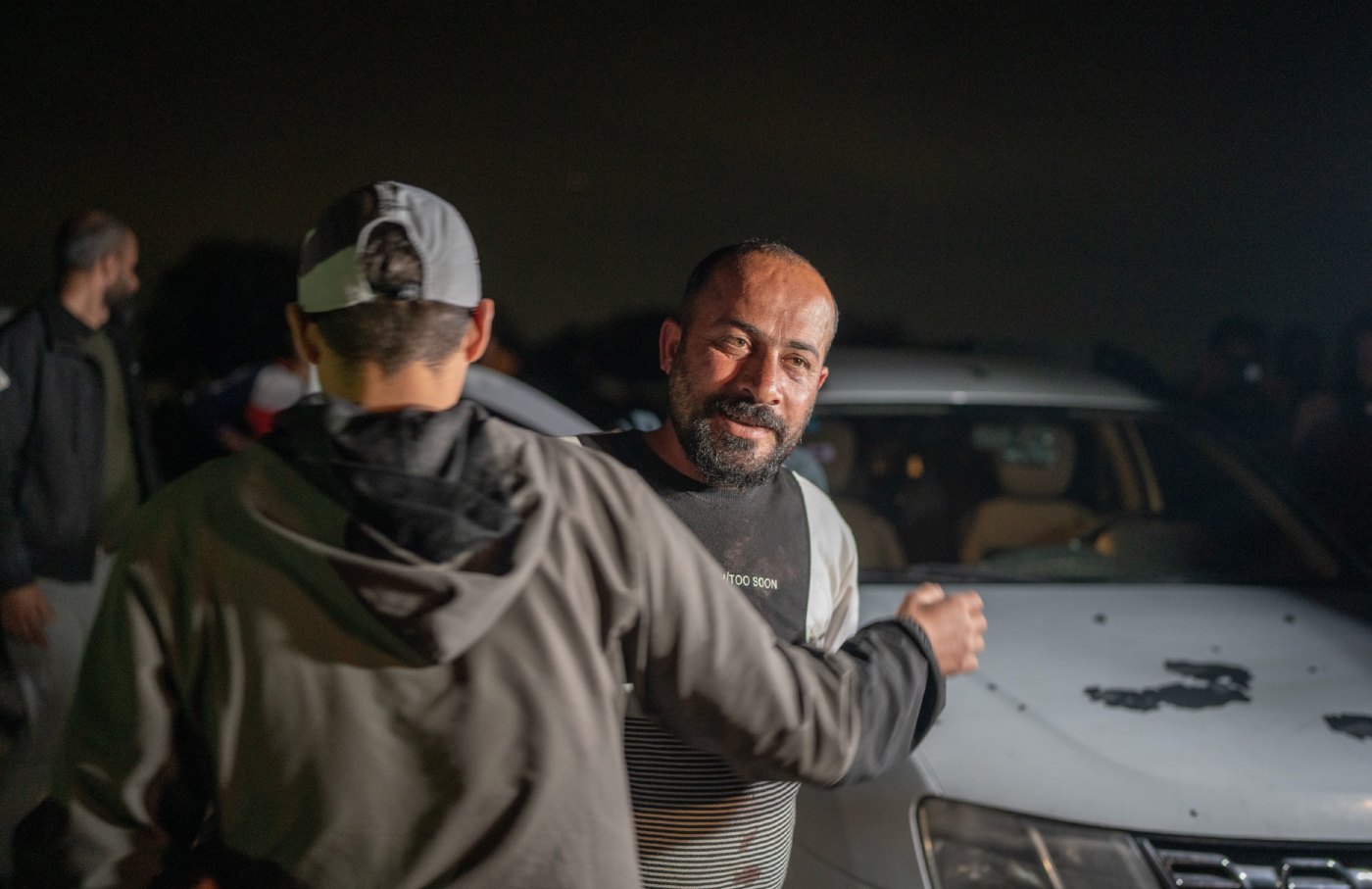
Oscar-winning Palestinian director Hamdan Ballal is greeted by family and friends upon his release from Israeli detention on March 25, 2025.
(Ilia Yefimovich / picture alliance via Getty Images)
The relief felt throughout the worlds of documentary filmmaking, Palestinian society, and Palestinian solidarity was palpable on March 25 after news spread that Oscar-winning documentarian Hamdan Ballal had been freed from Israeli detention. The lauded cocreator of No Other Land, which won the Academy Award for best documentary earlier this month, had been beaten bloody by masked Jewish settlers, who attacked him near his house in the Occupied West Bank, with rocks and sticks. Then Ballal was arrested and thrown in jail, presumably on charges of assaulting an innocent rock. As one of his codirectors, Basel Adra, said to the Associated Press: “We came back from the Oscars and every day, there is an attack on us. This might be their revenge on us for making the movie. It feels like punishment.”
For hours, no one seemed to know where Hamdan had been taken. (The answer, it was later revealed, was a police station in the Jewish-only settlement of Kiryat Arba.) But after an outcry that included a strong and angry statement in Variety from the International Documentary Association, he has been freed. Yet, even unchained (literally, he was chained), he still needs medical attention, and this remains an ugly attack on free speech, freedom of expression, and art as a mode of truth-telling, in addition to an open attack on Palestinian existence
Israel’s goal in such an assault brings to mind a quote by Howard Zinn, who said, “Whenever I become discouraged (which is on alternate Tuesdays, between three and four), I lift my spirits by remembering: The artists are on our side! I mean those poets and painters, singers and musicians, novelists and playwrights who speak to the world in a way that is impervious to assault because they wage the battle for justice in a sphere which is unreachable by the dullness of ordinary political discourse.”
Ballal helped make a work of art that has smashed through more than the dullness. It shatters the sociopathy and contempt for Palestinian life that runs through “ordinary political discourse” about Israel and Palestine. That is why Israel is not relying on “discourse” to silence Ballal. There is no “counter-film” in the works. Instead, in order to keep Zinn’s “artists on our side” from speaking truth and creating art, Israel’s solution is to just kill the artists.
Ballal’s story could have ended very differently, but it didn’t, thanks in part to the international outcry. Yet even as people rallied to his cause, another atrocity, this time a targeted assassination, was perpetrated on another Palestinian truth-teller. The lauded 23-year-old Drop Site and Al Jazeera journalist Hossam Shabat was killed by an IDF missile, his car targeted solely and without warning, according to witnesses. To know of Shabat, who has been reporting in Northern Gaza for 18 months, is to know of a journalist both courageous and tireless. He was displaced 20 times while continuing to file stories and suffered medically from severe food deprivation as Israel blocked aid from entering the Strip. Israel’s open policy of targeting reporters in Gaza makes Shabat’s, and all of the journalists still on the ground, both heroic and increasingly scarce. On the day he was assassinated, Palestine Today correspondent Mohammed Mansour was also killed by the IDF in Khan Younis. This brings the number of slain Palestinian media members, according to the Committee to Protect Journalists, to over 170 in the past 18 months.
Shabat’s loss will be felt intimately by his family, friends, and colleagues. It will also be felt by those of us who have depended upon his work in trying to amplify what is happening to the people of Gaza. Shabat’s Drop Site editor Sharif Abdel Kouddous wrote the following about an exchange they had at the end of last year:
In December, after the Israeli military killed five journalists in an airstrike on their vehicle, I messaged to check in on him.
“Our job is only to die,” he responded. “I hate the whole world. No one is doing anything. I swear I’ve come to hate this job.” About his surviving colleagues he wrote, “We’ve started saying to each other: ‘Ok, whose turn is it?… Our families consider us already martyred.’”
When Israel resumed its scorched earth bombing last week, I messaged again to check in on him. He responded with one word: “Death.”
In an article by Shabat that Abdel Kouddous highlighted in his heartbreaking tribute, he explained what life was like in January, during the three days between the announced ceasefire and the day it was enacted:
[The IDF] targeted the al-Falah school; they bombed an entire residential block in Jabaliya; they killed families, like the Alloush family, whose bodies have not yet been recovered and still lie under and over the rubble. The children I saw that night appeared happy but they were no longer living, their faces frozen in a mix of smiles and blood.
Please, whether relieved, infuriated, or a mix of both in regards to Hamden Ballal, say Hossam Shabat and Mahmoud Mansour’s name in the same sentence: three truth-tellers in a part of the world where the price for speaking a truth that gets past the checkpoints is violence, prison, or a death sentence. Three truth-tellers not wanting but willing to die for a free Palestine.