
I’ve Endured Two Years of Genocide. But I’m Still Here.
The world before October 7, 2023, is a distant memory. But we carry on, fueled by the determination that this land will become a place of life once more.
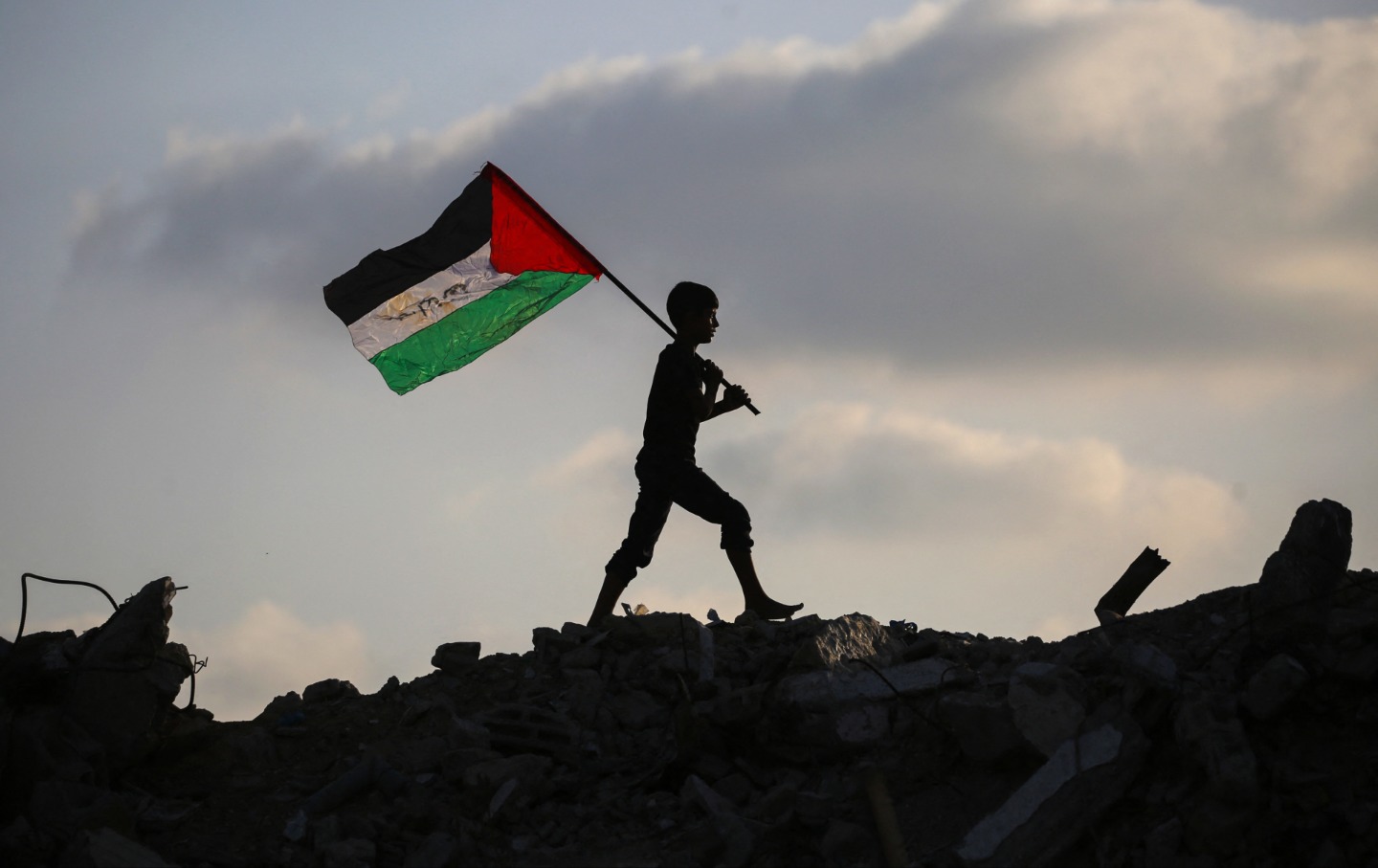
A displaced Palestinian child waves a Palestinian national flag as he walks on the rubble of a destroyed building at the Bureij camp for refugees in the central Gaza Strip on September 22, 2025.
(Eyad Baba / AFP via Getty Images)For two years, Gaza has lived through an unrelenting genocide. Life has been reduced to an endless cycle of loss and suffering in a system that spares nothing—neither human, stone, nor tree. Death is a constant presence. Day after day, we suffer from siege, hunger, bombardment, and destruction; from displacement and disorientation; from homes collapsing into rubble atop the bodies and dreams of those who once lived inside them. Loved ones vanish, leaving only photographs in place of their faces. The city itself throbs with chaos, beating as wildly as my own heart.
The world of two years ago is a distant memory. Before October 7, and despite 18 years of blockade imposed by the Israeli occupation, life still felt almost luxurious to us—ordinary, simple, and threaded with a sense of safety and freedom that survived inside our hearts. The siege narrowed our horizons, but it never robbed us of the feeling of being alive. It did not stop us from imagining a future we could build with our own hands.
On July 20, 2023, I graduated from high school. Those days were full of joy—celebrations with my friends, ceremonies that seemed endless. Soon after, I enrolled at the Islamic University of Gaza, where my father is a professor, and where he had taken me countless times as a child. The memories of walking beside him through those corridors remain vivid. I chose to major in English literature, a subject I had always loved. The world of books and new languages fascinated me, and I was eager to begin the university life I had imagined for years.
For one month, my father drove me to the university each morning, and we returned together in the afternoons. I met my friends in lectures or just after. Then the genocide came, and everything I had built collapsed. Classes stopped for nine months. On June 28, 2024, the university announced that classes would resume, but only online.
I continued with determination. Only 42 credit hours now separate me from graduation. I would say to myself over and over: This is not the university life I imagined. But I persevered, because education is a form of resistance to the occupation.
I built an inner world within my studies to escape the one outside. In my Introduction to Literature course, we were asked to follow the lectures of Dr. Refaat Alareer, the writer and poet assassinated by the Israeli military. I was never his student in a classroom, but I watched all his lectures and read everything he wrote, everything he inspired his students to write. In one video he spoke of the importance of telling stories, quoting two passages that stayed with me.
The first was about a First Nations Canadian who approached colonizers dividing up the land. When they told him, “We own this land; we are dividing it among ourselves,” he replied, “If this is your land, tell me your stories. If this is indeed your land, tell me your stories.” There was only silence in response, because they had no stories about that land—they did not truly belong.
The second was from Nigerian writer Chinua Achebe: “If the lions do not have their own historians, the history of the hunt will always glorify the hunters.” So if we don’t write our stories, as Dr. Alareer put it, ”history will always glorify the occupier and the colonizer, rather than the colonized, the oppressed, the indigenous, the rightful people of the land.“
These words pushed me to take my own step into writing. Eight months ago, I began publishing because I felt it was my duty to tell the stories of my people. Reading and writing have been my talents since childhood, but under the ongoing Israeli genocide they became both my therapy and my weapon.
For the past eight months, I have written about the daily experience of this genocide and about those I have lost. The occupation did not only kill our dreams; it killed my loved ones one after another. Each name marks an emptiness that cannot be filled, each memory lives in my texts and my heart: my dearest friends Shimaa Saidam (19), Raghad Al-Naami (19), Lina Al-Hour (19), Mayar Jouda (18), Asmaa Jouda (21), along with members of my family: my aunt Asmaa, my uncle’s wife Neveen, my cousin Fatima, my uncle Abd al-Salam and his children Huthaifa (13) and Hala (8). When I look at their photos I do not see mere images—I see faces full of affection, warmth, and life.
Then, I turned to writing about the destruction of schools and universities by the Israeli occupation, including the Islamic University itself, and about the teachers and professors who were killed, leaving behind an academic and spiritual void. I wrote about displacement, which has become part of our daily existence—I personally was displaced five times: one month in Khan Younis and five months in Rafah. I recounted all the homes we have lost: my uncle’s home, my grandfather’s four-story house, my sister’s six-story building—even Gaza City itself. A home is part of your identity. Every corner, every street, every room holds a story.
I also wrote about the famine caused by deliberate siege, the chronically ill denied even the medicines they needed for survival, and the children growing up amid hunger and lack of basic necessities—children who silently ask, Will we eat today? All this, while the world stands paralyzed.
Popular
“swipe left below to view more authors”Swipe →Despite the digital blockade imposed by the occupation to erase us from memory, I refused to surrender. I engaged in international programs and workshops—from Gaza to the UK, Malta, Germany, and Sweden—continuing my education and creative work through online programs that were windows to a still-living world.
All the writing I have done cannot convey the depth and breadth of our suffering. No words can adequately describe the horrors we have survived.
I am exhausted. We are exhausted. If fatigue can be worn, we are all wearing threadbare shirts. We long for the Gaza we once knew, for the lives we once lived, and for the selves we once were. All we ask is for this relentless nightmare of genocide to end, for the land to become a land again, and for us to once again embrace life, not death.
More from The Nation
Trump and Netanyahu Want to Turn Iran Into a Failed State Trump and Netanyahu Want to Turn Iran Into a Failed State
This war looks designed to cause maximum chaos and instability. The world will pay a high price.
The War on Terror Paved the Way for Trump’s Rise—Now He’s Making It His Own The War on Terror Paved the Way for Trump’s Rise—Now He’s Making It His Own
Only the total abolition of the DHS can restore freedom.
The Iranian Voices America Isn’t Hearing The Iranian Voices America Isn’t Hearing
We need to listen to those who oppose both the Islamic Republic’s authoritarianism and foreign military escalation.
The US Attacks Iran in a War of Aggression The US Attacks Iran in a War of Aggression
The US has waged many wars—but this is one of the most senseless we've ever seen.
Opposing Trump’s Cruel Assault on the Cuban People Opposing Trump’s Cruel Assault on the Cuban People
An interview with Representative Jim McGovern.
A New Report on Alexey Navalny’s Death A New Report on Alexey Navalny’s Death
Boris Kagarlitsky and hundreds of unknown political prisoners remain in Russia’s prisons.

