
The Gaza Genocide Has Not Ended. It Has Only Changed Its Form.
A real ceasefire would mean opening borders, rebuilding what was destroyed, and allowing life to return. But this is not happening.
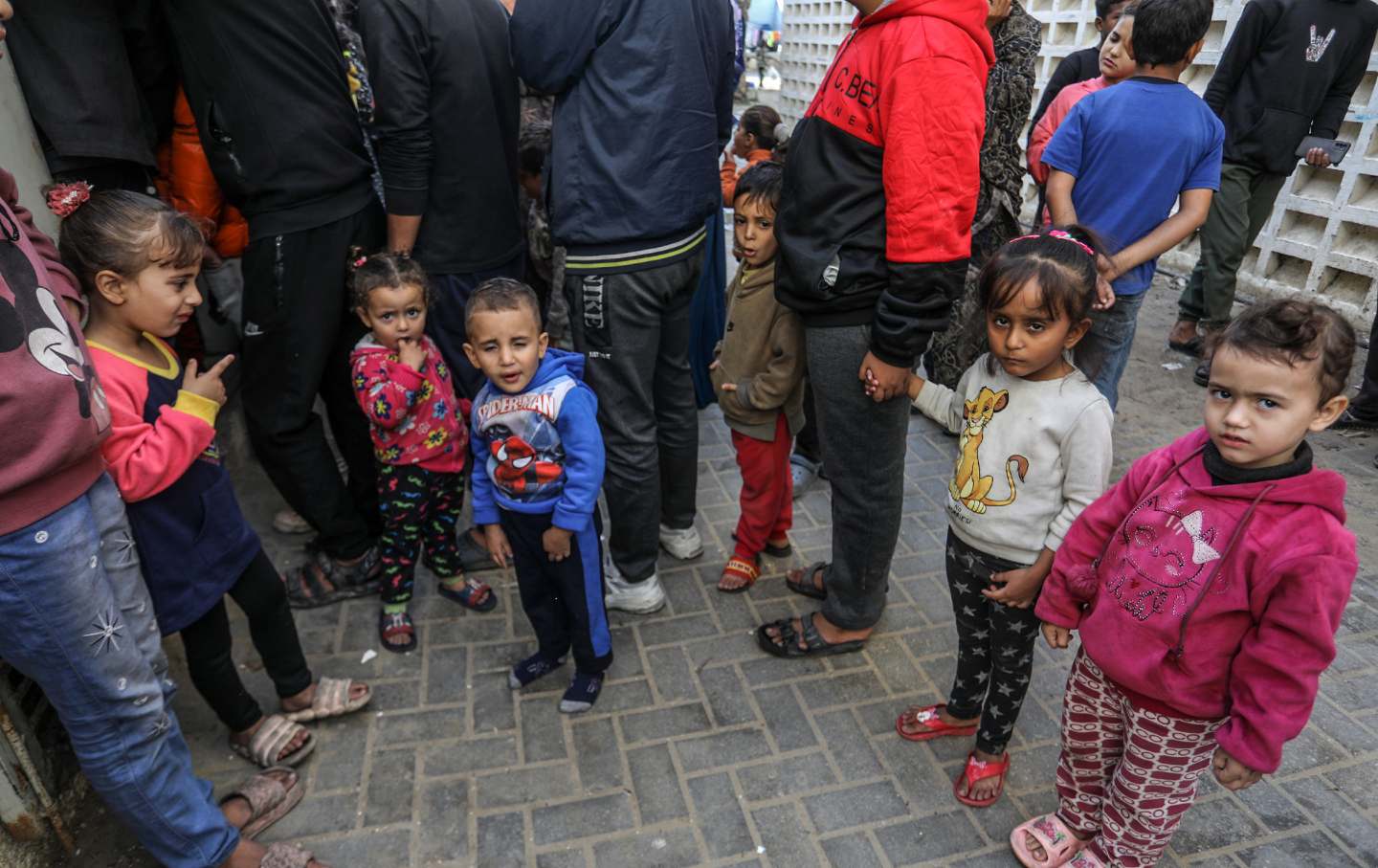
Khan Younis, Gaza, November 30, 2025.
(Abed Rahim Khatib / Anadolu via Getty Images)When the bombs stopped falling endlessly on Gaza, the silence that followed for several days felt unnatural. We were not used to it after two years of waking up to the sounds of bombing and sleeping under its shadow.
After two years of genocide, the American president’s deal has not fully ended the suffering, though it has paused some of it. Since the truce went into effect on October 11, at least 357 people have been killed, and over 900 injured, mostly by Israeli bombs. The world calls this “peace,” yet in reality “peace” here does not mean the end of anything; hunger, fear, and death remain, while the occupation continues to strangle Gaza through crossings, restrictions, and deliberate obstruction of recovery.
After the partial withdrawal of Israeli forces under the agreement, some coordination for humanitarian movement is no longer required. Yet Israel still controls crossings, convoy movements, and the pace at which aid enters. Every truck, every patient transfer, and every piece of construction equipment still requires Israeli approval. This suffocating blockade makes a lasting recovery impossible. Humanitarian teams are unable to retrieve bodies or clear rubble because of a critical shortage of heavy and specialized equipment.
Meanwhile, with Israel closing crossings and threatening renewed mass killing, the Palestinian Civil Defense estimates that around 10,000 bodies remain trapped under rubble. Families have been deprived of a chance to say farewell or bury their loved ones in proper cemeteries—while the media and the world turn a blind eye.
After the ceasefire, many returned to the areas they once called home. Some returned home without knowing whether they were within the so-called “Yellow Line”—areas controlled by the Israeli army covering around 58 percent of the Strip after the ceasefire. Others found their homes destroyed and decided to remain in the south, still living in dilapidated tents that provide no protection from cold or rain.
Following the last wave of evacuations, many residents moved to Gaza City and northern areas. Nearly 500,000 people were observed moving from south to north, either for visits or as displaced persons returning to their homes.
I was one of them. As I journeyed north, the only thing I saw along Al-Rashied Street was rubble. I went with some of my colleagues from We Are Not Numbers to clean our partially damaged office. We focused on the sea to avoid seeing the destruction.
According to the World Food Programme, conditions in southern areas remain extremely difficult, with access to food and clean water still severely limited. The tents that so many people are living in are no longer “temporary shelters.” Even bringing in prefabricated structures or equipment to clear rubble is blocked by the Israeli occupation. Most displaced families rely entirely on aid that trickles in too slowly to meet needs.
Since October 10, only about 150 trucks, carrying commercial goods and aid, have been allowed to enter Gaza per day—just 24 percent of the 600 trucks agreed upon under the truce. (A spokesperson for the UNRWA relief agency told reporters on Tuesday that Israel is blocking at least 6,000 aid trucks from entering Gaza.) The shortage is due to Israeli restrictions on numbers and crossings, with all trucks rerouted through Kerem Shalom crossing—a route unsuitable for large-scale transport whose narrow roads and heavy congestion cause further delays. The price for materials such as gas and certain types of wood has skyrocketed.
Israel treats humanitarian aid as a tool of leverage, not as a right. Aid arrives fragmented, delayed, sometimes near expiration or spoiled. All this has kept food prices for staples like vegetables, meat, and chicken extremely high. Even if prices have not reached the exorbitant levels seen before the ceasefire, they remain out of reach for the average Gazan, who has had no work opportunity for nearly two years and has virtually no income. Most trucks that arrived during this period contained chocolates and snacks, not essential items for patients and the elderly, such as eggs and large quantities of frozen foods and vegetables, which could have helped reduce prices significantly.
For many, the ceasefire did not bring relief but revealed the cruelty of leaving people to face their fate alone. Many now feel that this suffering is their destiny, not a reality that will change soon. Those most affected are patients and prisoners; the health crisis is no less tragic. According to the World Health Organization, over 16,500 people, including thousands of children, urgently need medical care unavailable in Gaza. Yet the first medical evacuation after the ceasefire was declared included only 41 patients and 145 companions. Thousands of wounded remain untreated, hospitals are overwhelmed, and many facilities operate without electricity, sanitation, or sufficient medication.
Medical staff in Gaza are severely exhausted after working two full years, day and night. The shortage of specialties, such as neurology and orthopedics, forces hospitals to try to preserve lives until evacuation can provide proper treatment. The health sector hangs in a balance between who receives care and evacuation, and who must wait—or die. The one deciding who survives: Israel.
More than 9,100 Palestinians are still in Israeli prisons, including 400 minors and 52 women. Their families, in Gaza and the West Bank, often have no idea where they are or if they are alive. Israel calls them “security prisoners,” but to their families they are sons, daughters, and parents—their only crime is being Palestinian.
The system holding them is the same system that holds all of Gaza hostage. Even after the guns fall silent, the occupation continues—over borders, over most of the Strip, over hope. Gaza remains a prison without walls.
The truth is simple: Gaza has been denied the right to heal. Rubble remains, patients still suffer, prisoners have not returned home, and the occupation’s grip tightens even in times of “peace.” A real ceasefire would mean opening borders, rebuilding what was destroyed, and allowing life to return. But this is not happening. What we see is engineered stagnation—punishment disguised as calm.
Popular
“swipe left below to view more authors”Swipe →Nearly two months into the ceasefire, Gaza remains suspended in limbo. Waiting for aid. Waiting for news of prisoners. Waiting for the world to see that the genocide has not ended—it has only changed its form, becoming quieter: genocide without explosions or headlines. A genocide of Palestinians’ dreams, of their ability to survive and recover on their own land.
Become a Sustaining Donor This September
Between the reemergence of right-wing red-baiting and Donald Trump’s use of the chilling National Security Presidential Memorandum–7 to criminalize left political organizing, we’re seeing McCarthyism reborn before our eyes.
This assault on democracy cannot be ignored or wished away. Resisting it requires bravery in the face of threats and repression, a steadfast commitment to the truth, and the unwavering belief that we can—and will—overcome this darkness.
We must have an independent media that sets the record straight, unearths corruption and abuses of power, and advances a politics of justice and dignity for all if we’re to win this fight.
That’s why I’m writing to you today. This September, The Nation needs to add 100 monthly donors to sustain our progressive journalism. Your contribution makes the next investigative report, the next truth-speaking column, and the next pathbreaking essay all possible.
I hope you’ll support our work with a recurring donation today. If you donate $10 or more a month, we’ll send you a brand new “Hands Off the Free Press!” sticker to recognise your commitment to our cause. Please, donate today.
Onward,
Katrina vanden Heuvel
Editor and Publisher, The Nation
More from The Nation
Israel’s Election Can’t Fix What Netanyahu Broke Israel’s Election Can’t Fix What Netanyahu Broke
The fundamental problem is not the name of the prime minister, but rather the actions of the Israeli government and the urgent issues that need to be addressed.

The AfD’s Rise Isn’t Just About East Germany The AfD’s Rise Isn’t Just About East Germany
The Alternative für Deutschland has a stable national poll lead, including in the former West Germany. Its rise owes to much more than Eastern grievances.
Chinese Development Is the Betrayal Washington Cannot Forgive Chinese Development Is the Betrayal Washington Cannot Forgive
The prospects for Xi Jinping’s visit are dim because American leaders are blaming China for the failures of globalization.
Pinochet: The Verdict of History in the Letelier-Moffitt Case Pinochet: The Verdict of History in the Letelier-Moffitt Case
An act of international terrorism on the streets of Washington, DC, still reverberates 50 years later.
How to Arrest Benjamin Netanyahu How to Arrest Benjamin Netanyahu
Make no mistake: The United States can seize Netanyahu for crimes under US law and prosecute him in US courts when he is in New York City this week.
In the Age of AI, Nuclear Weapons Abolition Is a Renewed Imperative In the Age of AI, Nuclear Weapons Abolition Is a Renewed Imperative
As long as we have nuclear weapons, the job of ending humanity will continue to be as easy as the push of a button—or an AI agent hacking into a nuclear command-and-control system...

