Israel’s Cultural Genocide Is Destroying Gaza’s Very Memory
Israel has attacked universities, mosques, heritage sites, libraries, and more. The goal is simple: to eradicate the past, present, and future of Palestine.
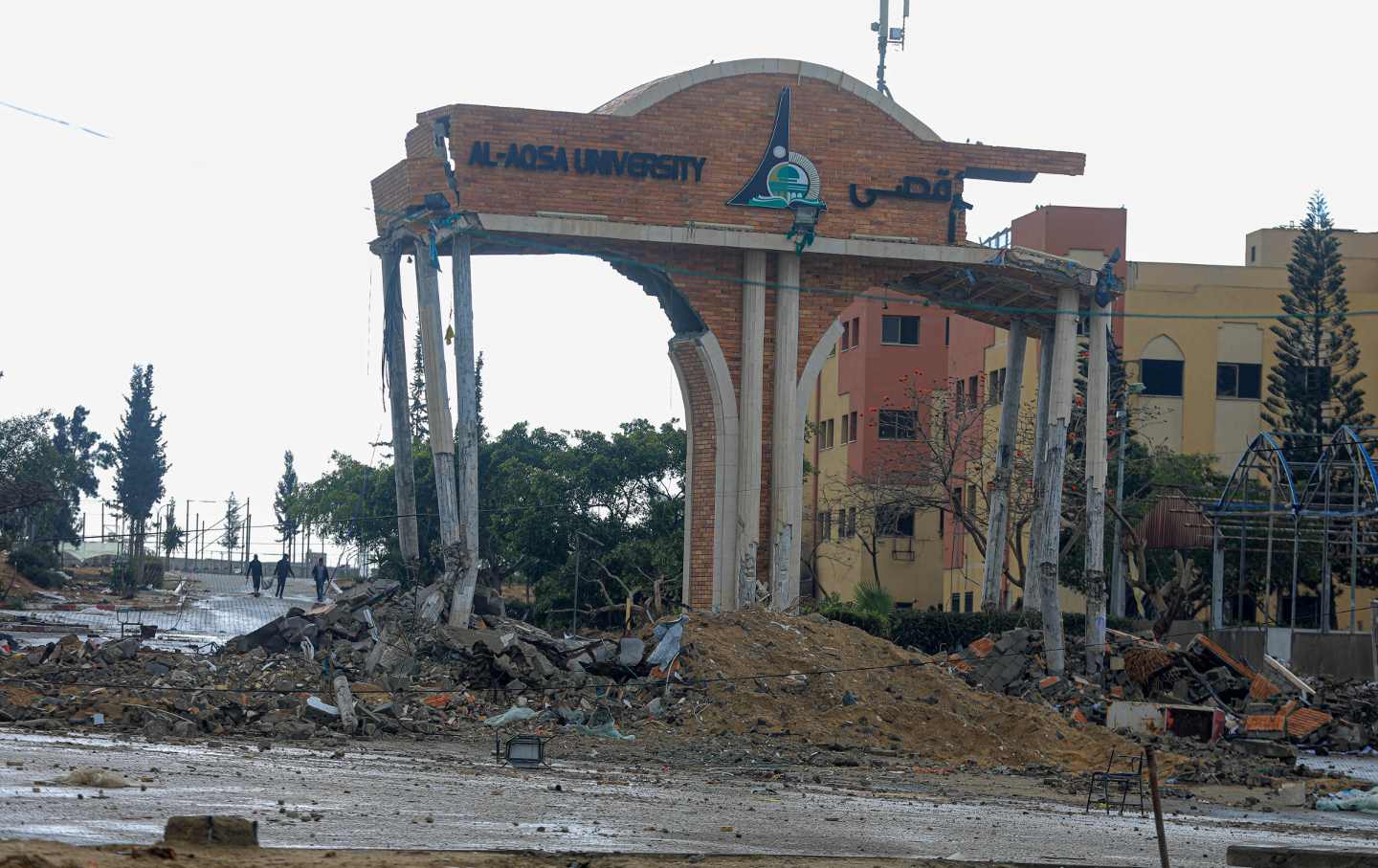
A university gate is seen destroyed in the southern Gaza Strip city of Khan Younis, on January 29, 2024.
(Rizek Abdeljawad / Xinhua via Getty Images)Growing up in the diaspora, I clung to the stories of Palestine I heard from my parents and grandparents. They gave me the undying belief that Palestinians would one day be free because we are a people rooted in resilience, culture, language, and one another.
Part of resisting the 76 years of brutal Israeli occupation is passing on these stories. Some were told by my mother when making dishes like maklouba, which was always served with “Sahtain!,” the Arabic equivalent of “Bon appétit!” (though, since it means “may your health be doubled,” it is so much more than a pleasantry). Others were told to us at bedtime, laced in the fabrics of fairy tales where we learned the true strength of Palestine lies in the “Mountain of Fire.” Then there were the stories told through tears as our grandparents relieved their darkest days, carried by every stitch and thread of Palestinian embroidery, telling of the towns lost and lives all but forgotten. Holding on to these stories is both our greatest honor and burden.
Now, this culture is threatened as never before. For the last four months, we have seen images of the dead and injured, people pulling each other out of the rubble, parents carrying the remains of their children in bags, and children screaming as they watch their parents burn. But alongside the very real genocide taking place against the Palestinian people, there is also a concentrated effort by the Israeli military against the very memory and existence of the Palestinian people—bombarding our cultural sites, hospitals, universities, homes, churches, and mosques, and, perhaps most chillingly, desecrating the gravesites of the very people they placed in the ground because even in death Palestinians cannot achieve peace.
According to UNESCO, over 195 heritage sites have been destroyed or damaged in Israel’s ongoing assault. The Gaza Media Office said in December that 200 of the 325 ancient or archeological sites registered across the enclave had been destroyed.
The devastation is unending. Gaza’s main public library and central archives have been destroyed. The Rafah Museum, which spent 30 years curating ancient coins and artifacts, now lies in ruins. Gaza’s Tourism and Antiquities Ministry says over 100 mosques have been bombed, including the Great Omari Mosque, which dates back nearly 1,400 years. Churches haven’t been spared either: the fourth-century Saint Hilarion Monastery suffered damage, while 17 Palestinian Christians were killed in an attack on the third-oldest church in the world, the Greek Orthodox Church of St. Porphyrius.
This pattern echoes previous assaults on Palestinian heritage. During its 2023 attack on Jenin in the West Bank, Israel bulldozed the Jenin grave marker honoring the Palestinian-American journalist Shireen Abu Akleh, who was assassinated by an Israeli soldier. During its 2021 bombardment of Gaza, Israel leveled high-rise buildings housing libraries and media organizations.
The intentional destruction of cultural heritage is a hallmark of occupation and colonial violence. From the Romans to the Nazis, conquering powers destroy artifacts, manuscripts, monuments, and houses of worship in order to dominate, displace, and erase traces of the people they subjugate. (Equally insidious is the way colonizers such as Israel appropriate the cultural touchstones of the people they have tried to destroy.) Wiping out Gaza’s cultural heritage is one of the many war crimes alleged by South Africa in its genocide case against Israel at the International Court of Justice.
In Gaza’s case, the targets include evidence of multicultural, multifaith coexistence predating today’s occupation, like the Katib al-Waliya mosque neighboring Gaza’s historic Saint Porphyrius Church. Other damaged sites, like the Grand Omari Mosque, were community focal points for cultural gatherings. Still others contain rare insights into Gaza’s past as a bustling trade hub, like the now-damaged ancient necropolis and third-century Byzantine mosaics.
All these vital windows into Gaza’s storied history and culture have been smashed under Israeli bombs. It’s cultural genocide with no attempt to hide it.
I am left wondering how these actions are undertaken so brazenly.
Culture provides the narratives, symbols, and social bonds through which people make sense of themselves and the world. Cultural heritage offers clues to the past while anchoring group identity and purpose in the present. That’s why consolidating control over a people, colonizing their land, or erasing their national aspirations starts by confiscating their art, artifacts, books, and buildings. Destroying cultural heritage is an attempt to destroy our hope.
But, you see, Palestinians are poetry—epic and endangered while racing against time. We have composed ourselves as poets do. Our essence flows through the oneness of our people—the resilient and the steadfast, children in the land of prophets—and our determination to see freedom in every direction. To honor the humanity of our martyrs, to read their verses, and ensure that their memories stay alive. The memory of Palestinians, and Palestine, is one that resists forgetfulness—no matter the attempts to erase us from the earth we are returned to.
Support independent journalism that does not fall in line
Even before February 28, the reasons for Donald Trump’s imploding approval rating were abundantly clear: untrammeled corruption and personal enrichment to the tune of billions of dollars during an affordability crisis, a foreign policy guided only by his own derelict sense of morality, and the deployment of a murderous campaign of occupation, detention, and deportation on American streets.
Now an undeclared, unauthorized, unpopular, and unconstitutional war of aggression against Iran has spread like wildfire through the region and into Europe. A new “forever war”—with an ever-increasing likelihood of American troops on the ground—may very well be upon us.
As we’ve seen over and over, this administration uses lies, misdirection, and attempts to flood the zone to justify its abuses of power at home and abroad. Just as Trump, Marco Rubio, and Pete Hegseth offer erratic and contradictory rationales for the attacks on Iran, the administration is also spreading the lie that the upcoming midterm elections are under threat from noncitizens on voter rolls. When these lies go unchecked, they become the basis for further authoritarian encroachment and war.
In these dark times, independent journalism is uniquely able to uncover the falsehoods that threaten our republic—and civilians around the world—and shine a bright light on the truth.
The Nation’s experienced team of writers, editors, and fact-checkers understands the scale of what we’re up against and the urgency with which we have to act. That’s why we’re publishing critical reporting and analysis of the war on Iran, ICE violence at home, new forms of voter suppression emerging in the courts, and much more.
But this journalism is possible only with your support.
This March, The Nation needs to raise $50,000 to ensure that we have the resources for reporting and analysis that sets the record straight and empowers people of conscience to organize. Will you donate today?