
On the 75th Anniversary of the Declaration of Human Rights
How Eleanor Roosevelt’s leadership made her the “First Lady of the World.”
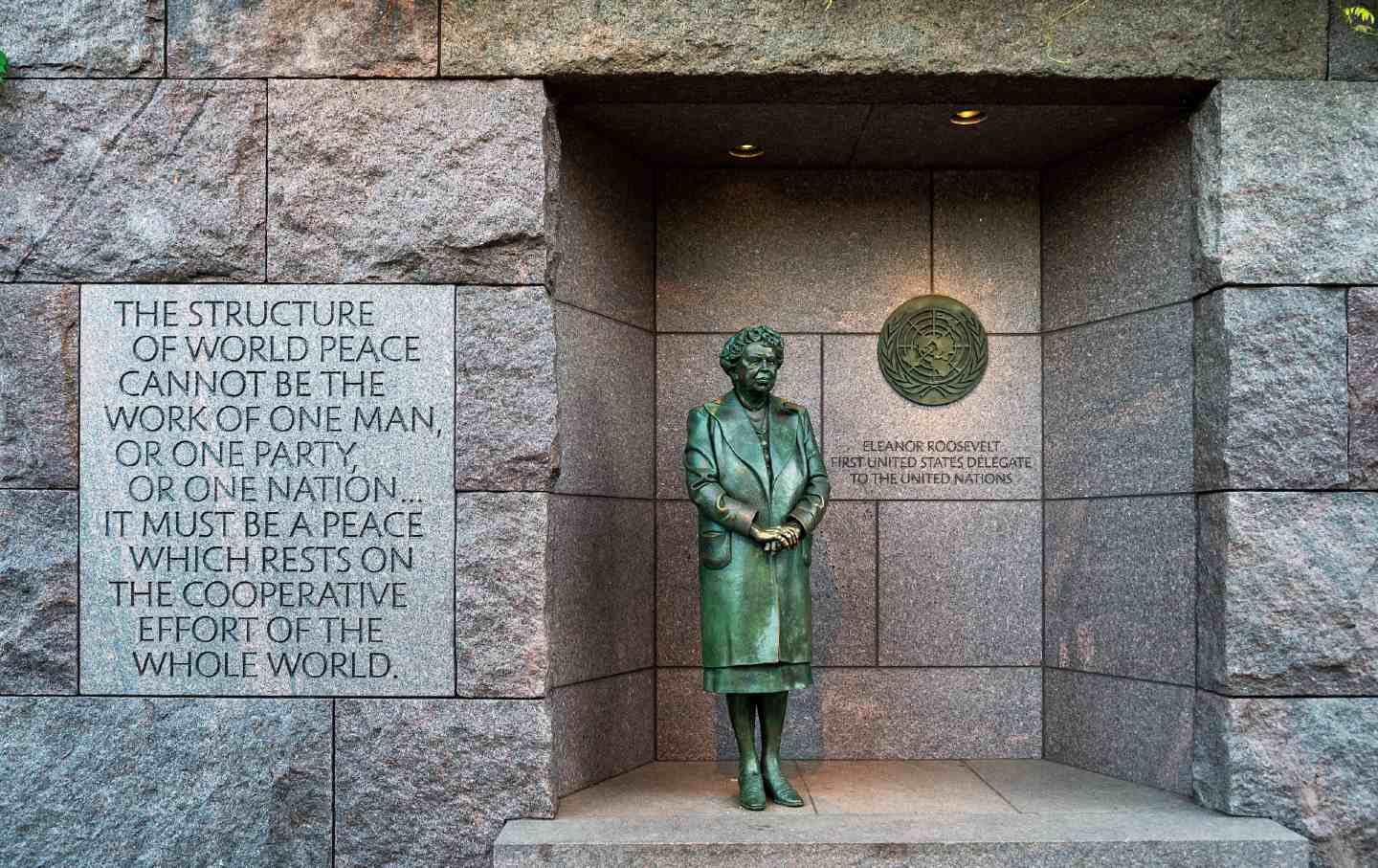
The statue of first lady Eleanor Roosevelt stands before the United Nations emblem at the Franklin Delano Roosevelt memorial.
(John Greim / LightRocket via Getty Images)This Sunday, December 10, marks the 75th anniversary of the ratification of the Universal Declaration of Human Rights by the United Nations. It comes at a time when disregard and contempt for human rights has resulted in barbarous acts of violence around the world.
Brutal wars continue to ravage civilians, especially women and children, in Gaza and Ukraine. We are seeing mass detentions, ethnically targeted killings, and violence against opposition leaders by autocratic governments across the globe. In Gaza City, a UN compound itself was attacked, reportedly injuring and killing a number of evacuees who had sought refuge in this symbolic center of international humanitarian cooperation.
President Franklin D. Roosevelt emphasized that the main purpose of the United Nations was “the establishment of a true peace based on the freedom of man.” This anniversary is an opportunity to commemorate the Universal Declaration of Human Rights, remember the freedoms enshrined within it, and commit to pursuing its ideals even as millions of people are still fighting for those rights today.
It should also lead us to remember the leadership of Eleanor Roosevelt, the woman who brought the document into being.
As the longest-serving first lady in American history, Roosevelt left an indelible mark on the country and the world. She transformed the role into what it is today, becoming a public face of her husband’s administration. Throughout his presidency, she advocated for the rights of women, African and Asian Americans, and refugees.
In 1945, the same year her husband died, his successor President Harry S. Truman appointed Roosevelt to the US delegation to the newly formed United Nations. There, Roosevelt took on what she called her “most important task”: the Commission on Human Rights, which unanimously elected her its first-ever chairperson. In that role, she led the development of the document that became the Universal Declaration of Human Rights.
The declaration itself is a nonbinding collection of 30 articles, enshrining the freedoms that all human beings, regardless of national origin, should have. It prohibits slavery, torture, and exile; pledges freedom of religion, expression, and participation in cultural life; and proclaims that all people should have equal recognition under the law and be free from discrimination.
Roosevelt hoped it would inspire countries to introduce legally binding charters of their own. Indeed, as of today, it has influenced over 80 of the laws and Constitutions that form the world’s legal system for preserving human rights.
Roosevelt turned out to be a formidable diplomat. She worked tirelessly and creatively to facilitate compromise and coalitions between countries with varying ambitions and perspectives on freedom. She was one of the few public figures who could successfully reconcile the seemingly irreconcilable differences of the United States and the Soviet Union. She even persuaded her fellow American delegate, future secretary of state John Foster Dulles, of the rights to food, shelter, and education—principles he believed to be communist—by invoking his Presbyterian upbringing.
Roosevelt’s achievements at the UN were so significant that President Truman deemed her “the First Lady of the World.” Last month, at the memorial service of Rosalynn Carter, the world was reminded of the not-so-soft power first ladies have to shape global politics. Carter went on foreign policy missions by herself, negotiating issues like the Panama Canal and nuclear de-escalation. Like Roosevelt, she was a champion of human rights and global harmony, playing an important role during the 1978 Israel-Egypt talks that led to the peace agreement known as the Camp David Accords. At that summit—which was her idea to begin with—she served as a confidant and crucial backchannel to Egyptian President Anwar Sadat. She, like the global first lady before her, demonstrated that the first step in speaking truth to power is speaking at all.
But words are just that: the first step. Eleanor Roosevelt understood that the United Nations was a flawed but necessary institution. Though we often fixate on the geopolitical intrigue at the Security Council, where countries ceaselessly clash and resolutions are vetoed, some of the most crucial work happens in agencies like the World Health Organization, the International Labour Organization, and the UN Refugee Agency, which draw attention to human rights violations and distribute humanitarian aid. It happens when compassionate leaders like Roosevelt use the unique global platform to guide global discourse, set goals and standards, and draw lines in the sand.
As we celebrate the anniversary of the Universal Declaration of Human Rights, it is clear how much farther we still have to go. And as each day brings new atrocities testing the parameters of humanity, remember that human rights are a precondition for all global positive change. “War destroys all human rights and freedoms,” Roosevelt said in a 1951 speech. “In fighting for those, we fight for peace.”
Support independent journalism that does not fall in line
Even before February 28, the reasons for Donald Trump’s imploding approval rating were abundantly clear: untrammeled corruption and personal enrichment to the tune of billions of dollars during an affordability crisis, a foreign policy guided only by his own derelict sense of morality, and the deployment of a murderous campaign of occupation, detention, and deportation on American streets.
Now an undeclared, unauthorized, unpopular, and unconstitutional war of aggression against Iran has spread like wildfire through the region and into Europe. A new “forever war”—with an ever-increasing likelihood of American troops on the ground—may very well be upon us.
As we’ve seen over and over, this administration uses lies, misdirection, and attempts to flood the zone to justify its abuses of power at home and abroad. Just as Trump, Marco Rubio, and Pete Hegseth offer erratic and contradictory rationales for the attacks on Iran, the administration is also spreading the lie that the upcoming midterm elections are under threat from noncitizens on voter rolls. When these lies go unchecked, they become the basis for further authoritarian encroachment and war.
In these dark times, independent journalism is uniquely able to uncover the falsehoods that threaten our republic—and civilians around the world—and shine a bright light on the truth.
The Nation’s experienced team of writers, editors, and fact-checkers understands the scale of what we’re up against and the urgency with which we have to act. That’s why we’re publishing critical reporting and analysis of the war on Iran, ICE violence at home, new forms of voter suppression emerging in the courts, and much more.
But this journalism is possible only with your support.
This March, The Nation needs to raise $50,000 to ensure that we have the resources for reporting and analysis that sets the record straight and empowers people of conscience to organize. Will you donate today?
More from The Nation
Israel Is Using Its Genocidal Gaza Playbook on Iran Israel Is Using Its Genocidal Gaza Playbook on Iran
Just as in Palestine, the Israeli government is framing its latest conflict as a holy war of extermination.
Trump and His Soulless Cronies Have Managed to Suck the Joy Out of the World Cup Trump and His Soulless Cronies Have Managed to Suck the Joy Out of the World Cup
Not even soccer is immune from Trump’s reverse Midas touch.
Garbage In, Carnage Out Garbage In, Carnage Out
The harrowing lessons of the Pentagon’s recently dissolved partnership with Anthropic.
The Iran War Could Be Catastrophic for the US-Israel Alliance. Good. The Iran War Could Be Catastrophic for the US-Israel Alliance. Good.
As Israel’s role in pushing the war with Iran comes into ever sharper focus, it’s up to us to turn outrage into change.
An Unlawful War An Unlawful War
The precedent being set by the US in launching this war of aggression against Iran will long live in infamy.
Trump and Netanyahu Want to Turn Iran Into a Failed State Trump and Netanyahu Want to Turn Iran Into a Failed State
This war looks designed to cause maximum chaos and instability. The world will pay a high price.

