Trump’s “Board of Peace” Is Part of a Sordid Anti-Palestinian History
The refusal of those who have held power over Palestine to acknowledge the grievances and aspirations of its indigenous Arab people isn’t new.

Donald Trump at the “Board of Peace” meeting during the annual meeting of the World Economic Forum in Davos on January 22, 2026.
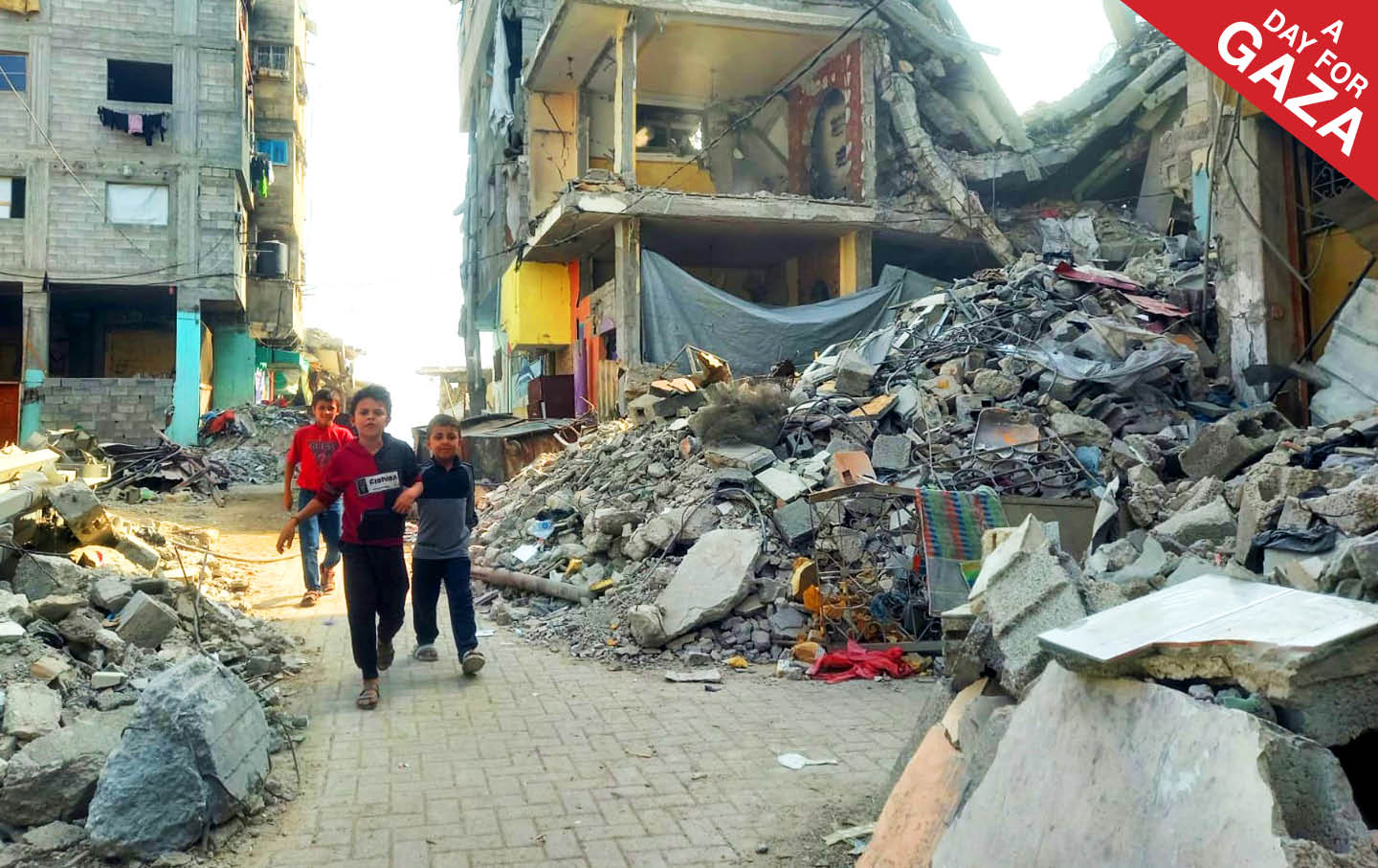
(Fabrice Coffrini / AFP via Getty Images)When President Donald Trump convened his so-called Board of Peace in Davos, Switzerland, a key item on the agenda was to endorse his son-in-law Jared Kushner’s extravagant (and, I might add, detached from reality) plan for a “New Gaza.” The rendering of Kushner’s scheme shows it to be more of a luxury resort for wealthy tourists than the foundation of a just future for the Palestinian victims of Israel’s genocide. But since the raison d’être of the Board of Peace was supposed to be dealing with the aftermath of Israel’s war on Gaza, the conversation, by necessity, had to address the needs of hundreds of thousands of now-homeless Palestinians.
Thus, Kushner presented a proposal for a model Palestinian community—the “New Rafah”—he intends to build to house Palestinians in Gaza. The plans for this New Rafah have been circulated since the meeting. Everything is covered: how Gaza’s economy will run, how its educational and health systems will create a new generation of hale and non-ideological Palestinians, and how the “new cities” will be laid out, function, and be governed. And everything has been calculated down to how many teachers, doctors, judges, religious leaders, and laborers will be needed per capita in each community.
If Kushner were preparing an owner’s manual for a complex piece of machinery or the instructions for installing and operating new software, this plan might seem flawless. But Palestine isn’t a video game, and Palestinians are human beings, not Lego pieces to be assembled, as per the instructions. Like every other people on earth, Palestinians have emotional ties to their homes and families, and memories of the personal and collective injustices they have endured. This failure to consider the fullness of Palestinian humanity is the fatal flaw that will either stop the New Rafah before it begins or cause it to unravel soon afterward.
The refusal of those who have held power over Palestine to acknowledge the grievances and aspirations of its indigenous Arab people isn’t new. In fact, it has defined their history.
For example, in 1919, when the British Lord Balfour was presented with the findings of the US-commissioned survey of Arab attitudes, which demonstrated their overwhelming rejection of his intent to grant the Zionist movement a homeland in Palestine, he famously responded, “In Palestine, we do not propose even to go through the form of consulting its inhabitants as to their wishes.… Zionism…[is] of far profounder import than the desire and prejudices of the 700,000 Arabs who inhabit that ancient land.”
And Palestinians were not consulted when the UN drew up grossly unfair maps to partition Palestine into Jewish and Arab states. Those maps gave the Jewish community over one-half of the land (despite its being less than a third of the population). The maps were rejected by Palestinians because more than half a million of them were disenfranchised without any say in the matter. Nor did Palestinians receive support when 650,000 of their brethren were expelled from the newly created Israel in 1948, or when, after the Oslo Accords, neither the UN nor the US would hold Israel accountable for sabotaging the peace plan through settlement expansion, land seizures, the erection of a wall, and the deliberate obstruction of the development of a Palestinian economy.
Instead of acting to support Palestinians as their rights were systematically trampled, the US and other Western states have historically blamed Palestinians, while exonerating themselves and Israel. The result of this century of systematic abuse and denial of rights has been to create a Palestinian community that is justifiably embittered and losing hope. And when they express these feelings, their grievances are dismissed and they are told to just “deal with it”—something that would never be said to, for example, Israelis or the Jewish people.
This is because US policymakers understand the full humanity of the Jewish community. They understand their history of the losses they have experienced and their need to be respected and heard.
What we are seeing in the wake of the genocide in Gaza and in the midst of the state-sanctioned ethnic cleansing and erasure of Palestinian communities in the West Bank is just the same story playing out one more time. Every effort is made to make Israelis feel secure, while Palestinians are expected to lose their homes, families, and memories, and be resigned to being moved about like pawns on a chessboard and be grateful to have the opportunity to live in a model city once they have been properly vetted, biometrically identified, and de-radicalized.
The bottom line is that Palestinians have never been permitted the human right to make their own decisions. The results have been devastating for both them and the region. The reason behind the wars that have been fought and the aberrant behavior of some elements of Palestinian society can be found in one simple fact: the refusal to allow Palestinians the freedom to determine their future in a manner that recognizes the fullness of their humanity.
We’ve polled throughout Palestine a number of times in the past few years, and what we’ve found is that Palestinians don’t want to live under the control of Israel or any other external powers. They want the Israeli occupation to end, national unity of all factions in all parts of their country, and to hold a national referendum to elect new leaders and develop a plan for governance that can move them toward freedom and independence. They deserve nothing less.